
EASY READ Electronics

CITE
We have made every effort to follow citation style rules, but there may be some minor differences. If in doubt, please refer to the appropriate citation style manual.
EASY READ What is a variable resistor?. (2026). In Q-files Encyclopedia, Technology, EASY READ Electronics. Retrieved from
https://www.q-files.com/technology/easy-read-electronics/easy-read-what-is-a-variable-resistor
"EASY READ What is a variable resistor?." Technology, EASY READ Electronics, Q-files Encyclopedia, 7 May. 2026.
https://www.q-files.com/technology/easy-read-electronics/easy-read-what-is-a-variable-resistor.
Accessed 22 Sep. 2026.
EASY READ What is a variable resistor? 2026. Technology, EASY READ Electronics. Retrieved 22 September 2026, from
https://www.q-files.com/technology/easy-read-electronics/easy-read-what-is-a-variable-resistor
Technology, EASY READ Electronics, s.v. "EASY READ What is a variable resistor?," accessed September 22, 2026.
https://www.q-files.com/technology/easy-read-electronics/easy-read-what-is-a-variable-resistor


What is a variable resistor?
There are some types of resistors that have a variable resistance value—the resistance can change. In a potentiometer, the resistance changes when a knob is turned. In a photoresistor, also called a light-dependent resistor (LDR), resistance changes when the amount of light falling on it increases or decreases.

How does a potentiometer work?

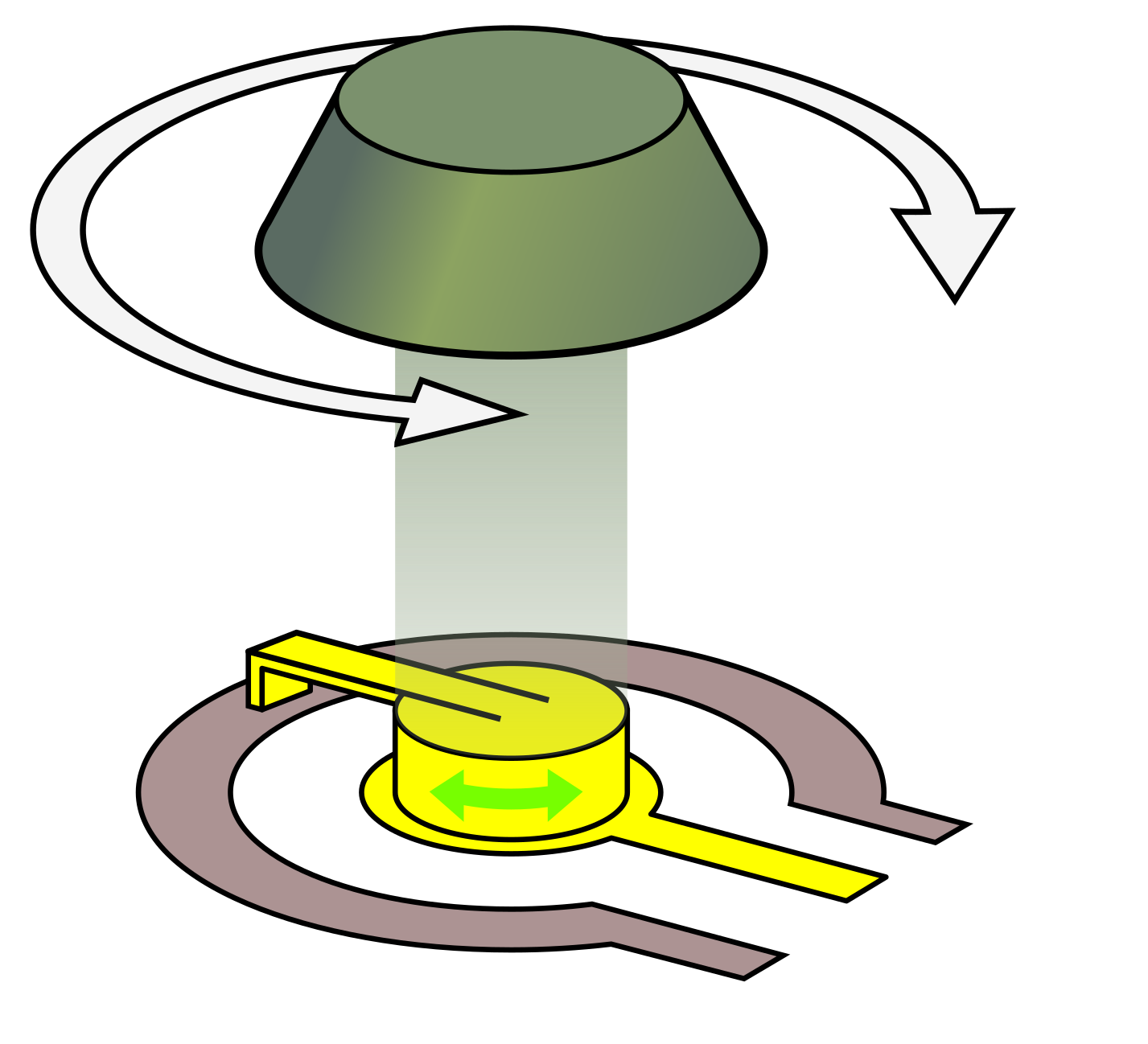
A potentiometer (or "pot") has a shaft, which can be rotated, and three pins. See the diagram below. Between pins 1 (on the left) and 3 (on the right) there is a strip of resistive material (a material that provides resistance) such as carbon. Pin 2 (in the middle) of the potentiometer is called a wiper and is controlled by the rotating shaft.

According to how much you turn the shaft, the wiper connects to the resistor anywhere between pins 1 and 3. Turn it to the left, the resistance between pin 2 and pin 1 decreases, while the resistance between pin 2 and pin 3 increases. Turn the shaft to the right and the opposite happens.
Using a potentiometer, you can manually adjust the voltage in order to, for example, increase or lower the volume of a radio.
This diagram shows you how to build a simple circuit to dim an LED using a potentiometer. The extra resistor is there to ensure the LED is not damaged even if you lower the potentiometer resistance to zero.


LDR
In an LDR, most electrons are bound to atoms. This means the LDR cannot normally conduct electricity—it is an insulator. When light shines on the LDR, however, it supplies energy to free up its electrons, so the LDR now becomes a conductor. When an LDR forms part of a circuit, electricity can flow through it only when light is present.

A variable resistor that works in the same way but whose electrons are freed by heat instead of light is called a thermistor.
Voltage divider
If you connect two resistors with the same resistance to both the positive and negative sides of a battery, the voltage measured from a point between the two resistors will be half the battery voltage. If the resistors are unequal, the voltage is divided proportionately. The two resistors have created what is called a voltage divider. It is used to produce different voltage levels for different parts of a circuit.

You can make good use of a voltage divider by replacing one of the "known" resistors in a voltage divider set-up with a variable resistor of one kind or another. Using a potentiometer, for example, you can manually adjust the voltage level for another part of the circuit.

Using an LDR, you will get a voltage that depends on the amount of light. Using a thermistor, you will get a voltage that depends on the temperature. You could then connect it up to a circuit that automatically turns on an electric fan if the temperature rises above, say, 30°C.
How to create an LDR circuit
You can build an electronic circuit using an LDR to create a light-controlled alarm. When it is dark, no light falls on the LDR, meaning it has high resistance. This makes the voltage flowing into the base of the transistor too low to turn it ON. No current will pass from the collector to the emitter and on to the LED.

When it is light, however, the LDR has lower resistance. This makes the voltage flowing into the base of the transistor high enough to turn the transistor ON. The current now flows from the collector to the emitter of the transistor and on to the LED, lighting it up. By connecting it to another transistor that controls a buzzer, you can create a sound alert.

Consultant: Mike Goldsmith
pics


Without in any way limiting Q-files Ltd’s exclusive rights under copyright, any use of this publication to “train” generative artificial intelligence (AI) technologies to generate text is expressly prohibited. Q-files Ltd reserves all rights to license use of this work for generative AI training and development of machine learning language models.