
Peoples

CITE
We have made every effort to follow citation style rules, but there may be some minor differences. If in doubt, please refer to the appropriate citation style manual.
Writing and alphabets. (2026). In Q-files Encyclopedia, Culture, Peoples. Retrieved from
https://www.q-files.com/culture/peoples/writing-and-alphabets
"Writing and alphabets." Culture, Peoples, Q-files Encyclopedia, 13 May. 2026.
https://www.q-files.com/culture/peoples/writing-and-alphabets.
Accessed 13 Sep. 2026.
Writing and alphabets 2026. Culture, Peoples. Retrieved 13 September 2026, from
https://www.q-files.com/culture/peoples/writing-and-alphabets
Culture, Peoples, s.v. "Writing and alphabets," accessed September 13, 2026.
https://www.q-files.com/culture/peoples/writing-and-alphabets


Writing and alphabets
Thousands of years ago, as languages became more established and civilizations developed, people needed to write things down. The earliest forms of writing used pictures or symbols to represent words. Later, alphabets, which use single letters to represent the different sounds in a word, were developed. Writing with letters is far easier and quicker than using hundreds of different symbols. Many Chinese and Japanese characters are descended from ancient picture writing. The characters symbolize parts of words or whole words.

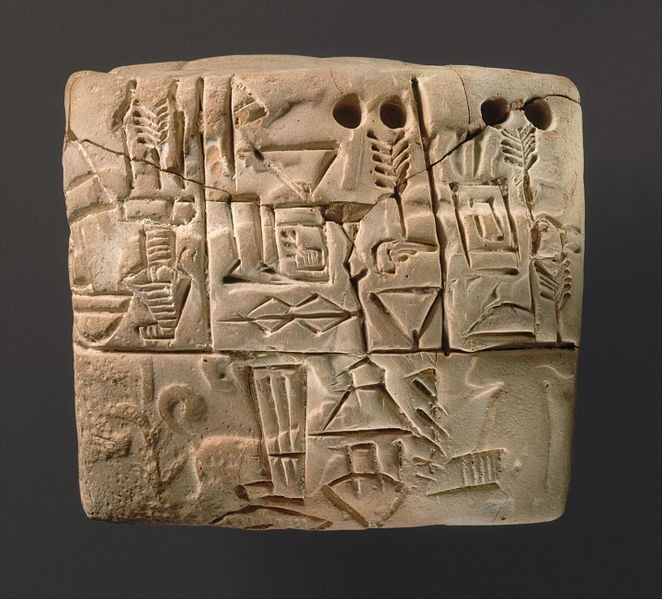
Ancient writing
The earliest known writing was developed in about 3300 BC by the Sumerians, who lived in Mesopotamia (the region of present-day Iraq). At first they scratched pictures of what they wanted to represent on to stone tablets. Later, they simplified their pictures and used a reed stylus (pen) with a wedge-shaped tip to write symbols in soft clay. This style of writing is known as cuneiform, from the Greek word for “wedge-shaped”. This picture writing was still slow to use because there were around 600 different symbols.
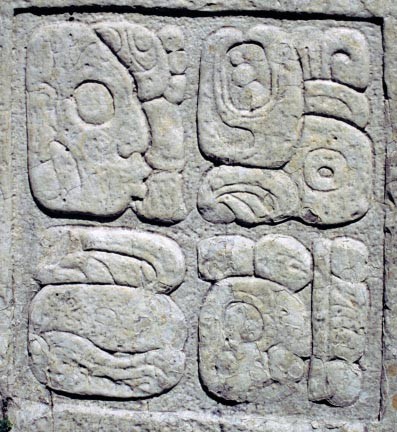
Other ancient peoples also developed picture writing. The ancient Egyptians used a form of picture writing known as hieroglyphs and later added a simplified form called hieratic script which was quicker to use. The Maya, who built up a civilization in Central America between AD 300 and 900, were the only ancient American people known to have a complete writing system. They wrote using symbols that archaeologists call glyphs. Each glyph contained parts that stood for sounds or syllables. When these parts were combined they could stand for a word or an idea. Although only four books, written on long strips of paper and folded up, survived from the time, the deciphering of carved inscriptions on stone stelae revealed the histories of Maya kings and queens.
The first alphabet
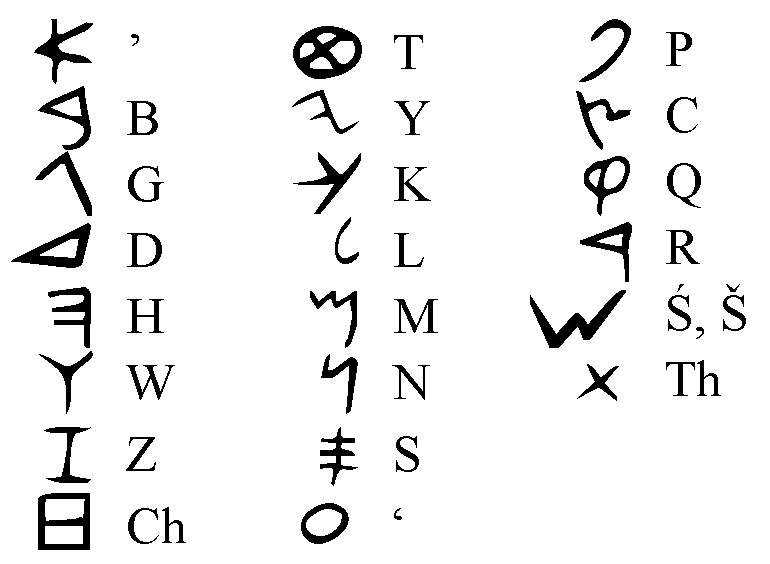
The first people to use an alphabet were the Phoenicians, originally known as the Canaanites, who lived about 3000 years ago on the eastern shores of the Mediterranean Sea. Their writing had only 18 letters—and they were all consonants. Greek, Roman, Hebrew, Arabic and Hindi alphabets all developed from it.
Different alphabets
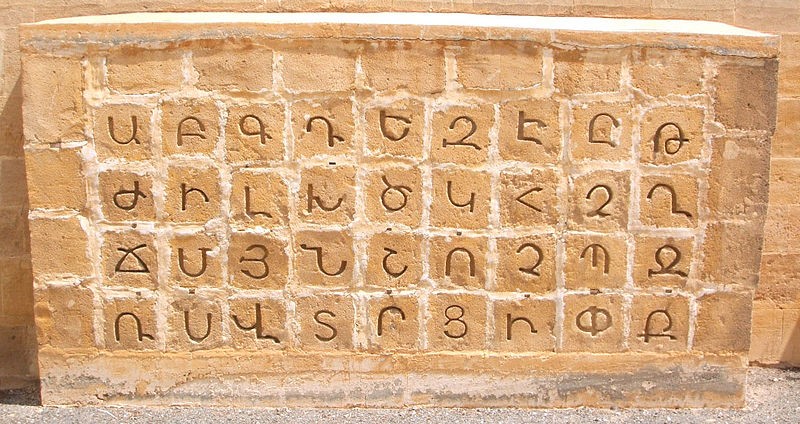
The ancient Greeks took up the Phoenician alphabet but added vowels. The Romans developed their alphabet from a later Greek version. All western European languages use the Roman alphabet. Many other languages also use it, but some have accents over letters to show that they are pronounced in a special way. The Cyrillic alphabet also developed from the Greek alphabet. It is used in Russia and some Eastern European countries. Arabic and Hebrew alphabets are descended from the Phoenician alphabet. Originally they were abjads (alphabets without consonants). Later, methods (such as dots) were devised to indicate some or all of the vowels.


Chinese characters
The Chinese, Japanese and Koreans write with symbols called characters. Traditionally, the characters are painted with deft strokes, using a brush and ink. Today, their forms have been standardized so they can be written using a computer or printed in a book. There are tens of thousands of Chinese characters, although most people can get by with a knowledge of between three and four thousand. Japanese uses a combination of Chinese characters, called kanji, symbols, called hiragana, usually for grammar, and katakana, which are mostly used for foreign words and phrases.

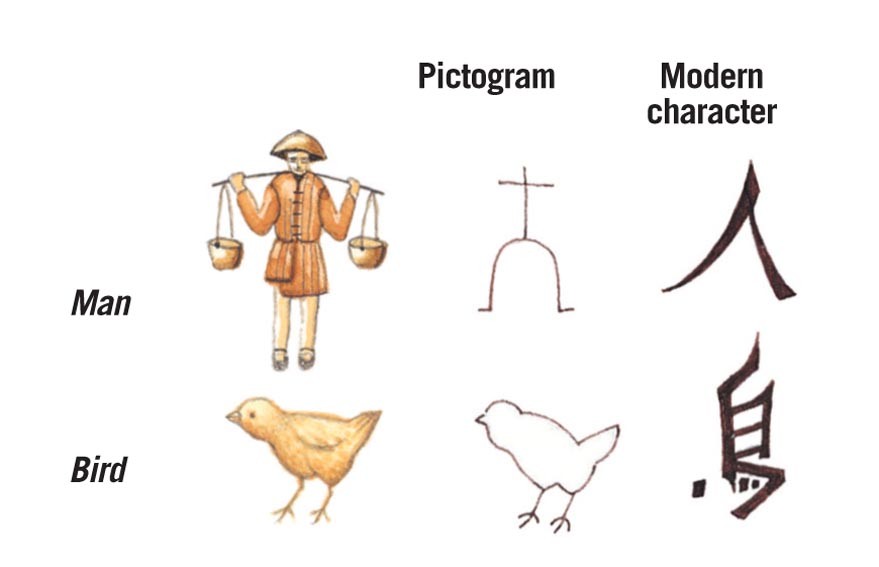
Chinese characters are descended from an ancient form of picture writing, in which the pictures symbolize whole words or parts of words. The symbols, over time, became simplified into characters to make them easier to write. Most no longer looked much like what they originally represented.
Pictograms now make up only a small portion of Chinese characters. Most characters are used to represent a word not related to its original meaning, but which happens to have a similar pronunciation when spoken. For example, the character spoken as “zì” which originally meant "nose”, now means "oneself".
In fact, in modern Chinese, most words consist of two or more characters. Each character usually corresponds to a single syllable. A single character may have a range of different meanings, according to how it is pronounced when spoken.

Consultant: Philip Wilkinson
pics

Without in any way limiting Q-files Ltd’s exclusive rights under copyright, any use of this publication to “train” generative artificial intelligence (AI) technologies to generate text is expressly prohibited. Q-files Ltd reserves all rights to license use of this work for generative AI training and development of machine learning language models.