
Peoples

CITE
We have made every effort to follow citation style rules, but there may be some minor differences. If in doubt, please refer to the appropriate citation style manual.
Traditional homes. (2026). In Q-files Encyclopedia, Culture, Peoples. Retrieved from
https://www.q-files.com/culture/peoples/traditional-homes
"Traditional homes." Culture, Peoples, Q-files Encyclopedia, 13 May. 2026.
https://www.q-files.com/culture/peoples/traditional-homes.
Accessed 13 Sep. 2026.
Traditional homes 2026. Culture, Peoples. Retrieved 13 September 2026, from
https://www.q-files.com/culture/peoples/traditional-homes
Culture, Peoples, s.v. "Traditional homes," accessed September 13, 2026.
https://www.q-files.com/culture/peoples/traditional-homes


Traditional homes
There is an enormous variety in the style of houses built in different parts of the world. Local conditions play an important part in the design of houses. In regularly flooded areas, houses are built on stilts. In places where earthquakes are common, houses need to be able to withstand sideways movement. Houses in mountainous lands often have steep roofs, so that heavy layers of snow can slide off. Mud and mudbricks are traditional building materials that have been used for thousands of years. Early builders noticed that mud bakes hard in hot sun. So they shaped bricks from wet mud, or built up their walls with mud, and then left them to dry.


Tongkonan
Tongkonan are the traditional homes of the Torajan people, from South Sulawesi, Indonesia. They are made from wood with a large, boat-shaped roof protruding over the front of the building. Tongkonan are customarily built facing north-south. Cramped and dark with few windows, the internal space is small by comparison with the huge roof. But it is intended only for sleeping and storage; most daily life is carried on outside. In larger Torajan villages, houses are arranged in a row, side by side. Opposite or at right angles to each house is the family's rice barn, or alang. A large tongkonan can take a team of ten about a year to build.
Today, many Torajan villagers prefer to live in a single-storey houses, which are more spacious, brighter and better ventilated.
Tulou

The Fujian tulou (“Fujian earthen buildings") are dwellings in the mountainous region of southeastern Fujian, China. Some date back to the 12th century. A tulou is usually circular in shape with very thick rammed (compacted) earth walls between three and five stories high and housing up to 800 people. Smaller interior buildings are often enclosed inside these huge walls, making the whole structure resemble a small fortified city.
Cave houses
A yaodong, or "house cave", is a type of dwelling commonly found in the Loess Plateau of northern China (Gansu, Shanxi, Henan provinces, and Ningxia Autonomous Region). Yaodong are carved out of a hillside or dug out of the sides of a sunken courtyard. They have a door and windows at their front and are plastered inside. The earth that surrounds the dwelling is as an effective insulator, keeping the inside of the structure warm in winter and cool in summer. Dating back centuries, yaodong continue to be popular today: about 40 million people live in them. Some modern yaodong are built wholly or partially outdoors from stone or brick, often with patterned facades.

Rainforest huts

The Efé pygmies (a people of less-than-average height) live in the rainforests of central Africa. They travel around hunting animals and collecting honey. At night they make huts to shelter in. First they mark out a circle in the ground (1) and drive branches into the ground round the circle (2). Then they weave the branches together to form a dome-shaped frame (3) which they cover with leaves (4). Traditional huts made from natural materials are still used by hunter-gatherers in other parts of the world, such as in the Amazon rainforest or the forests of New Guinea.

Sama-Bajau stilt houses
Sometimes known as "Sea Gypsies" or "Sea Nomads”, the Sama-Bajau come from the islands of Philippines and eastern Indonesian islands. They travel around coastal waters catching and selling fish. They sometimes live in their boats, called lepas, or in wooden houses on stilts in the water. Today many Sama-Bajau people have moved ashore, but thousands of them still maintain their traditional seaborne lifestyle.
Maasai houses
In East Africa, many Maasai prefer to live in small, traditional settlements on the grassland plains close to their cattle or their fields. Maasai women build their own homes. First, they draw the shape of the house on the ground. They make a frame by weaving together branches and twigs. Then they pack mud, grass and dung over the outside to keep the building dry.

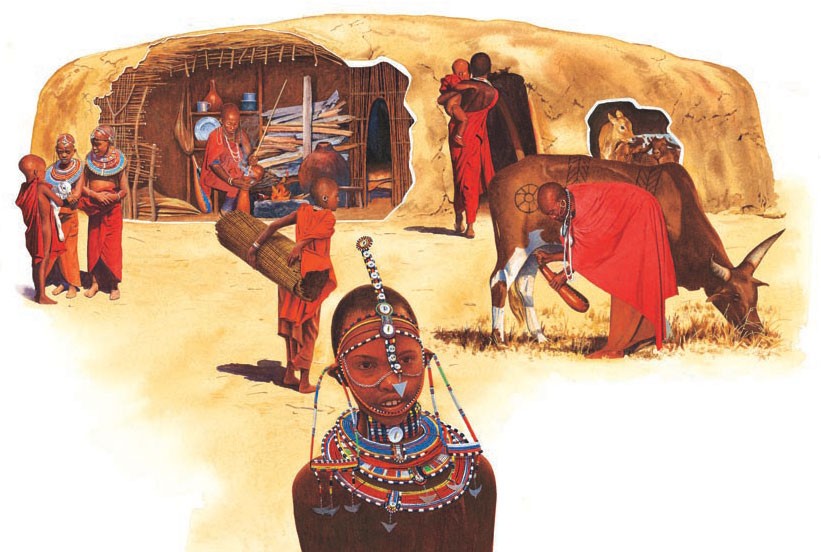
There is just one room inside a Maasai house. Up to six people sleep together in one large bed made of branches and covered with animal hide. The woman of the house and her young children sleep in another bed in a more private area. A fire burns in the hearth in the centre of the house. It is used for cooking, warmth and light. There are no windows—just an opening to let light in and smoke out. Cattle come second only to children in importance to the Maasai. They drink the animals' milk but only eat meat on special occasions. The women store the milk in a calabash, a long container made from a hollowed-out gourd, a kind of fruit.

Igloos
Nowadays, Inuit people, from Canada’s Arctic north and Greenland, live in modern houses in settlements, but when they go on a hunting or fishing trip they may still build an igloo for shelter. An igloo is a dome-shaped house made of snow. First, blocks of snow are cut out and laid one on top of the other to form the dome. Each layer leans inwards slightly so that the blocks eventually meet at the top. When the dome has been completed, a lamp is lit inside to melt the snow on the inside walls. Then the lamp is removed and the cold wind freezes the melted snow into a solid, smooth sheet of ice which keeps the walls firm and windtight. Finally, skins and rugs are draped over the walls and ceiling to make the igloo warmer inside.
Yemeni "skyscrapers"

Some multi-storey houses, made out of mud bricks, have stood in the cities of Yemen, including the capital, Sana’a, and Shibam, for hundreds of years. The design was used to protect residents from Bedouin attacks. It is the custom in Islamic countries to keep family and visitors apart, and also for men and women to live separately, so each storey in the house has its own special purpose. The top floor is kept for visitors, for example. It has windows to catch cooling breezes.
Japanese homes
Japanese homes are a mixture of the old and the new. They are equipped with modern technology such as microwave ovens, televisions and computers, but many people also like to keep up some traditions that have been around for centuries. When you enter a Japanese home, it is customary to take off your shoes and put on slippers. Shoes are stored in a cupboard or rack in the entrance hall or genkan.

Some rooms have woven rush mats, called tatami, on the floor. Tatami mats are made from fresh grasses: they are green when new. On entering a tatami mat room, you take off your slippers, to help keep the mats clean. Summers in Japan can be hot, so some rooms have sliding doors made of wood and paper, called shoji, which allow fresh air to move around the house. The dining room usually has a low table with no chairs. Everyone sits on a cushion called a zabuton. In winter people use a table called a kotatsu which has a heater underneath and a quilt to keep the warmth in.

Many Japanese people like to sleep on a futon at night. This is a padded mattress laid out on a tatami mat. In the morning, the futon is folded up and put into a special cupboard (oshiire). In a Japanese bathroom, known as the o-furo, the whole room is used as a bathing place: there is a drain in the floor. People sit on a stool to soap and rinse themselves, before stepping into the deep, square bath. Even modern Japanese homes may have a Buddhist altar. On it are placed photographs of family ancestors.

Mongolian yurts
Many Mongolians, not just the nomadic herdsmen, prefer to live in circular tents, called yurts. The Mongolian word for a yurt is ger, which means "home". A yurt is made of a wooden framework covered with thick pads of felt made from sheep’s wool, and a canvas cover to protect it against rain. Inside there may be modern appliances such as a TV and cooker.
Consultant: Philip Wilkinson
pics


Without in any way limiting Q-files Ltd’s exclusive rights under copyright, any use of this publication to “train” generative artificial intelligence (AI) technologies to generate text is expressly prohibited. Q-files Ltd reserves all rights to license use of this work for generative AI training and development of machine learning language models.