
Asia

CITE
We have made every effort to follow citation style rules, but there may be some minor differences. If in doubt, please refer to the appropriate citation style manual.
Philippines. (2026). In Q-files Encyclopedia, Geography, Asia. Retrieved from
https://www.q-files.com/geography/asia/philippines
"Philippines." Geography, Asia, Q-files Encyclopedia, 31 Mar. 2026.
https://www.q-files.com/geography/asia/philippines.
Accessed 31 Oct. 2026.
Philippines 2026. Geography, Asia. Retrieved 31 October 2026, from
https://www.q-files.com/geography/asia/philippines
Geography, Asia, s.v. "Philippines," accessed October 31, 2026.
https://www.q-files.com/geography/asia/philippines


Philippines
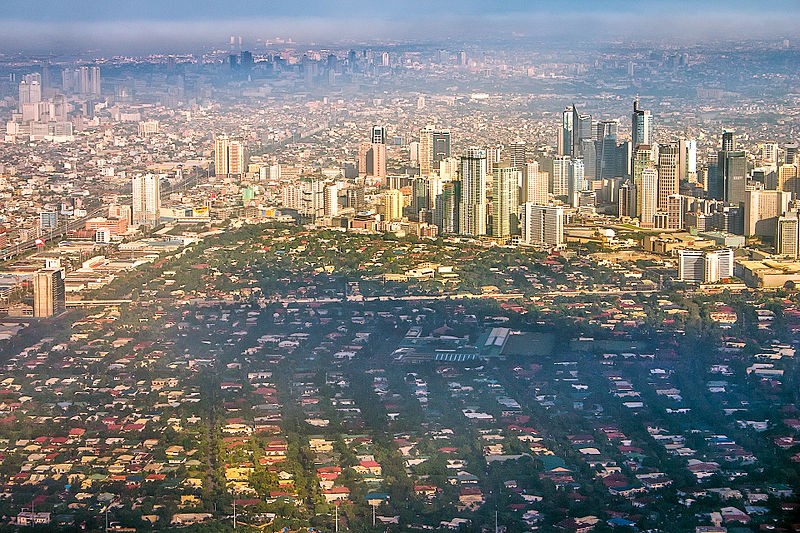
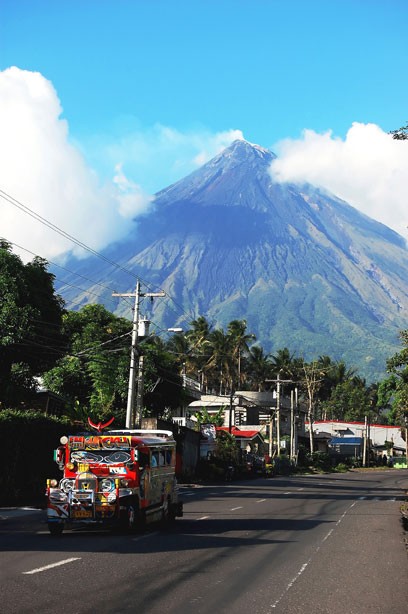
The Philippines is made up of about 7600 islands lying between the South China Sea and the Pacific Ocean. Located on the Pacific Ring of Fire, many of these islands were formed and shaped by volcanic eruptions. The northern island of Luzon is home to around half the country’s population, many of whom live on its large central plains in the cities and suburbs that surround the capital, Manila. To the south is another large island, Mindanao. Lying between them is a group of smaller islands known as the Visayas. Many Philippine islands have hilly, volcanic uplands, sloping to plains, beaches and mangrove swamps at the coast. The Philippines’ location just north of the equator gives the islands a tropical climate with hot, humid weather all year round. The rainy season lasts from June to November.


People
The Philippines is home to a number of different ethnic groups who migrated to the islands from mainland Asia, other Southeast Asian islands or Oceania hundreds, or even thousands, of years ago. Among them are the Tagalog and Cebuano. The two largest non-indigenous groups are the Chinese and Spanish. The southern island of Mindanao is largely Muslim; elsewhere most people are Christian. In recent years, the Philippines’ population has grown rapidly, causing a shortage of jobs, housing and services. As a result, many people have left the country to find work abroad.
Religion
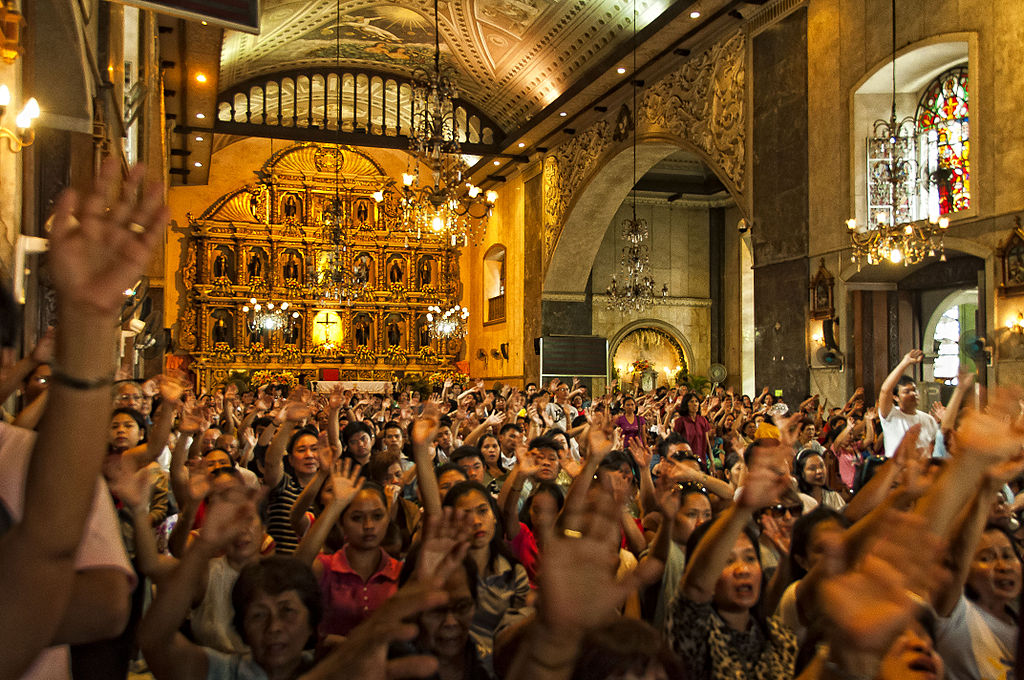
The Philippines is a secular state, a country that protects freedom of religious worship. Christianity is the dominant faith, followed by about 89% of the population, most of whom are Roman Catholics. The largest Christian nation in Asia, the Philippines has the world's third largest Catholic population. Around 56% regularly attend mass.
Islam is the second largest religion, officially at around 6%, although 11% of Filipinos say they are Muslims. The majority of Muslims live in Mindanao, Palawan and the Sulu Archipelago, an area known as the Moro region.
Economy
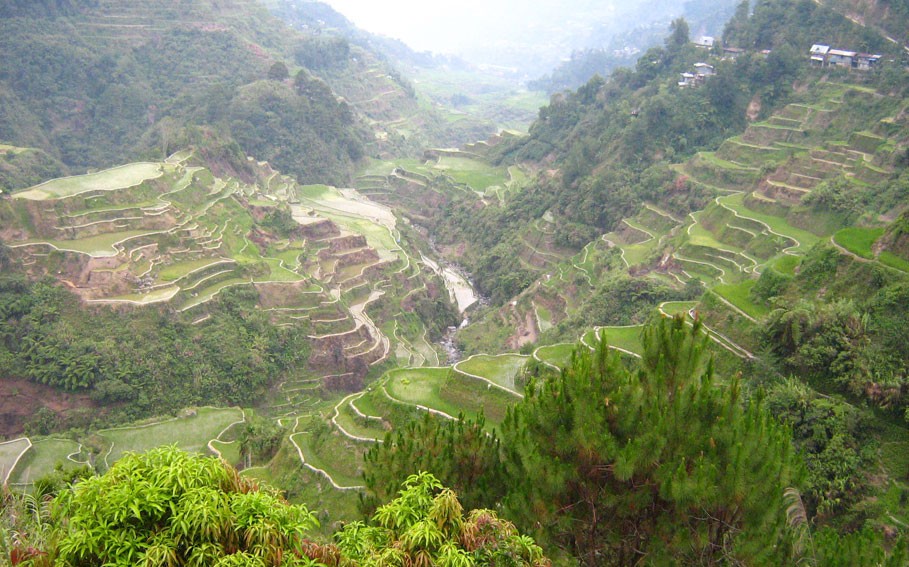
About a third of the Philippines’ population is employed in farming. A major crop is rice, which is grown in the northern uplands of Luzon. The Philippines’ warm, wet climate is ideal for growing coconut palms. The inner white part of the coconut, called copra, is an important export, used to make soaps and cosmetics.

In recent decades, manufacturing and services have become more and more important to the Philippines' economy. Today many of the world’s electronic goods, including computer parts such as circuit boards, are produced and assembled in the Philippines. A major service industry is call centres, where people answer phone calls from overseas customers who have product problems or are in need of technical support. More than 1 million people are employed in this sector.
Typhoons
The Philippines is vulnerable to typhoons, huge tropical storms that cause widespread destruction. In a typical year, the islands experience 19 typhoons, about six of which make landfall (pass over the land). Destructive typhoons hit the Philippines so often that they have affected where people live: the east coast of Luzon often experiences the worst of the storms, and so is less developed. In 2013, Typhoon Haiyan hit the Philippines, killing over 6000 people. With maximum wind speeds of 230 km/h (145 mph), it was the strongest tropical storm ever recorded. The 2024 season was particularly severe, with saw six typhoons hitting the country over just 30 days.

Consultant: Nicholas Harris
Facts about the Philippines
Area 298,170 sq km (115,120 sq miles)
Population 114,163,719 (2024 estimate)
Highest point Mount Apo 2954 m (9692 ft)
Capital Manila (population 1,543,670)
Other major cities Quezon City (2,761,720), Davao (1,212,504), Caloocan (1,661,584), Malingao (1,121,974), Zamboanga (861,799), Taguig (804,915), Cebu (798,634) Note: Quezon City, Manila, Caloocan and Taguig are all part of Metro Manila conurbation, which is made up 16 cities, total population 14,942,000. The population of the entire Manila urban area is 24,700,000.
Languages Filipino and English (official languages), Tagalog, Cebuano
Religions Christian (Catholic) 79%, Christian (Protestant) 13%, Muslim 6%, other 2%
Ethnicity Tagalog 28%, Cebuano 13%, Ilocano 9%, Bisaya/Binisaya 8%, Hiligaynon Ilonggo 8%, Bikol 6%, Waray 3%, other 25%
Currency Philippine peso (PHP)
Chief exports Electronic products, transport equipment, clothing, copper, oil and petroleum products, coconuts, fruit

History of the Philippines
AD 10th–16th century
The Kingdom of Tondo rules the region from the island of Luzon, setting up trade links with China.
1520
A Muslim kingdom, the Sultanate of Maguindanao, is established in Mindanao. Many islanders convert to Islam.
1521
A Spanish expedition, led by Ferdinand Magellan, lands in the Philippines and claims the islands for Spain. He is killed by islanders at the Battle of Mactan.
1543
A Spanish expedition led by Ruy López de Villalobos claims the islands for Spain and names them Las Islas Filipinas (Philippine islands), after the heir to the Spanish throne (later Philip II).
1565
Spanish colonization of the Philippines begins with the arrival of Spanish explorer Miguel López de Legazpi from New Spain. Spanish Manila becomes the capital of the Spanish East Indies in 1571. Spanish trading ships, known as Manila galleons, make voyages to Acapulco in Mexico (then part of New Spain) until 1815, carrying cargoes of Chinese goods, spices and slaves in exchange for New World silver.
1578
Castilian War: Spanish forces are victorious against Muslim states in Southeast Asia, including the Sultanates of Brunei, Sulu and Maguindanao. It is the first war in the Spanish–Moro conflict, a series of battles against the Moro people of Mindanao, Sulu and Palawan (the Bangsamoro) in the Philippines lasting more than three centuries.
1762–64
British forces occupy Manila during the Seven Years' War
1896
Philippine Revolution: the Katipunan, a rebel movement, begin armed resistance to Spanish rule.
1898
Spanish-American War: US Navy destroys Spanish fleet in Manila Bay (May). Revolutionary forces led by Emilio Aguinaldo proclaim independence (June). Following its defeat in the war, Spain cedes Philippines to US at the Treaty of Paris (December).
1899
Philippine revolutionaries refuse to recognize US takeover and proclaim First Philippine Republic with Aguinaldo as president. Philippine-American War breaks out as the armed struggle against US rule begins. The war results in the deaths of up to a million people, mostly due to famine and disease.
1902
Philippine-American War ends with defeat of the First Philippine Republic (although some rebels fight on in Moro until 1913) and the capture of Emilio Aguinaldo. US replaces military rule of the Philippines with civil government.
1907
Philippine assembly elected, although US rule is maintained.
1935
The establishment of the Commonwealth of Philippines, with Manuel Quezon as president, is recognized by US government.
1941–42
Japan invades the Philippines during World War II. The Japanese occupation is opposed by large-scale underground guerrilla activity.
1944–45
Philippines campaign: the Philippines is retaken by US forces after a military campaign that includes the naval Battle of Leyte Gulf (October 1944). Japanese massacre at least 100,000 Philippine civilians during the during the Battle of Manila (February–March 1945).
1946
The Philippines gains full independence from the United States at the Treaty of Manila and renamed Republic of the Philippines.
1965
Ferdinand Marcos becomes president. During his presidency, along with his wife, Imelda, he is accused of stealing billions of dollars in public funds.
1972
Marcos declares martial law (military rule). Parliament is suspended and opposition leaders arrested.
1986
People Power Revolution: Filipinos protest against the government of President Ferdinand Marcos, resulting in a return to democracy and a new president, Corazon Aquino, widow of opposition leader Benigno Aquino Jr., who was assassinated at Manila Airport in 1983
1991
Mount Pinatubo, a volcano on the island of Luzon, erupts. It is one of the largest volcanic eruptions of the 20th century.
2001
Following protests, President Joseph Estrada is overthrown during the EDSA Revolution and succeeded by his vice president, Gloria Macapagal Arroyo.
2006
More than 1000 people are killed by a mudslide which engulfs a village on the central island of Leyte
2012
The government agrees a peace deal with the Muslim rebel Moro Islamic Liberation Front (MILF), ending a 40-year conflict that has cost an estimated 120,000 lives. The agreement is signed by the MILF in March 2014.
2013
Typhoon Haiyan hits the Philippines.
2016
President Duterte launches an intense anti-drug campaign.
2017
Fighting erupts between government forces and Islamist militants on the island of Mindanao.
2021
(December) Typhoon Rai, known locally as Odette, brings widespread devastation, power outages, flooding and landslides to southern and central Philippines, especially the islands of Siargao, Dinagat, Mindanao, Bohol and Cebu. Many communities are destroyed with hundreds of thousands left homeless. More than 400 deaths are recorded. Tens of thousands of hectares of agricultural land are destroyed.
2022
(April) Tropical Storm Megi causes floods and landslides in Leyte, devastating parts of southern Davao, Mindanao and Negros Oriental and claiming the lives of 167 people, with 110 missing.
2022
(May) Ferdinand Marcos Jr, the son of the former president, wins a landslide presidential election victory. Known as “Bongbong”, he uses social media to falsely portray his father's dictatorial regime as a golden era.
2024
(August) Chinese and Philippine ships collide near disputed Sabina Shoal in South China Sea, one of a series of confrontations between the two countries (China claims control of almost the entire South China Sea without any legal basis).
2026
(June) A 7.8-magnitude earthquake strikes the southern coast of Mindanao, raising the seabed by up to 2 metres. The most destructive quake in the country for 50 years, it claims the lives of at least 77 people, while over 1300 are injured.
pics


Without in any way limiting Q-files Ltd’s exclusive rights under copyright, any use of this publication to “train” generative artificial intelligence (AI) technologies to generate text is expressly prohibited. Q-files Ltd reserves all rights to license use of this work for generative AI training and development of machine learning language models.