
Asia

CITE
We have made every effort to follow citation style rules, but there may be some minor differences. If in doubt, please refer to the appropriate citation style manual.
Turkey. (2026). In Q-files Encyclopedia, Geography, Asia. Retrieved from
https://www.q-files.com/geography/asia/turkey
"Turkey." Geography, Asia, Q-files Encyclopedia, 31 Mar. 2026.
https://www.q-files.com/geography/asia/turkey.
Accessed 13 Sep. 2026.
Turkey 2026. Geography, Asia. Retrieved 13 September 2026, from
https://www.q-files.com/geography/asia/turkey
Geography, Asia, s.v. "Turkey," accessed September 13, 2026.
https://www.q-files.com/geography/asia/turkey


Turkey
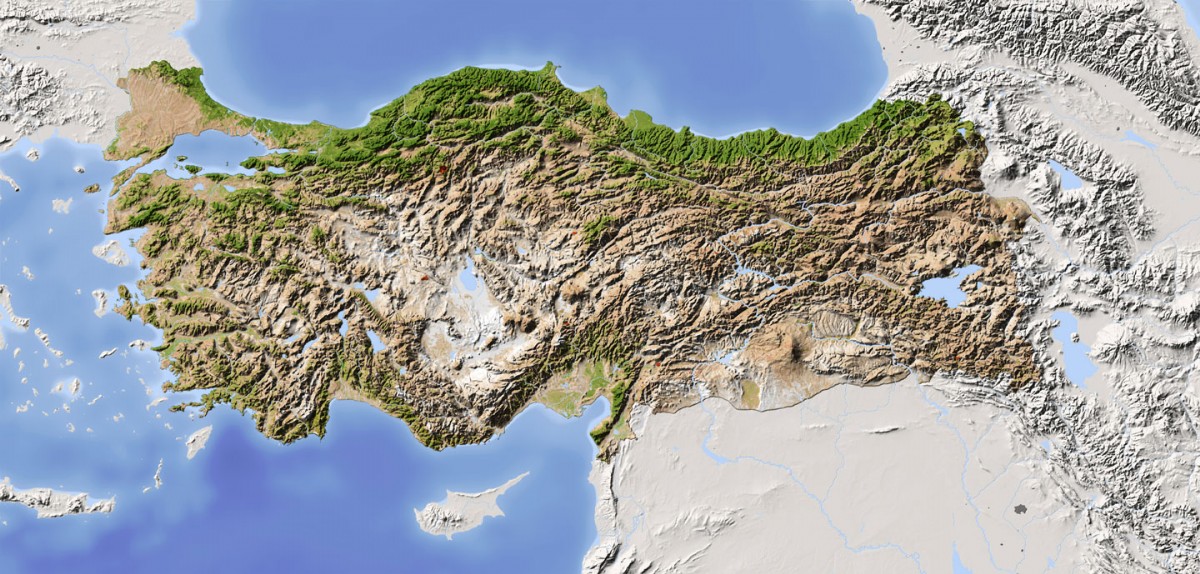
The modern country of Turkey is all that remains of the once-mighty Ottoman Empire. It once stretched from Iran in the east almost as far as Vienna in the west. Turkey is divided between Europe and Asia by a narrow stretch of water called the Bosporus. The small European part, which includes the country's largest city, Istanbul, is home to over 10% of the population. The Asian part—by far the largest portion–is the peninsula of Anatolia, which lies between the Black Sea and the Mediterranean Sea.

Anatolia
Once known as Asia Minor, today the Asian part of Turkey is called Anatolia. Much of the land is mountainous: the high Pontic Mountains fringe the northern coast while the Taurus Mountains rise in the south. In the east are high volcanic peaks. The central part is made up of gently rolling plains, low mountains and valleys. Turkey’s coasts have a warm Mediterranean climate, but the mountains and dry grasslands of its interior can be bitterly cold in winter.

People
The Turks are descended from peoples who came from Russia, Central Asia and Mongolia. Although nearly everyone is Muslim, Turkey is a secular state—it has no official religion, and people are free to follow whichever religion they wish. Family is very important in Turkey, and it is usual for children to live with their parents until they are married. Since Ottoman times, the tea- and coffee-houses have been at the heart of Turkish life; here, people meet their friends to talk or play games.


Kurds
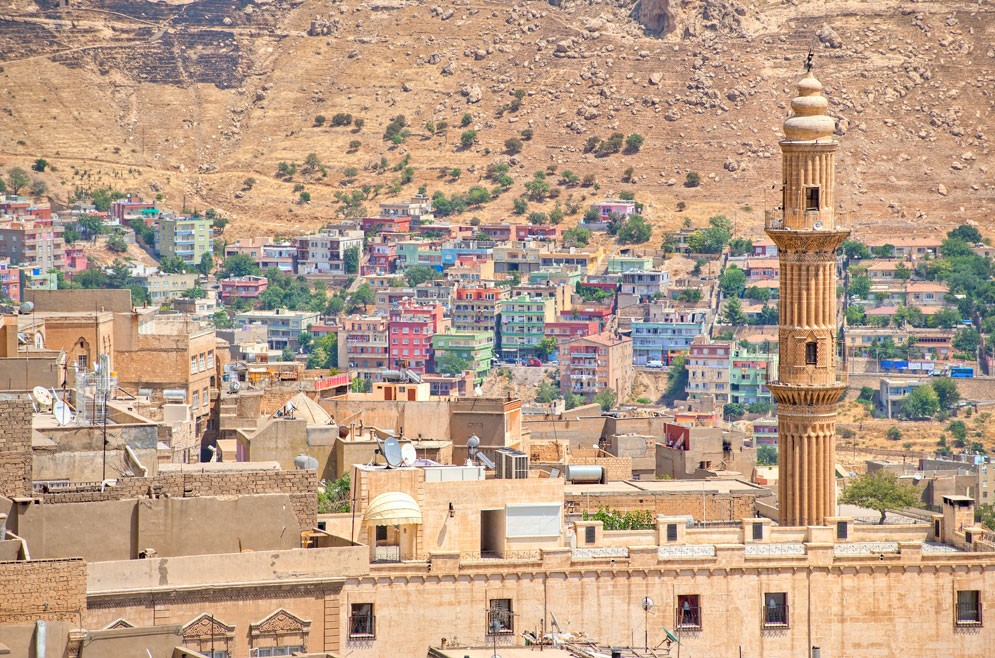
Around a fifth of Turkey’s population are Kurds, a people whose ancestors came from ancient Iran. They speak a variety of Kurdish languages and most are Muslim. Southeastern Turkey is home to most of the Kurdish population; this area, south of the Taurus Mountains, is part of Kurdistan, a region that extends into Iran, Iraq and Syria. There is a long history of conflict between Turkey and its Kurdish people. Some Kurds want Kurdistan to be independent and have fought many wars and protests against the Turkish government.
Economy
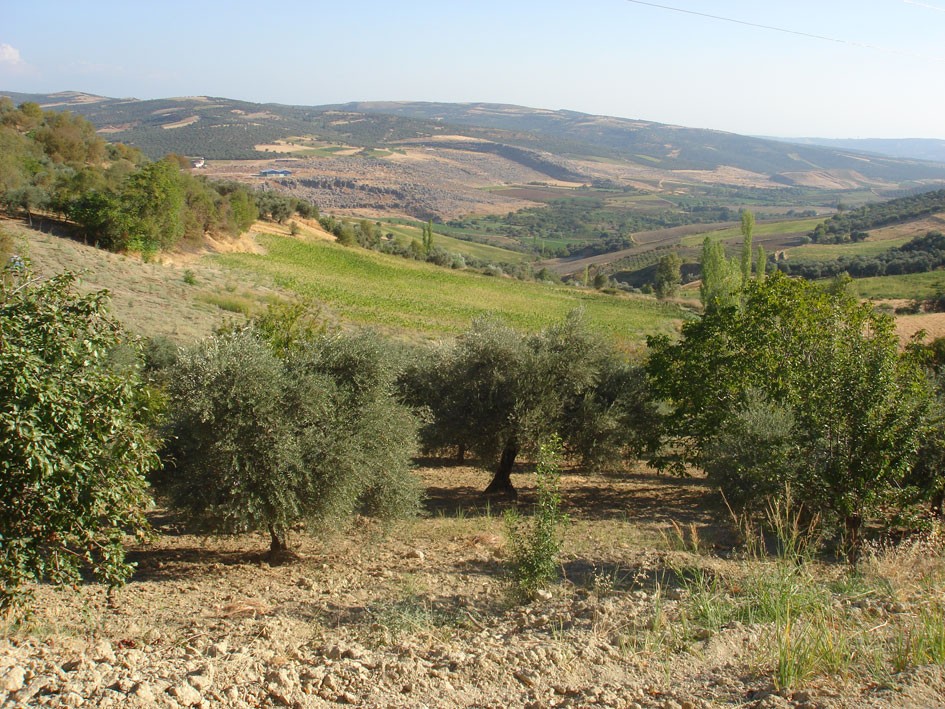
Although Turkey is rapidly becoming a modern industrial state, about a quarter of all Turks still work in the fields, many on small hill farms with just a few sheep and goats. Inland, farmers grow cereal crops such as wheat, barley and corn, while near the Mediterranean coast, tobacco, figs, sultanas and cotton are the main crops.

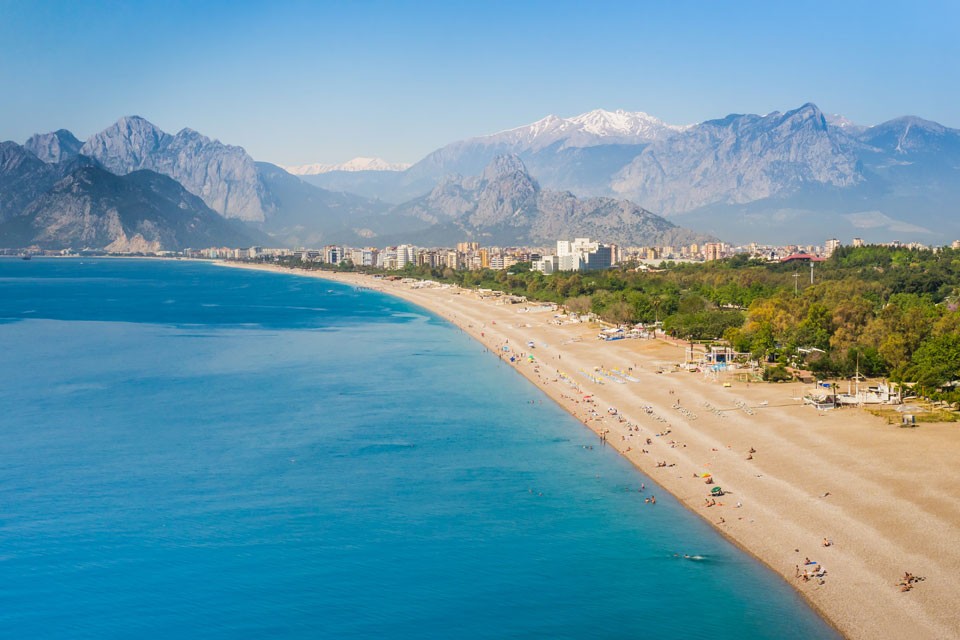
Textiles, petrochemicals and the manufacturing of cars and electrical appliances are among Turkey's most important industries. Turkey is famous for its craft industry, especially carpets and pottery. Its Mediterranean coastline and ancient sites also make it a popular tourist destination.
Istanbul
Turkey’s largest city, Istanbul, lies at the point where Europe meets Asia. It is the only city in the world to be split across two continents. Founded as the Greek city of Byzantium, in 330 AD it became the capital of the Roman emperor Constantine the Great, who named it Constantinople. Modern Istanbul's population grew rapidly in the 1970s as new factories were set up on its outskirts and thousands of people flocked to work there. Today, it is the largest city in Europe. The European part of Istanbul is its commercial centre, while the Asian part—reached by bridge or by ferry across the Bosporus strait—is mainly residential.


Consultant: Nicholas Harris
Facts about Turkey
Population 85,664,944 (2024 estimate)
Area 769,632 sq km (291,760 sq miles)
Highest point Mount Ararat 5165 m (16,944 ft)
Capital Ankara (population 5,864,049)
Other major cities Istanbul (pop. 15,655,924), Izmir (4,479,525), Bursa (3,214,571), Antalya (2,696,249), Konya (2,320,241), Adana (2,270,298)
Languages Turkish (official language), Kurdish, Arabic, Zaza
Religion Muslim 99%, other 1%
Ethnicity Turks 70–75%, Kurds 18%, other 6–11%
Currency Turkish lira (TRY)
Chief exports Clothing and textiles, metals, ships, vehicles


History of Turkey
6000 BC
The settlement of Çatal Höyük grows up in southern Anatolia.
2000–1200 BC
Hittites rule Anatolia.
1200 BC
Greek settlements, including Miletus, are established along the Aegean coast of Anatolia. The interior of Anatolia is dominated by the Phrygian Kingdom until 675 BC
6th–5th century BC
The Persian Achaemenid Empire conquers and rules Anatolia.
334 BC
Alexander the Great conquers the region for the Macedonian Empire. Following his death, the Seleucids rule large parts of Anatolia, while in eastern Anatolia, the kingdom of Armenia emerges.
282–129 BC
Greek Kingdom of Pergamon rules much of the western part of Anatolia.
129 BC
Roman Republic annexes former kingdom of Pergamon into the Empire as its province of Asia
3rd century
The Roman Empire splits into eastern and western parts, with the region of modern Turkey in the east.
330
The ruler of the eastern half of the Roman Empire, Constantine I, founds a new capital at Byzantium and names it Constantinople (modern-day Istanbul).
527–565
The emperor Justinian rules the Byzantine Empire, expanding it to include parts of North Africa, Greece, Italy and Spain.
7th century
Arab armies invade the Byzantine Empire, taking Constantinople and introducing their religion, Islam.
9th century
Under the rule of Basil I, the Byzantine Empire flourishes. His death in 1025 begins the decline of the Byzantine era.
1071
Seljuk Turks defeat the Byzantines at the Battle of Manzikert, and later establish the Seljuk Sultanate of Rum. During the 11th–13th centuries, Turkic peoples gradually migrate to Asia Minor (Anatolia), previously a largely Christian Greek-speaking region, transforming it into a mostly Muslim Turkic-speaking region.
1299
The Ottoman beylik (principality) is founded by Osman I in the northwestern Anatolian region of Bithynia. During the 14th century, the Ottomans annex neighbouring principalities in Anatolia and expand into the Balkans
1453
Mehmed II completes Ottoman conquest of the Byzantine Empire by capturing its capital, Constantinople, which is renamed Istanbul.
1512–66
Under Ottoman sultans Selim I and his son Suleiman I, the Ottoman empire expands enormously through conquest of the Mamluk Sultanate of Egypt (1516–17), the Safavid Empire (1535) and southeastern Europe (1521–29).
19th century
Decline of Ottoman Empire: wars with Russia and uprisings in the Balkans (southeastern Europe) lead to millions of Muslim refugees migrating into modern-day Turkey from the Balkans, Caucasus, Crimea and Mediterranean islands. Ethnic tensions in Anatolia lead to Hamidian massacres of Armenians, a Christian people, in the mid-1890s, in which up to 300,000 Armenians are slaughtered.
1913
The government is overturned by a coup, led by the "Three Pashas".
1914
The Ottoman Empire enters World War I on the side of the Central Powers.
1915
The Armenian population of Turkey is forcibly relocated from Eastern Turkey to Syria, resulting in an estimated 1.5 million deaths.
1919–22
The Turkish War of Independence: Turkey fights for independence, having been occupied by Greece in the west and Armenia in the east following its defeat in World War I. In November 2022 the Turkish Parliament formally abolishes the Sultanate, ending 623 years of Ottoman rule.
1923
Turkey is declared a republic in the country's new capital, Ankara, with Mustafa Kemal Atatürk as its first president.
1974
Turkey invades Cyprus, establishing the Turkish Republic of Northern Cyprus in 1983.
1984–2025
Kurdish protests against Turkish rule, led by Kurdistan Workers' Party (PKK), an armed guerrilla group
1999
A major earthquake kills over 17,000 people in northwest Turkey.
2005
Turkey starts negotiations to become a full member of the European Union (EU).
2011
Thousands of refugees fleeing civil war in Syria start to stream into Turkey.
2013
Anti-government protests spread to several cities, sparked by plans to develop one of Istanbul's few green spaces
2015
Turkey announces air strikes against Islamic State militant group (July); Turkey shoots down a Russian military jet on Syria bombing mission; EU strikes a deal whereby Turkey restricts flow of migrants into Europe, in return for €3 billion payment and concessions on talks to join the EU
2016
(July) An attempt to overthrow the Turkish government and President Erdogan, carried out by a faction within the Turkish Armed Forces, fails after forces loyal to the state defeat them; a state of emergency is declared by the president.
2017
Uzbek gunman, supported by Islamic State, kills 39 people celebrating New Year at the Reina nightclub in Istanbul (January); President Erdogan wins referendum to extend his powers; Turkey launches air strikes on Kurds in Syria and Iraq
2023
(February) A severe earthquake (magnitude 7.8) with an epicentre near Gaziantep strikes southern and central Turkey and northwestern Syria. It is followed by another quake, almost as powerful, centred 95 km (59 miles) further north, near Ekinozu, then by a number of aftershocks. There is extensive damage with more than 45,000 deaths in Turkey (more than 6700 in Syria) and about 1.5 million people left homeless. Damaged roads, winter storms and disruption to communications hamper rescue efforts. It is the deadliest natural disaster in Turkey's modern history.
2025
(March) PKK, the Kurdish militant group, declares a ceasefire with Turkish government. (May) It announces plans for the dissolution of the organization.
pics


Without in any way limiting Q-files Ltd’s exclusive rights under copyright, any use of this publication to “train” generative artificial intelligence (AI) technologies to generate text is expressly prohibited. Q-files Ltd reserves all rights to license use of this work for generative AI training and development of machine learning language models.