
Asia

CITE
We have made every effort to follow citation style rules, but there may be some minor differences. If in doubt, please refer to the appropriate citation style manual.
East Asia. (2026). In Q-files Encyclopedia, Geography, Asia. Retrieved from
https://www.q-files.com/geography/asia/east-asia
"East Asia." Geography, Asia, Q-files Encyclopedia, 31 Mar. 2026.
https://www.q-files.com/geography/asia/east-asia.
Accessed 13 Sep. 2026.
East Asia 2026. Geography, Asia. Retrieved 13 September 2026, from
https://www.q-files.com/geography/asia/east-asia
Geography, Asia, s.v. "East Asia," accessed September 13, 2026.
https://www.q-files.com/geography/asia/east-asia


East Asia
Over 1.65 billion people, around a fifth of the world's population, live in East Asia. It is one of the world's most populated regions, with, on average, 143 inhabitants per square kilometre (370 people per square mile)—three times the world average. There are five fully recognized, independent states in East Asia. In descending order of their population sizes, they are: China, Japan, South Korea, North Korea and Mongolia. Two islands off the coast of China, Hong Kong (previously a British colony) and Macau (formerly a Portuguese colony) are Special Administrative Regions of China. Although under the authority of China, they have some degree of independence. The status of the island of Taiwan is complicated. It is regarded as a Chinese territory by China and is not recognized as an independent state by the United Nations. However, it does have its own independently elected government.

China


The third largest country in the world by area, China has the world's second highest population (overtaken by India in 2023)—about 17.4% of all the people in the world today. The west of the country is mountainous, with deserts and grassland plains or steppes. Very few people live in this region, but those that do belong mainly to Mongol, Turkish or Tibetan ethnic groups. The eastern part of China has a warm climate, with fertile soil and river valleys. Great rivers, including the Yangtze and the Huang He, or Yellow River, wind from the western mountains to the sea in the east.
Most of the population of China, the Han, or Chinese-speaking peoples, live in the east. Here, millions of farmers produce crops such as rice, maize, wheat, sweet potatoes, cotton and tea. To the north, the Huang He (Yellow) River flows across lands of fertile soil, called loess, which turns the river the yellow colour after which it is named. The fields are planted with cereal crops such as wheat and millet. Southeastern China is much wetter and is crisscrossed with canals and wide rivers like the Yangtze. Here, wet-field rice farming is found everywhere. Pigs and poultry are raised all over China.
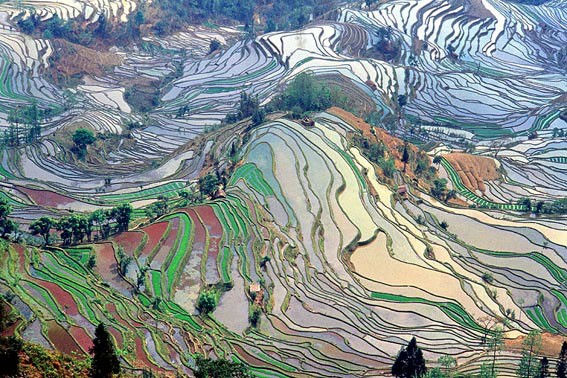


China has developed extemely rapidly as a major industrial nation over the last few decades. Huge industrial cities, such as Guangzhou and Chongqing, line the great rivers and coastal plains. China has heavy industry such as steel and chemical plants. It also produces and exports vast quantities of textiles, clothing and other manufactured goods. Around a half China's population now lives and works in cities—but there is still a colossal rural population living off the land.

The ancient kingdom of Tibet became part of China in 1951. It is the highest region on Earth, with an average height of roughly 5000 metres (16,000 feet) above sea level. Several of Asia's greatest rivers, including the Yangtze, Huang He, Indus, Mekong, Ganges, Salween and Brahmaputra, originate on the Tibetan plateau, although the land is dry for most of the year. Most Tibetans live by raising livestock, especially yaks. Their religion, Buddhism, is extremely important to Tibetans.

Mongolia
During the 13th and 14th centuries, Mongolia was the centre of one of the world’s greatest empires. Most of the land is mountainous, rocky desert (the Gobi) or rough, open grassland, where herdspeople live in their round tents known as yurts ("ger" in Mongolian). The one large city, Ulan Bator, draws many people away from their traditional way of life. Mongolia has coal and oil resources.
Japan

Japan is made up of four main islands, where most of the population lives, and nearly 7000 smaller ones. The four main islands are, in order of size, Honshu, Hokkaido, Kyushu and Shikoku. Winter is cold in the north, but the south of the country has mild winters and hot summers. Thickly forested mountains, many of them volcanic, run the length of the country. Because Japan is situated near major tectonic plate boundaries, it experiences frequent earthquakes. Most are minor, but several highly destructive ones occur each century, the most recent being the 2024 Noto earthquake, in which 526 people lost their lives, the deadliest earthquake in Japan since the 2011 Tohoku earthquake and tsunami.


The few lowland areas near the coast or along river valleys are shared between great cities like Tokyo, the capital, Osaka and Nagoya, and farmland—mostly rice fields. Japan's fishing fleet catches more fish than any other country's. With more than 120 million people, Japan has, as of 2025, the world's 11th largest population and is one of the richest industrial countries in the world. It is a leading producer of cars, ships and electronic goods such as computers, televisions and cameras. It is also one of the world's most important financial centres.
Korea
Since the Korean War (1950–1953) the ancient kingdom of Korea has been split into two, North Korea and South Korea. Communists rule in the North, which has little contact with the outside world, and relies on enormous state-controlled farms. The South has become a fast-growing manufacturing nation, producing electronic goods and cars. The best rice lands are along the southern coast, while most of the minerals—coal, iron, lead, zinc and copper—are found in the North.

Consultant: Lloyd Jenkins
pics
Without in any way limiting Q-files Ltd’s exclusive rights under copyright, any use of this publication to “train” generative artificial intelligence (AI) technologies to generate text is expressly prohibited. Q-files Ltd reserves all rights to license use of this work for generative AI training and development of machine learning language models.