
Asia

CITE
We have made every effort to follow citation style rules, but there may be some minor differences. If in doubt, please refer to the appropriate citation style manual.
Bangladesh. (2026). In Q-files Encyclopedia, Geography, Asia. Retrieved from
https://www.q-files.com/geography/asia/bangladesh
"Bangladesh." Geography, Asia, Q-files Encyclopedia, 31 Mar. 2026.
https://www.q-files.com/geography/asia/bangladesh.
Accessed 13 Sep. 2026.
Bangladesh 2026. Geography, Asia. Retrieved 13 September 2026, from
https://www.q-files.com/geography/asia/bangladesh
Geography, Asia, s.v. "Bangladesh," accessed September 13, 2026.
https://www.q-files.com/geography/asia/bangladesh


Bangladesh
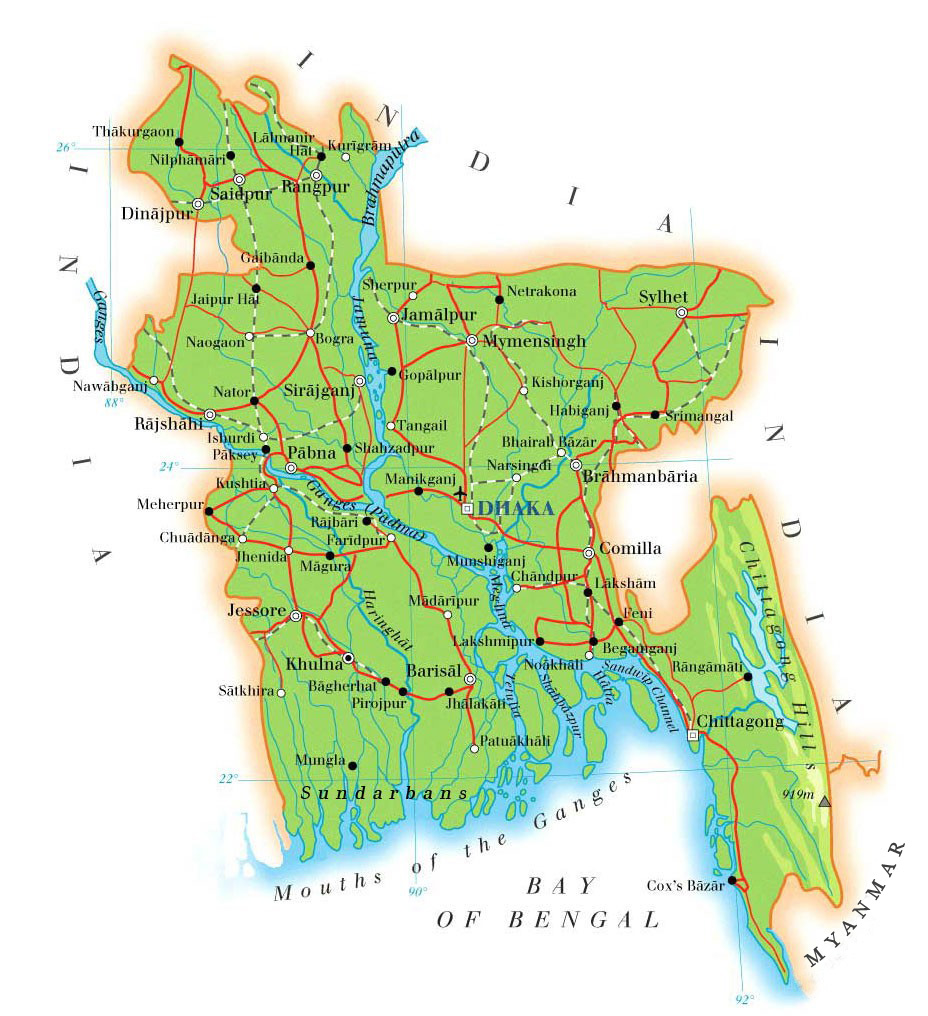
Bangladesh is the most densely populated large country on Earth, with approximately 1350 people living in every square kilometre (0.39 square miles). Most of Bangladesh is green, fertile floodplains. The country lies on the Ganges Delta, where the mighty rivers Ganges and Brahmaputra join the Meghna before flowing into the Bay of Bengal. The only uplands in Bangladesh, the Chittagong Hills, lie in the southeast. On the southwest coast lies an area known as the Sundarbans, the world’s largest mangrove forest. The climate is tropical, with hot, humid summers and mild winters. Natural disasters, including flooding and tropical cyclones, are a constant threat. One of the fastest growing economies in the world, Bangladesh's poverty rate has dropped from 80% in 1972 to just 19% today.


People
Around 98% of Bangladeshis are Bengali, while the Chittagong Hills are home to tribal peoples known as the Jumma. Bangladesh’s capital, Dhaka, is one of the fastest-growing cities in the world. As more and more people move to the city to look for work, shantytowns have sprung up at its edges, where around 4 million people live in makeshift housing and cramped, often dangerous conditions.
Most people in Bangladesh live in villages in the countryside. Their houses are often built on stilts or raised on mounds of earth to keep them above the water level during flooding. With more than 700 rivers in Bangladesh's vast floodplains, people often use boats to travel between villages, and rafts to transport crops and animals.
Bangladesh has one of the largest refugee populations in the world. As of 2024, around 1 million Rohingya people, more than half of them children, have fled violence in Myanmar to seek refuge across the border in Bangladesh. They currently live in overcrowded camps near Cox's Bazar, including Kutupalong (the world's largest refugee camp) and Nayapara.

Rice cultivation
Bangladesh’s most important crop is rice. The fertile soil and unusually wet conditions in Bangladesh mean that rice can be harvested up to three times a year (elsewhere in the world it can be harvested only once or twice). A hardy crop, rice can also survive flooding. Bangladesh is the sixth largest rice-producing country in the world, but the crop produced is still not enough to feed its huge population. It needs to import thousands of tonnes of rice each year.


Ship breaking

The ship breaking industry employs hundreds of thousands of Bangladeshis and produces a fifth of all the steel in Bangladesh. Ship breaking involves the breaking up of old ships, chiefly for the extraction and recycling of scrap metal, especially steel. Modern ships have a lifespan of no more than 30 years, after which rusting and metal fatigue make them too expensive to maintain.
The industry is important to countries such as Bangladesh, India and Pakistan—but extremely dangerous for the workers, who may suffer burns, inhaling toxic substances or injuries from falling metal. It is thought around a fifth of Bangladesh's ship breaking workforce are below 15 years of age. Hazardous waste chemicals, old batteries and asbestos (known to cause cancer) are simply left behind on the beach or set on fire—practices that are harmful to the environment.
Floods
Between June and October, the monsoon period brings heavy rain, causing Bangladesh’s rivers to swell and flood. Seasonal flooding is important for agriculture. The floods leave behind mineral-rich silt, a fine sediment, which makes the soil fertile and perfect for growing crops such as rice and jute. Sometimes enough silt is deposited to create new islands in the water. People build temporary farms on this land, known as charland, before the next season’s floods wash it away.
Sometimes the floods can be disastrous, however, causing great loss of life as well as destroying homes. A flood protection programme has been set up to reduce the impact of flooding. Building levees, artificial barriers running along river banks, are one method of protecting villages.


Tropical cyclones
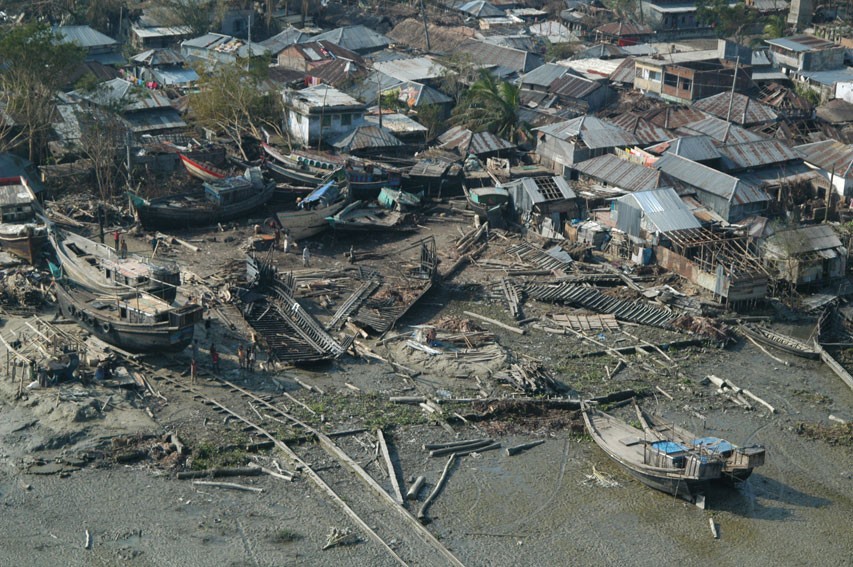
Bangladesh is vulnerable to tropical cyclones—huge, powerful storms that sweep in from the Bay of Bengal. These may cause both severe damage and flooding at the coast. As climate change causes sea levels to rise, Bangladesh is becoming even more at risk of disastrous floods. Storm surges bring huge tides inland over the low-lying ground.
Consultant: Nicholas Harris
Facts about Bangladesh
Population 168,220,000
Area 143,998 sq km (55,598 sq miles)
Highest point Keokradong 986 m (3235 ft)
Capital Dhaka (metro area population 36,600,000)
Other major cities Chittagong (pop. 4.5 million), Gazipur (2.7 million), Khulna (1.2 million), Narayanganj (967,951)
Languages Bangla (official language), English, Chakma, Santali, Urdu
Religions Muslim 90%, Hindu 9%, other 1%
Ethnicity Bengali 98%, other 2%
Currency Taka (BDT)
Chief exports Clothing and textiles, scrap metal, frozen seafood, jute, leather


History of Bangladesh
2700–700 BC
The first settlements are formed in the Ganges Delta, and are united as the Kingdom of Bengal.
AD 7th–12th century
Arab traders and Sufi missionaries bring a Muslim influence to Bengal.
1576
The Muslim emperor Akbar conquers Bengal and it becomes part of the Mughal Empire.
1717
Murshid Quli Khan becomes the first Nawab of Bengal. By the early 1700s, Bengal has become effectively independent of the Mughal Empire under the Nawabs
1757
Following their victories at the Battle of Plassey (1757) and the Battle of Buxar (1764), the British East India company takes control of Bengal, ending the power of the Nawabs of Bengal
1769–70
Great Bengal famine strikes Bengal, affecting some 30 million people. Caused by a combination of crop failure, drought and disease, between 7 adn 10 million people are thought to have died.
1858
The British government takes over rule of the subcontinent.
1943
The Bengal Famine; crop failures and events of World War II combine to cause the deaths of around 3 million people in Bengal (an area including present-day Bangladesh and western provinces of India).
1947
The British government grants independence and the Indian subcontinent is divided, creating the Muslim state of Pakistan. Bengal is partitioned between India and Pakistan. The eastern part, with the borders of present-day Bangladesh, is named East Pakistan. It is separated from West Pakistan by 1500 km (900 miles) of Indian territory.
1970
Tropical Cyclone Bhola strikes East Pakistan on 12th November 1970. It is the deadliest tropical cyclone ever recorded: according to estimates, 300,000 people lose their lives.
1971
(26th March) Proclamation of Bangladeshi Independence by Sheikh Mujibur Rahman. War of Independence (Liberation War) begins: Bengalis launch a guerrilla war against the Pakistani military. Following India's entry into the war on 3rd December, Pakistan surrenders on 16th December. Fighting kills between 300,000 and 500,000 people; millions of Bengalis are forced to leave their homes or flee to India.
1972
Bangladesh is established as an independent republic.
1974
One million people die in famine caused by flooding.
1982
General Ershad assumes power in a military coup. He suspends political parties, and becomes president the following year
1990
After mass protests, Ershad steps down. The constitution is changed to make the position of president ceremonial; prime minister now becomes head of government
1991
Bangladesh National Party (BNP) leader Khaleda Zia becomes Prime Minister. She and her rival Awami League leader Sheikh Hasina will alternate as Prime Minister over the next two decades (Hasina is the current Bangladesh PM): their political rivalry is popularly known as the "Battle of the Begums"
1998
Floods devastate three-quarters of the country, the most severe flooding in modern history.
2004
Severe flooding leaves nearly 800 people dead, millions homeless or stranded, and an estimated 20 million in need of food aid
2013
On 24th April Rana Plaza, an eight-storey building, collapses in Savar, Greater Dhaka, causing the deaths of 1129 people and injuring 2515. It is the deadliest garment factory accident in history.
2016
Thousands of Myanmar’s Bengali-speaking, Muslim Rohingya people arrive in Bangladesh as refugees after Burmese troops allegedly carry out mass killings in neighbouring Myanmar
2022
(June) Padma Bridge, a two-level road-rail bridge across the Padma River, the main distributary of the Ganges in Bangladesh, opens, linking the less developed southwest of the country to the northern and eastern regions. (December) The first section of the Dhaka Metro Rail opens.
2024
(January) Awami League, led by Prime minister Sheikh Hasina, wins the general election for the fourth consecutive time. The main opposition party, the Bangladesh Nationalist Party, boycotts the election protesting that it is not free and fair. Less than 40% of the eligible voters vote
2024
(August) Hasina resigns as prime minister and flees to India. Her resignation follows weeks of protests by students for fairer access to government jobs, which were met with violence involving police, the armed forces and members of the Awami League.
pics


Without in any way limiting Q-files Ltd’s exclusive rights under copyright, any use of this publication to “train” generative artificial intelligence (AI) technologies to generate text is expressly prohibited. Q-files Ltd reserves all rights to license use of this work for generative AI training and development of machine learning language models.