
Asia

CITE
We have made every effort to follow citation style rules, but there may be some minor differences. If in doubt, please refer to the appropriate citation style manual.
Syria. (2026). In Q-files Encyclopedia, Geography, Asia. Retrieved from
https://www.q-files.com/geography/asia/syria
"Syria." Geography, Asia, Q-files Encyclopedia, 31 Mar. 2026.
https://www.q-files.com/geography/asia/syria.
Accessed 13 Sep. 2026.
Syria 2026. Geography, Asia. Retrieved 13 September 2026, from
https://www.q-files.com/geography/asia/syria
Geography, Asia, s.v. "Syria," accessed September 13, 2026.
https://www.q-files.com/geography/asia/syria


Syria
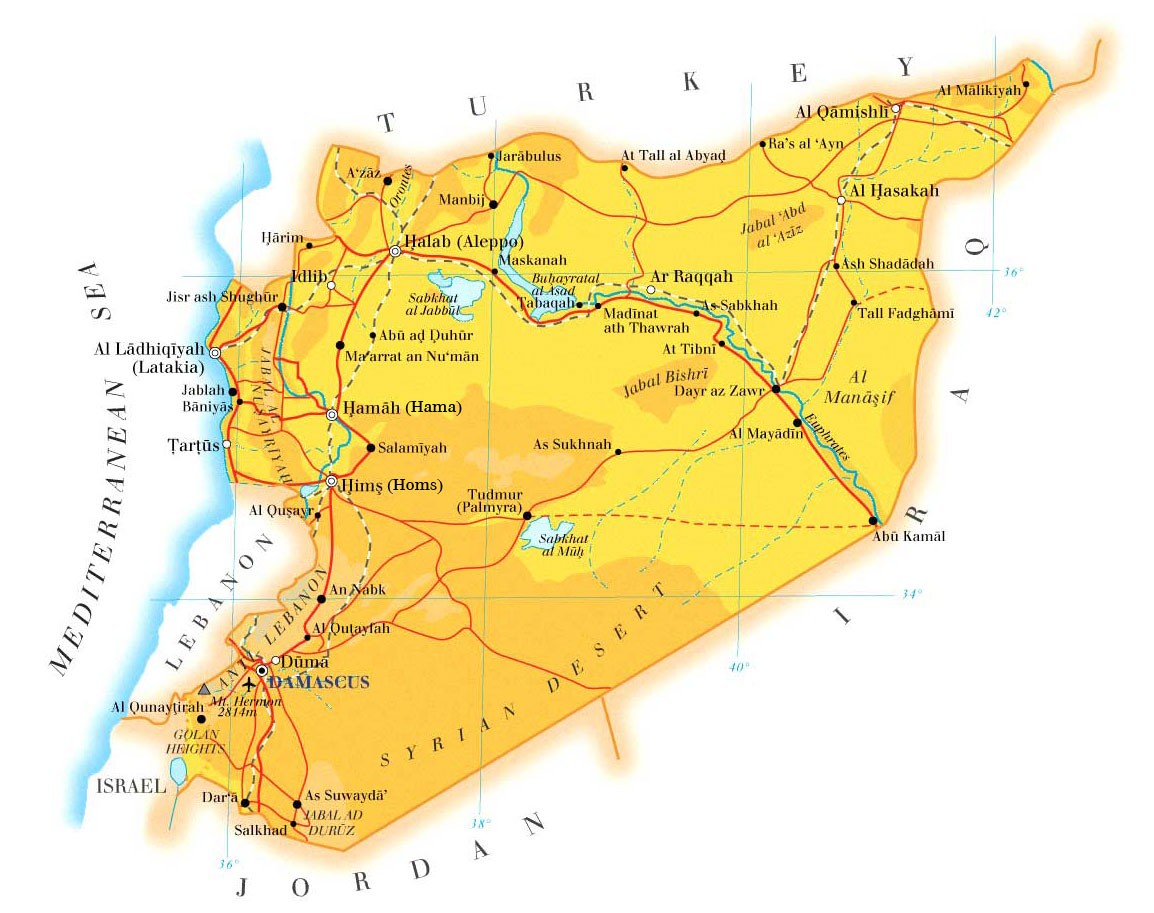
Lying at the crossroads of Europe, Asia and Africa, Syria has been at the centre of great trading civilizations for thousands of years. Its rich history includes periods of rule by the Akkadian, Babylonian, Assyrian, Persian, Greek, Roman, Arab and Ottoman empires. Its ancient capital, Damascus, is situated in the mountainous west. To the east, a dry, grassland region merges into the rocky Syrian Desert. The fertile floodplains of the River Euphrates, which flows through northeastern Syria, have enabled settlements to flourish in the otherwise harsh conditions of the desert. On its coast, Syria has a Mediterranean climate similar to that of California. Further inland the climate is arid, with hot, dry summers and cold winters.


People
Most Syrians today are Muslim Arabs, descended from the many different peoples who passed through Syria throughout its history. Also living in Syria are Christian Assyrian people, including several thousand Iraqi refugees, and Kurds, an Indo-European people who live mainly in the northeast. Most people live along the River Euphrates or in western parts; here, water supplies the main towns and cities and the land is more suitable for farming. In the countryside, most people farm sheep or goats and grow fruit and vegetables. Many rural people live a lifestyle that has hardly changed in hundreds of years.

Economy
Syria’s largest export is oil, which was discovered in the northeast in 1956. Two major foreign oil pipelines from Iraq and Saudi Arabia cross Syria on their way to the Mediterranean Sea; revenues paid by these countries to Syria are an important source of foreign income.


Agriculture employs just under half of the Syrian workforce. Along the Mediterranean coast, fruits such as apples and tomatoes are grown for export. Cotton is a major cash crop, grown in the fertile Euphrates valley. In 1975, a dam was built on the Euphrates river, making it possible to conserve water and irrigate fields more efficiently. Hydro-electric power produced by the dam also supplies Syria’s cities.
Civil War

The Syrian Civil War began in 2011. Unrest, which began in March as part of the Arab Spring protests, grew out of discontent with the government. It became an armed conflict after the protests calling for the removal of President Assad were violently suppressed. Fighting broke out between different rebel groups within the the Syrian population (most of whom follow Sunni Islam) on one side, against the armed forces loyal to the government (dominated by a smaller group of people called the Alawites, who follow Shi'a Islam) on the other.
Other countries gave military assistance to the rival forces: the rebels were backed by Turkey and the Gulf states; the government were supported by Iran and Russia. The Kurds, meanwhile, who seized the opportunity to press for self-rule, had the backing of the US, in order to fight against Islamic State (Isis or ISIL) forces. Kurdish fighters sought to take advantage of the turmoil to gain territory of their own, invading from Iraq.
Since the war began, over 13.5 million Syrians fled their homes to look for a safer place to live. Around 6.8 million became refugees, seeking shelter in neighbouring countries such as Jordan, Lebanon, Turkey and Iraq, or travelling to Europe. Of those who stayed on in Syria, life became almost unbearably hard. On top of the perils of living in a war zone, many buildings were destroyed in the fighting, and it was too difficult and dangerous for children to go to school. Industries such as tourism and oil production were severely damaged by the war, causing many people to lose their jobs. Around half of Syrian families were starving, with many in the rebel-held areas dependent on United Nations aid.

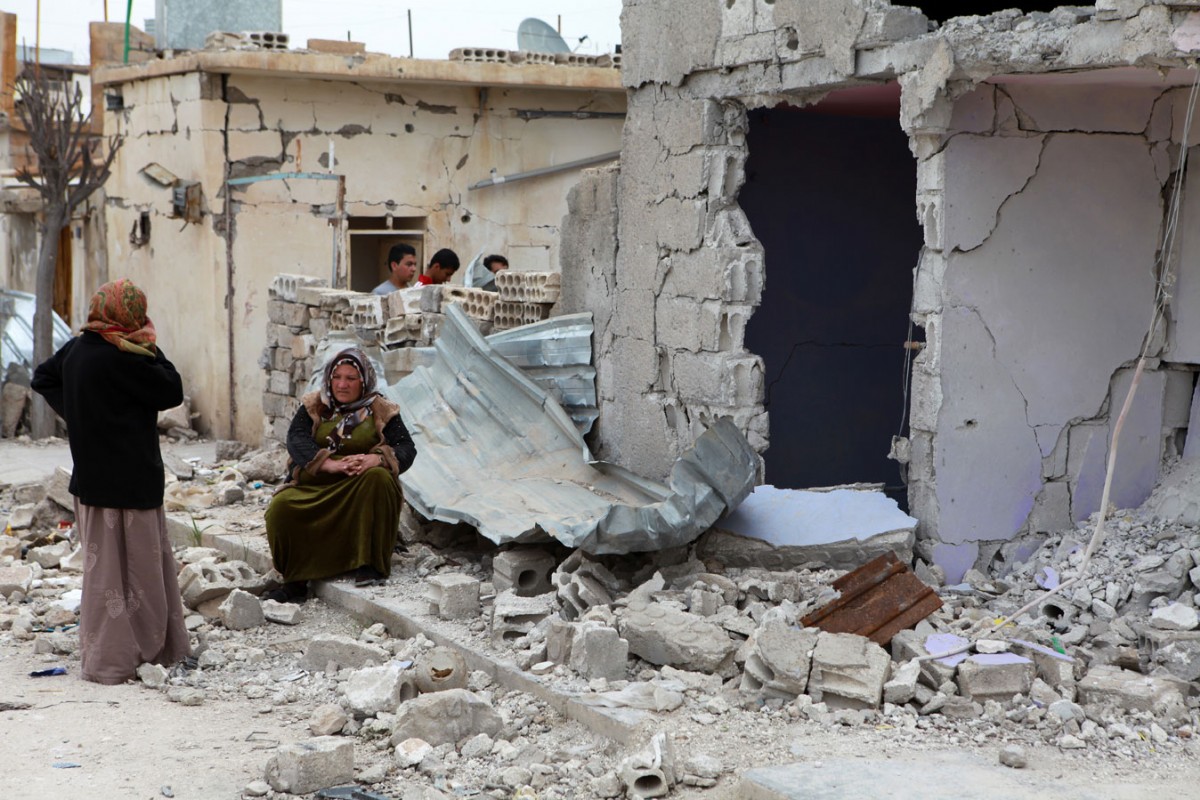
Following the ceasefire of March 2020, Syria was divided into three main areas. The government controlled more than two-thirds of the country, including the cities of Damascus, Aleppo and Homs. The northwestern corner, centred on Idlib, was in the hands of rebel opposition, while the northeastern region, called Rojava, was governed by its Kurdish population from their capital Raqqa. In addition, parts of the northern border were occupied by Turkish troops, to prevent Syrian Kurds allying with Turkish Kurds. More than 600,000 Syrians are thought to have died as a result of the war.
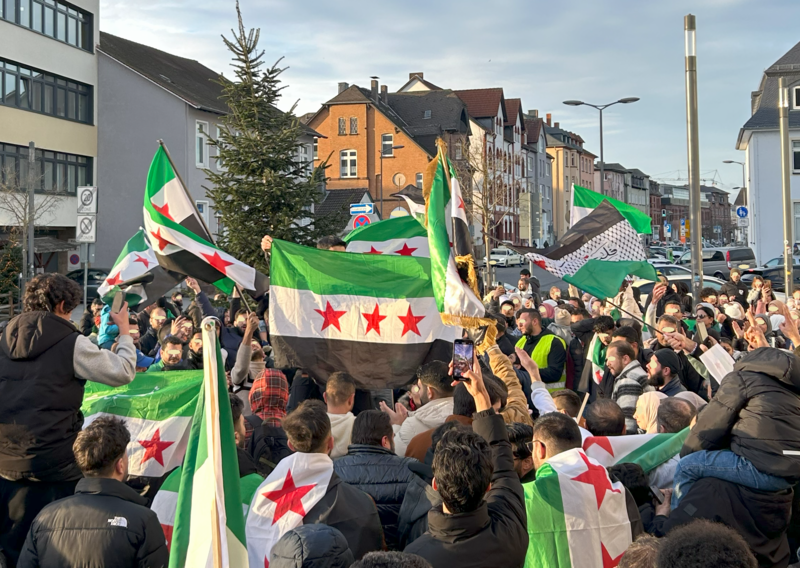
On 27th November 2024, a coalition of Syrian opposition groups led by Hay'at Tahrir al-Sham (HTS) under Ahmed Hussein al-Sharaa (also known as Abu Mohammad al-Julani), launched an offensive against Syrian government forces in Idlib, Aleppo and Hama. They made rapid advances as government forces disintegrated, taking Homs and the capital Damascus on 8th December. President Assad fled to Moscow, bringing to an end the Assad family's 53-year-long rule over Syria.
Facts about Syria
Area 183,630 sq km (70,900 sq miles)
Population 22,924,000 (pre-war estimate, made up of 21,124,000 Syrians, 1.3 million Iraqi refugees and 500,000 Palestinians); 17,500,000 (October 2021 estimate)
Highest point Mount Hermon 2814 m (9230 ft)
Capital Damascus (population 2.08 million)
Other major cities Aleppo (1.8 million), Homs (775,000 million), Hama (940,000)
Language Arabic (official language), Kurdish, Armenian, Turkish
Religions Muslim 87%, Christian 10%, Druze 3%
Ethnicity Arab 90.3%, other (inc. Kurds and Armenians) 9.7%
Currency Syrian pound (SYR)
Chief exports Oil and petroleum products, fruits and vegetables, cotton, clothing and textiles, meat and live animals


Consultant: Nicholas Harris
History of Syria
10,000 BC
The Natufians, a Neolithic people living in Syria, are among the first in the world to cultivate crops and to breed and farm cattle.
3500 BC
The Kingdom of Ebla, a powerful trading empire, flourishes in northern Syria. It is conquered by the Sumerian Akkadian Empire in the 2200s BC.
16th century–3rd century BC
Syria is dominated by a number of foreign empires, including the Hittite, Egyptian, Assyrian and Babylonian Empires.
13th century–3rd century BC
The Phoenician civilization flourishes on the Mediterranean coasts of present-day Lebanon and Syria.
1274 BC
Egyptians fight the Hittites for control over western Syria at the Battle of Kadesh in western Syria
c. 330 BC
Syria is conquered by Alexander the Great and ruled by the Macedonian Empire. Following Alexander's death, it becomes a province of the Seleucid Empire in 323 BC.
64 BC
Syria is conquered by Pompey the Great and becomes a province of the Roman Empire.
260 AD
Palmyrene kingdom, based on the Syrian city of Palmyra, breaks away from the Roman Empire and builds an empire of its own. Ruled by Queen Zenobia, it encompasses the Roman provinces of Syria Palaestina, Arabia Petraea and Egypt, as well as large parts of Asia Minor (Anatolia, modern Turkey). It is brought back into Roman control in 273.
640
Syria is conquered by the army of the Rashidun Caliphate led by Khalid ibn al-Walid. Later, he Islamic Umayyad dynasty rules the Caliphate from the Syrian city of Damascus. After the Umayyads are overthrown in 750 by the Abbasid dynasty, the capital is moved to Baghdad. Arabic becomes the region’s main language.
1098–1189
Parts of Syria are occupied by French, British, Italian and German armies as part of the Crusades. They are known as the Crusader states; the primary one in Syria is the Principality of Antioch.
13th–16th century
The Mongol and Mamluk Empires fight for control of Syria.
1516
The Ottoman Empire invades the Mamluk Sultanate of Egypt, conquering Syria and incorporating it into its empire.
1914
The Ottoman Empire enters World War I as an ally of Germany and the Austro-Hungarian Empire.
1920
Following World War I and the defeat of the Ottoman Empire, the League of Nations places Syria under a French mandate.
1925–27
Great Syrian Revolt: Sunni, Druze and Shiite and other factions across Syria lead armed rebellion against French occupation. It is put down by French colonial forces with the help of local collaborators.
1946
French troops evacuate Syria, leaving the country in the hands of a republican government: the Syrian Republic becomes independent
1948
Syria is involved in the Arab-Israeli War.
1958–61
Syria unites with Egypt to form the United Arab Republic.
1963
Following a coup (military takeover), Syria is governed under Emergency Law, which gives the new Ba'athist government absolute power. Hafez al-Assad takes over the presidency in 1970.
1967
During the Six Day War, Israel occupies a mountainous region of Syria known as the Golan Heights. Decades of further conflict with Israel follow, including the 1973 Yom Kippur War.
1976–2005
Syria occupies Lebanon.
1982
Hama massacre: Syrian troops, under the orders of President Assad, besiege Hama for 27 days in order to quell an uprising by the Muslim Brotherhood. More than 40,000 civilians are killed.
2011
Civil war breaks out in Syria as people protest at President Assad’s rule. Millions of refugees leave Syria for Lebanon, Turkey, Iraq and Jordan.
2013
(September) UN weapons inspectors conclude that chemical weapons have been used in an attack on the Ghouta area of Damascus in August that killed about 300 people
2014
Islamic State (Isis) fighters declare "caliphate" in eastern Syria. By August they control entire Raqqa province. In September, US and five Arab countries launch air strikes against them
2015
(September) Russia enters the conflict on the side of the Syrian government. It carries out first air strikes, targeting both Islamic State and anti-government rebels
2016
(December) Government troops, backed by Russian air strikes and Iranian forces, recapture Aleppo, the rebels' last major stronghold
2017
Government troops drive Islamic State fighters from Raqqa, their stronghold, and later from surrounding areas
2018
(April) Government forces launch an assault on Eastern Ghouta, the last rebel-held area near Damascus, probably using chemical weapons. (July) Government forces recapture almost all of the south of the country. (September) Kurdish-led forces launch offensive against Islamic State, reducing its territory to a tiny enclave on the Iraqi border.
2019
(October) US withdraws troops from northeastern Syria, prompting Turkey to invade the region and attack Kurdish forces there.
2020
(March) Turkey invades northwestern Syria to prevent Syrian government forces from retaking Idlib, the last province still in rebel hands. Turkish President Erdoğan and Russian President Putin agree a ceasefire.
2023
(February) A severe earthquake (magnitude 7.8) with an epicentre near Gaziantep, Turkey, strikes southern and central Turkey and northwestern Syria. It is followed by another quake, almost as powerful, then by a number of aftershocks. There is extensive damage with more than 6700 deaths recorded in Syria (45,000 in Turkey) and about 1.5 million people left homeless in both countries. Damaged roads, winter storms, poor communications in rebel-held areas and closed border crossings due to the war all hamper rescue efforts.
2024
On 27th November, a coalition of Syrian opposition groups led by Hay'at Tahrir al-Sham (HTS) under Ahmed Hussein al-Sharaa (also known as Abu Mohammad al-Julani), launch an offensive against Syrian government forces in Idlib, Aleppo and Hama. They make rapid advances as government forces disintegrate, taking Homs and the capital Damascus on 8th December. President Assad flees to Moscow. The Assad family's 53-year-long rule over Syria comes to an end.
pics


Without in any way limiting Q-files Ltd’s exclusive rights under copyright, any use of this publication to “train” generative artificial intelligence (AI) technologies to generate text is expressly prohibited. Q-files Ltd reserves all rights to license use of this work for generative AI training and development of machine learning language models.