
Ancient Middle East
Babylon
The city of Babylon was founded in around 2000 BC. Under the rule of Hammurabi (1792–1750 BC) it became the centre of the Babylonian Empire, before being conquered by the Assyrians. The city became powerful again during the reign of King Nabopolassar (ruled 626–605 BC), who overthrew the Assyrians. His son, Nebuchadnezzar II (ruled 604–562 BC), conquered Assyria and Judah. He may have built the Hanging Gardens of Babylon. This new Babylonian Empire came to an end in 539 BC, when the city was conquered by the Persians.


The city
Nebuchadnezzar made Babylon the finest city of its day. The 5th-century BC Greek historian Herodotus described it as “surpassing in splendour any city of the known world”. Archaeologists excavating Babylon at the beginning of the 20th century found that the city wall made a circle almost 18 kilometres (11 miles) long. The Babylonians built in mud-brick covered with glazed tiles, on which artists created sculptured designs.
Ishtar Gate

Babylon had eight gateways in its walls, the finest of which was the Ishtar Gate. Built to honour Ishtar, the goddess of love and battle, the gateway, through which sacred processions would have passed, was 15 metres (50 feet) high. The walls surrounding it were covered in glazed blue bricks, decorated with carvings of dragons and bulls. The dragons were symbols of the Babylonians’ chief god, Marduk. The bulls represented the lightning god, Adad. The gate was at the northern entrance to the city of Babylon.

The Hanging Gardens

According to legend, Nebuchadnezzar created the Hanging Gardens to remind his wife, Amytis, of the green hills of Media (in modern-day Iran), her homeland. The lush gardens are thought to have been built on arched terraces. Water was pumped up from the river and ran down through the gardens as cooling streams. Sadly, no archaeological evidence supports the existence of the Hanging Gardens in Babylon, although similar gardens were definitely built in the Assyrian city of Nineveh in the early 7th century BC.
Babylonian science
From the earliest days of its founding, Babylonians were keen astronomers. They studied the stars and planets and tried to work out their positions in relation to the Earth. They believed that the Earth was a flat disc suspended in space on a cushion of air. Some scientists of ancient Greece also adopted this theory.
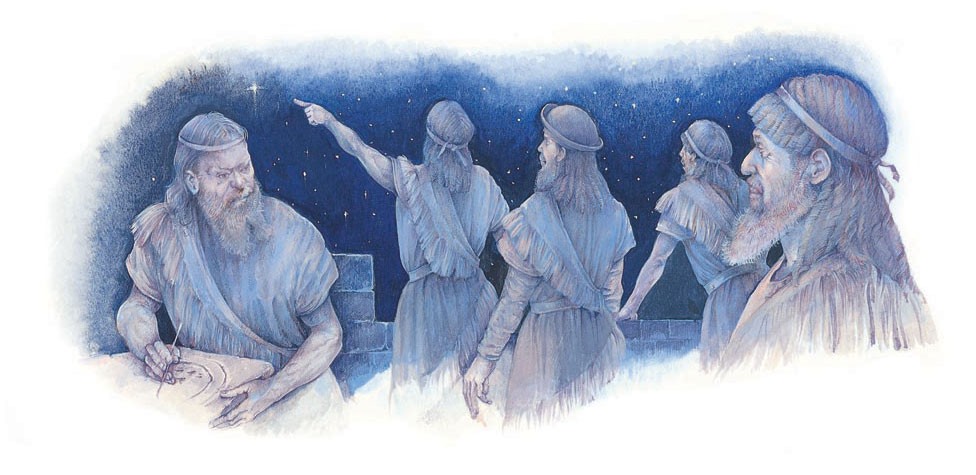
Babylonian mathematicians were the first to divide a day into 24 hours, each hour into 60 minutes and each minute into 60 seconds. These ancient units of time have, of course, survived to this day.
Consultant: Philip Parker