
Planets and moons

CITE
We have made every effort to follow citation style rules, but there may be some minor differences. If in doubt, please refer to the appropriate citation style manual.
Planets. (2026). In Q-files Encyclopedia, Space, Planets and moons. Retrieved from
https://www.q-files.com/space/planets-and-moons/planets
"Planets." Space, Planets and moons, Q-files Encyclopedia, 2 Jun. 2026.
https://www.q-files.com/space/planets-and-moons/planets.
Accessed 21 Sep. 2026.
Planets 2026. Space, Planets and moons. Retrieved 21 September 2026, from
https://www.q-files.com/space/planets-and-moons/planets
Space, Planets and moons, s.v. "Planets," accessed September 21, 2026.
https://www.q-files.com/space/planets-and-moons/planets


Planets
A planet is an object orbiting a star. Most planets contain rock and metal and are surrounded by atmospheres of gas. Some have liquids on their surfaces, or beneath their crusts. A planet is massive enough to have a gravitational pull sufficient both to give it a rounded (rather than irregular) shape and to sweep its orbit clear of debris. At the same time, it is not massive enough for nuclear fusion to take place inside it, as occurs inside stars like the Sun. In our own Solar System, there are eight true planets orbiting the Sun, our parent star. They are, in order from their distance from the Sun: Mercury, Venus, Earth, Mars, Jupiter, Saturn, Uranus and Neptune (Pluto, once considered to be the ninth planet, has been reclassified as a dwarf planet). Observations of other stars made using orbiting telescopes show that many of these stars also have families of orbiting planets, called extrasolar planets or exoplanets. There could be billions of exoplanets in the Universe.


Origin of the planets
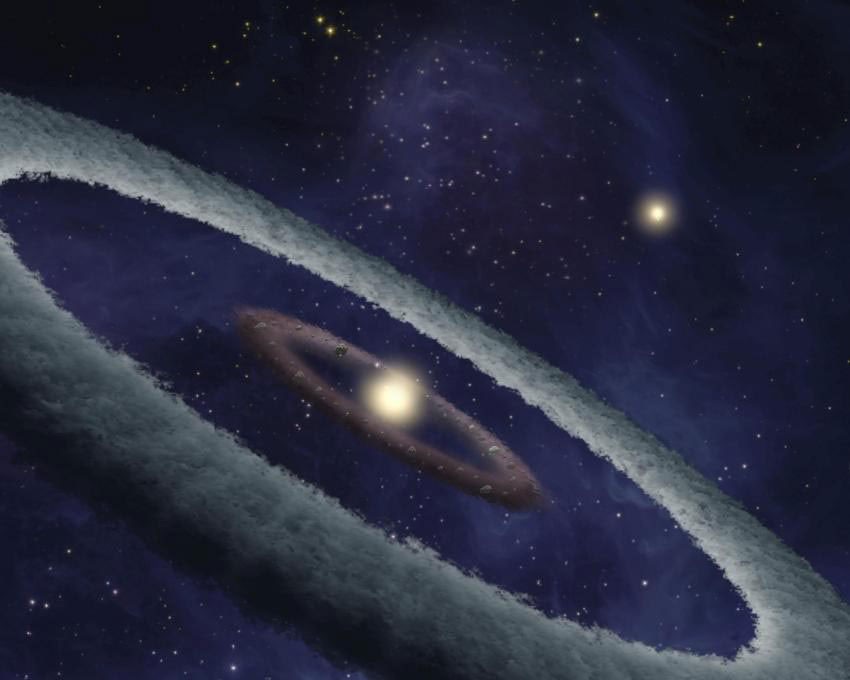
By studying meteorites, scientists have been able to work out the age of the Solar System itself: 4.6 billion years. At that time, a cloud of dust and gas drifted through space. A small part of the cloud became a swirling disc of matter, with a centre that became hotter and denser, eventually becoming the Sun. Particles of remaining dust clumped together and became boulders. These built up like snowballs into large balls of rock, called planetesimals, finally becoming planets.

Gas and ice giants
The two largest planets in the Solar System, Jupiter and Saturn, are known as the gas giants because, unlike our rocky planet, they consist mostly of gases: chiefly hydrogen and helium. They both probably have relatively small rocky cores. Uranus and Neptune have a composition quite different to that of Jupiter and Saturn, and are known as ice giants. Surrounding their cores are slushy oceans of water mixed with some ammonia (a mixture described by scientists as "ices"). Their thick atmospheres are composed mainly of hydrogen, with some helium and methane.

All four giants have a number of moons, some of which are larger than Mercury, the smallest planet. They also all have rings, although, apart than Saturn’s, they are very faint. Saturn’s bright rings consist of billions of pieces of ice, the largest of which are about the size of small houses.

Terrestrials and dwarfs
The four inner planets—Mercury, Venus, Earth and Mars—are much smaller than the giants and made mostly of rock, with cores consisting mainly of iron. They are known as the terrestrial planets.
Between Mars and Jupiter, thousands of asteroids (also called minor planets) orbit the Sun. The largest, Ceres, is about 1000 kilometres (600 miles) across. In 2006 it was given the status of "dwarf planet", a world that orbits the Sun and has a smooth, spherical shape, but is not big enough to qualify as a true planet.
Pluto was once regarded as a true planet, but has also been reclassified as a dwarf planet. Its orbit around the Sun is more elongated than those of the other planets, so that some of the time it is actually closer to the Sun than Neptune.
Moons

Moons, also known as natural satellites, are small bodies that circle around, or orbit, the planets of the Solar System. Earth has one moon, of course, known simply as the Moon, but the larger planets have many more (as of April 2026, Jupiter has 115 and Saturn has 292). Most moons orbit their parent planet in the same direction as the planet is rotating. A moon that rotates in the opposite way—usually because it has formed elsewhere and was later captured by a planet—has what is called a retrograde orbit. However, of the large moons, only Neptune's moon Triton has a retrograde orbit.
The moons range in size from the largest, Ganymede, which is 5268 kilometres (3273 miles) across, to a large number that are only a few kilometres in diameter. While the larger moons are roughly spherical, many other smaller moons are too small for their gravity to pull them into spheres, so they have irregular shapes. They were probably created in different ways. Some are the result of fragments of rock and ice coming together to form a globe. Others are old asteroids that have been "captured" by a planet’s force of gravity.

Consultant: Mike Goldsmith
pics

Without in any way limiting Q-files Ltd’s exclusive rights under copyright, any use of this publication to “train” generative artificial intelligence (AI) technologies to generate text is expressly prohibited. Q-files Ltd reserves all rights to license use of this work for generative AI training and development of machine learning language models.