
Famous leaders

CITE
We have made every effort to follow citation style rules, but there may be some minor differences. If in doubt, please refer to the appropriate citation style manual.
Mao Zedong. (2025). In Q-files Encyclopedia, History, Famous leaders. Retrieved from
https://www.q-files.com/history/famous-leaders/mao-zedong
"Mao Zedong." History, Famous leaders, Q-files Encyclopedia, 13 Sep. 2025.
https://www.q-files.com/history/famous-leaders/mao-zedong.
Accessed 6 Aug. 2026.
Mao Zedong 2025. History, Famous leaders. Retrieved 6 August 2026, from
https://www.q-files.com/history/famous-leaders/mao-zedong
History, Famous leaders, s.v. "Mao Zedong," accessed August 6, 2026.
https://www.q-files.com/history/famous-leaders/mao-zedong


Mao Zedong
Mao Zedong (also written as Mao Tse-tung, 1893–1976), sometimes called Chairman Mao, was a Chinese Communist revolutionary and leader. From 1935, he was leader of the Chinese Communist Party, and founded the People’s Republic of China in 1949. He was also responsible for the disastrous policies of the "Great Leap Forward" (1958–1961) and the "Cultural Revolution" (1966–1969), which resulted in the deaths of millions of people. Mao remains one of history's most controversial figures. Despite the death toll of his rule, for many Chinese people he is still the man who united their country and brought about much needed modernization.


Childhood
Mao was born on 26th December 1893 in Shaoshan, Hunan Province. His father had been a poor peasant, but had become wealthy through buying and selling grain. The young Mao attended primary school, then, at the age of 13, he was put to work on his father’s farm. His father also arranged for him to be married to the 17-year-old daughter of a local landowner. Mao rebelled against the marriage, and refused to acknowledge the woman, Luo Yigu, as his wife. She died in disgrace in 1910.
Qing dynasty China
At the end of the 19th century, China was still ruled by the Qing dynasty. The monarch had absolute power. The Dowager Empress Cixi was the effective ruler in China from 1861 to her death in 1908. She was a reluctant reformer at a time when China, still a feudal society, was in urgent need of modernization. The empress gave her support to the anti-foreigner Boxer Uprising in 1900, but was humiliated when this was crushed by Western forces. China's defeat by Japan in 1895 had already stirred anti-imperialist feeling in China. When the child-emperor, Puyi, became ruler of China in 1908, revolution seemed inevitable.


1911 Revolution
In 1911, Mao persuaded his father to allow him to study in Changsha, the provincial capital of Hunan. It was in Changsha that Mao first found out about the revolutionary leader Sun Yat-sen (1866–1925). In October 1911, a revolt broke out against the emperor. Mao joined the rebel army, although he did not take part in any fighting. The revolution ended in 1912 with the overthrow of the Qing dynasty and the establishment of the Republic
of China.
Sun Yat-sen was declared president, but was forced to hand over power to Yuan Shikai, a general who had been prime minister under Qing rule. When Yuan Shikai died in 1916, China entered the Warlord Era, when it was divided and controlled by competing warlords.
Peasant power
Mao left school in Changsha in 1918 and went to work as a library assistant at the university in Beijing. In 1920, Mao became the head of a primary school in Changsha. In the same year, he married Yang Kaihui.
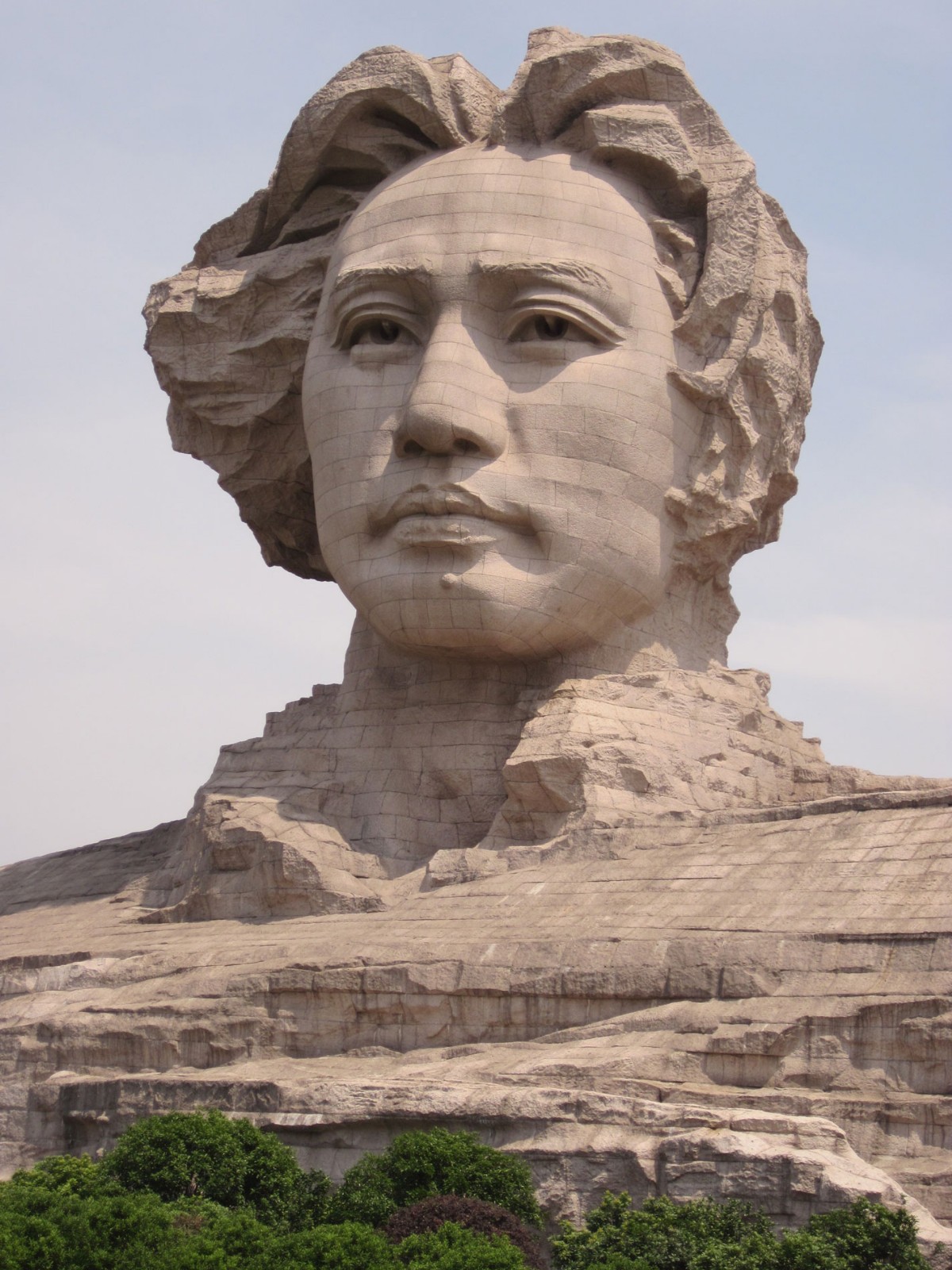
Mao attended the first National Congress of the newly formed Communist Party of China in July 1921. In 1923, the Communist Party allied itself with Sun Yat-sen’s Nationalist Party, also called the Kuomintang, to fight for control in northern China. During a stay in his home town of Shaoshan, Mao realised the potential for organizing revolution in the countryside, where there were millions of peasants. Mao set about training the peasants for rebellion. He had become a full-time revolutionary.
Communism
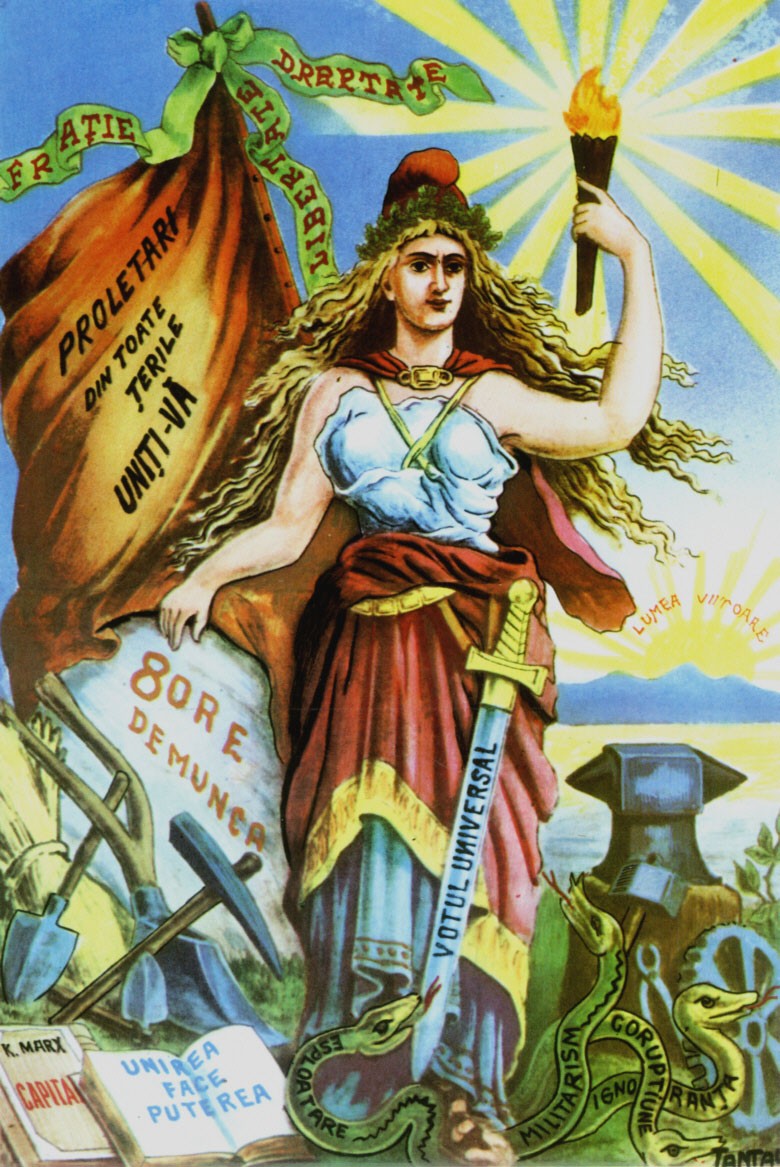
Communism is a society in which all property is owned by the community. In a Communist society, everyone enjoys equal status. The ideas of political thinkers Karl Marx and Friedrich Engels turned Communism into a revolutionary movement. In the 19th century, when they were writing, a tiny minority of people controlled nearly all the wealth in the world: they were the capitalists, the ruling class. The vast majority of people owned very little: they were the working class—those that worked in the factories or mines in industrial countries—or peasants who worked on the land. Communists wanted to see workers' revolutions and the redistribution of wealth into the hands of the working class, called the proletariat. A temporary "dictatorship of the proletariat" would be needed, however, before the establishment of a Communist society.
Red Army
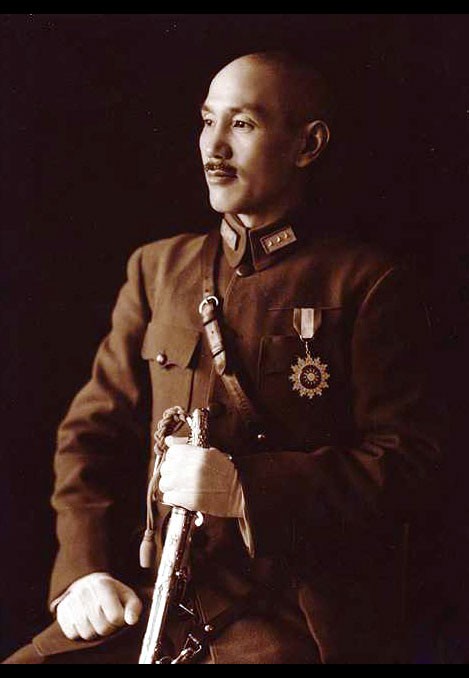
Sun Yat-sen died in 1925, and Chiang Kai-shek took over leadership of the Nationalist Party. He did not trust the Communists, and expelled most of them from the Nationalist Party. In 1926, Chiang Kai-shek set out on the Northern Expedition to overthrow the government in Beijing. In order to fight the Nationalists, the Communists set up the Red Army. Mao, who was now one of the leaders of the Communist Party, retreated to southeastern China with other Communist leaders.
The Long March
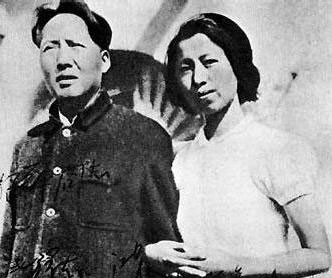
In 1930, Mao’s wife and sister were captured and killed by the Nationalists. Mao married again, this time a young revolutionary named He Zizhen. Mao adopted guerrilla warfare, using small forces to mount surprise attacks on the Nationalists. In 1934, the Red Army started on its famous "Long March" to northern China in order to escape from encircling Nationalist forces. In fact, it was not one long march, but a series of attacks and marches in which thousands died.
During the Long March, Mao gained support and power. By 1935, when the surviving Communist forces were safely in northern China, Mao was leader of the Communist Party. In 1937, Mao divorced his wife and married an actress, Jiang Qing, a year later. She was to play a major part in the Communist Party, and in the Cultural Revolution.
People’s Republic of China
In 1937, the invasion of China by Japanese forces brought the Nationalists and Communists back into alliance against the common enemy. This alliance held throughout World War II, but it broke apart shortly after the end of the war. Once more there was civil war between Communists and Nationalists, but this time the Communists emerged victorious in 1949. Chiang Kai-shek escaped to the island of Taiwan.
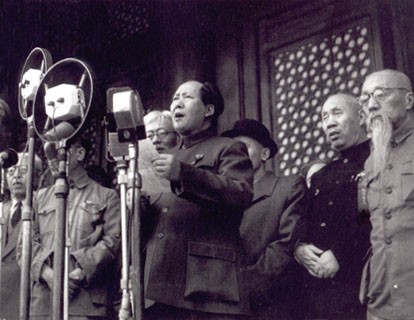
On 1st October 1949, Mao proclaimed the founding of the People’s Republic of China. Mao received assistance and support from China’s Communist neighbour, the Soviet Union, under its leader Joseph Stalin. However, relations were often uneasy between these two Communist giants.
Communist government
Mao and his fellow Communist leaders began to reshape Chinese society. Farmland was taken away from landowners and reorganized into communal farms (a commune is a group of people who live and work together) run by the farmworkers themselves, called collectives. With Soviet help, Mao launched a five-year plan (1953–1958) to increase industrial output.
In 1956, Mao proclaimed a policy of "letting a hundred flowers bloom"—allowing people to express their own ideas and to question the Chinese leadership. But after a few months, Mao completely reversed this policy, savagely turning against anyone who disagreed with the Communist party.
Great Leap Forward
A second five-year plan was launched in 1958. The plan focused on heavy industry such as steel and iron production. Small collectives were merged into much larger communes. Large numbers of peasants were moved directly from farming to industry. When a minister dared to question Mao’s policies, in the summer of 1959, he was removed from office and put in prison.
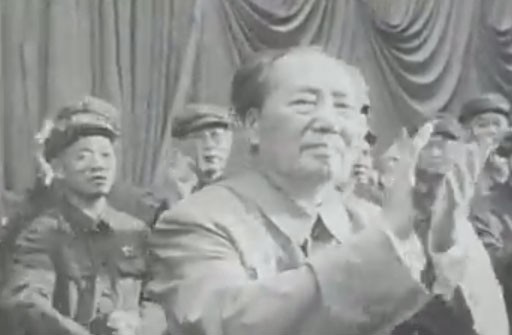
But the Great Leap Forward was a disaster, with the sudden lack of farmworkers resulting in a massive decline in food production that led to widespread famine. Millions of people died. Mao had to accept criticism of his policy from other Communist leaders, such as Liu Shaoqi and Deng Xiaoping.
Cultural Revolution
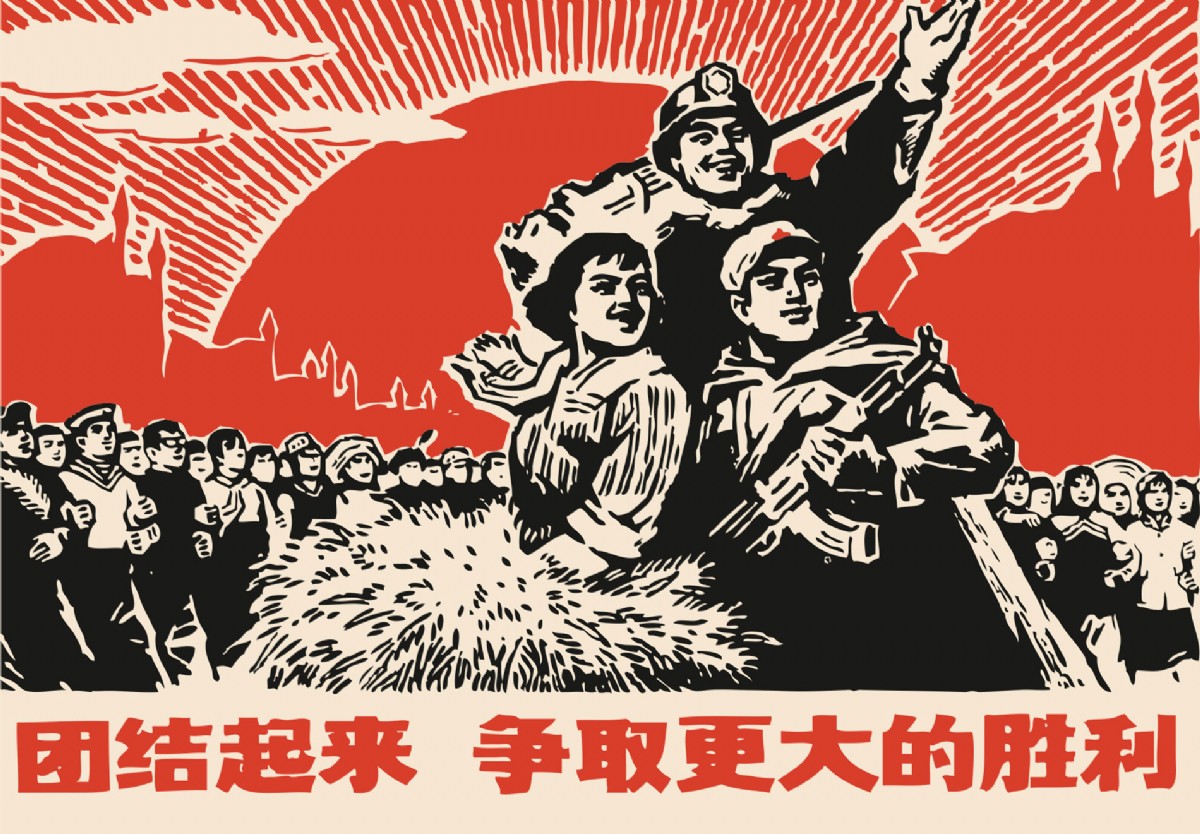
With his authority challenged, Mao launched the Cultural Revolution in 1966. He was encouraged and supported in this by his wife, Jiang Qing. His aim was to get rid of what he called "impure" elements in society. The actual work of the Cultural Revolution was done by groups of young people called Red Guards. Schools and universities were shut down, and the teachers, lecturers and other educated people were forced to go to rural areas for "re-education", doing hard labour in the fields. The policy caused widespread chaos, and brought the Chinese economy to a standstill. More than a million people are thought to have died during this period.
Death of Mao
Mao declared the Cultural Revolution to be over in 1969. As China began slowly to recover, Mao himself became increasingly old and frail. He died on 9th September 1976.
Mao Zedong remains one of history's most controversial figures. His policies resulted in the deaths of millions of people. Yet for many Chinese people he is still the founding father of modern-day China, the man who brought an end to civil war and united the country.
Consultant: Philip Parker
pics
Without in any way limiting Q-files Ltd’s exclusive rights under copyright, any use of this publication to “train” generative artificial intelligence (AI) technologies to generate text is expressly prohibited. Q-files Ltd reserves all rights to license use of this work for generative AI training and development of machine learning language models.