
Jewish history
Holocaust and Jewish state
The beginning of the 20th century saw a rapidly increasing Jewish population, particularly in the Russian Pale of Settlement, an area of western Russia where Jews were concentrated. Suffering from pogroms and poor living conditions, emigration from Eastern Europe especially to North America and Western Europe became a flood, with some 2.75 million Jews on the move between 1881 and 1917. Two major events took place in 1917 which would influence the direction of Jewish history: the Russian Revolution, which ended anti-Jewish laws and slowed the flow of migrants, and the British conquest of Palestine during World War I, which made possible the idea of a Jewish national home. The dark clouds of antisemitism, which continued to plague Jews in Europe at this time, were starting to gather, however.


British Mandate
Zionism, the movement to re-establish a Jewish homeland in Palestine, became more than a dream in the early years of the 20th century. During World War I, Palestine, then part of the Ottoman Empire, was captured by the British from the Ottoman Turks, fighting on the side of the Central Powers. The Jews also received the promise of a "National Home" from the British in the form of the Balfour Declaration on the 2nd November 1917. This aim was included in the Mandate for Palestine, by which Britain was to govern the territory on behalf of the newly-created League of Nations.
In 1923 the British Mandate of Palestine began and several waves of Jewish immigration occurred. The Arab population of Palestine was hostile to increased Jewish immigration, however, and resorted to violent attacks on Palestinian Jews.
Holocaust
Antisemitism continued in Europe throughout the early 20th century, and turned much uglier in 1933 with the rise to power in Germany of the openly antisemitic Nazi Party led by Adolf Hitler. Systematic persecution of Jews proceeded unchecked, with Jews being stripped of their citizenship and barred from many jobs and public places. Concentration camps were built to hold Jews, who, along with Romanies and others, were considered to be “undesirable”. Jewish emigration from Germany increased rapidly after the pogroms of 9th November 1938 (Kristallnacht), when in a single night hundreds of synagogues were burned down and nearly one hundred Jews were killed in the streets.
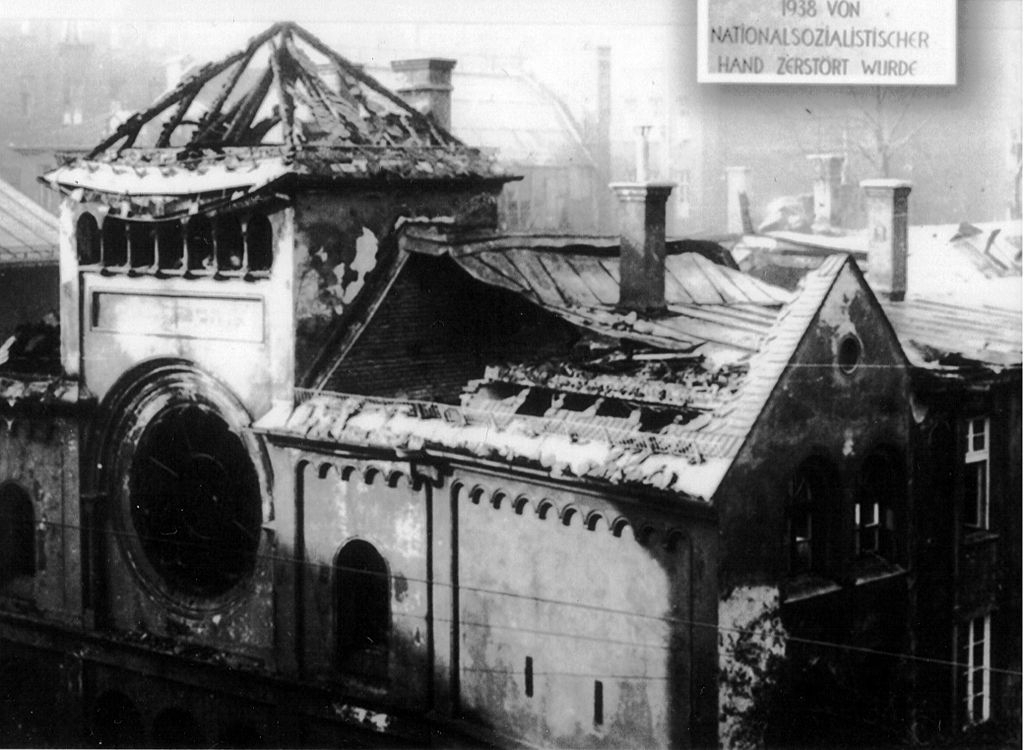

In 1939 World War II broke out. By 1941 Hitler occupied almost all of Europe, including Poland, where millions of Jews were living at that time. In 1941, following the German invasion of the Soviet Union, the “Final Solution” began, an organized operation on a massive scale aimed at the annihilation of the Jewish people. Death camps, such as Auschwitz-Birkenau and Treblinka, were built with the sole purpose of killing Jews.
As new territories were conquered in Europe, Jews were rounded up and shot, forcibly confined in overcrowded ghettos, or transported to death or slave labour camps. In the death camps, men, women and children were forced into gas chambers, where they were killed by a cyanide compound dropped into vents. Not all Jews and other prisoners were killed immediately: many were used as slave labour until they died of exhaustion or disease.

This mass killing, known as genocide, in which approximately 6 million Jews were murdered, is called the Holocaust or, in Hebrew, the Shoah.


Aftermath
The Holocaust took place throughout Nazi-occupied territory of Europe. In Poland, more than a million Jews perished in gas chambers at the Auschwitz-Birkenau death camp alone. The massive scale of the Holocaust, and the horrors it unleashed, was only understood after the end of World War II in 1945. It deeply affected the Jewish nation and world public opinion. Efforts were stepped up, with the United States—now home to almost half the world’s Jews—playing a leading role, to support the Zionist cause and establish a Jewish state in Palestine.
Jewish state
Jewish leaders began organizing the immigration of tens of thousands of Jewish war refugees to Palestine without the approval of the British government, who were opposed to an increase in Jewish migration. Britain decided to withdraw from the Mandate of Palestine and let the newly-formed United Nations decide what to do. On 29th November 1947, the UN General Assembly recommended partitioning Palestine into three: an Arab state, a Jewish state and the City of Jerusalem. The Jewish leadership accepted the decision but the Arabs opposed it. Civil war broke out between the Arabs and Jews in Palestine.


Immediately after the last British soldiers left Palestine, on 14th May 1948 the future first prime minister of Israel, David Ben-Gurion, declared the establishment of a Jewish state in Eretz Israel (Hebrew for “Land of Israel”), to be known as the State of Israel. In an attempt to destroy the new Jewish state, the armies of Egypt, Lebanon, Syria, Jordan and Iraq invaded the territory of the former British Mandate, triggering the 1948 Arab–Israeli War.
The Israel Defence Forces repulsed the Arab armies, and managed to extend Israel's borders beyond the original boundaries for the Jewish state that were proposed in the UN partition plan. By December 1948, Israel controlled most of Palestine west of the Jordan River, except for what became known as the West Bank (which was controlled by Jordan), and the Gaza Strip (controlled by Egypt). Some 711,000 Palestinians Arabs were expelled or fled their homes to become refugees. One third went to the West Bank and one third to the Gaza Strip, the rest to Jordan, Syria, Lebanon and other countries.
Modern Israel
In 1949 the Arab-Israeli war ended. The state of Israel started absorbing the hundreds of thousands of Jews from all over the world, including Holocaust survivors from Europe and Jewish refugees from Arab countries. (Many Jews also emigrated to the US, Australia and Western Europe in large numbers.) Israel's Jewish population continued to grow at a rapid rate for years, fed by waves of Jewish immigration from around the world, including a massive immigration wave of Soviet Jews, who arrived in Israel in the early 1990s.

Israel has been involved in a number of major military conflicts with its neighbours as well as a nearly constant series of Israeli–Palestinian conflicts. Diplomatic efforts involving Israel, Palestinian organizations, Arab countries, the United States and the European Union to bring peace and to reach a solution acceptable to all over the future of the Palestinian people, continue to this day.

Consultant: Philip Parker