
Domestic animals

CITE
We have made every effort to follow citation style rules, but there may be some minor differences. If in doubt, please refer to the appropriate citation style manual.
Cat breeds A-Z. (2022). In Q-files Encyclopedia, Life, Domestic animals. Retrieved from
https://www.q-files.com/life/domestic-animals/cat-breeds-a-z
"Cat breeds A-Z." Life, Domestic animals, Q-files Encyclopedia, 10 Feb. 2022.
https://www.q-files.com/life/domestic-animals/cat-breeds-a-z.
Accessed 13 Sep. 2026.
Cat breeds A-Z 2022. Life, Domestic animals. Retrieved 13 September 2026, from
https://www.q-files.com/life/domestic-animals/cat-breeds-a-z
Life, Domestic animals, s.v. "Cat breeds A-Z," accessed September 13, 2026.
https://www.q-files.com/life/domestic-animals/cat-breeds-a-z


Cat breeds A-Z
Domestic cats are descended from African wildcats (Felis silvestris lybica). They became a domestic species around 8000 BC, in the Middle East. They are little different from wild cats, so they can easily interbreed. The majority of cats kept as pets, including tabby cats, are called domestic cats—sometimes simply "moggies". Those listed below are pedigree cats: their ancestry contains only cats of the same breed. Many pedigree cats are exhibited at cat shows. They are judged on being as close to the physical ideal of the cat breed as possible.


Abyssinian
Abyssinians are a breed of short-haired cat with a unique coat, in which the individual hairs are banded with different colours. The name "Abyssinian" refers to its supposed country of origin, Ethiopia, whose old name was Abyssinia. It was thought British soldiers in North Africa in the 19th century returned home with wildcat kittens purchased from local traders. More recent research, however, suggests that they actually originated near the Egyptian coast. In ancient Egypt, Abyssinian cats were called the "children of the gods". Abyssinians' coats are dark when they are born but gradually lighten as they get older. Each hair is light at the base but then has three or four bands of darker colour going towards the tip.
American Curl
An American Curl's distinctive feature is its back-curling ears. Kittens are born with straight ears, but after approximately 80 days they start to curl back towards the skull. This process should be complete within four months, by which time the ears should be rigid. A judge at a cat show will give a higher score to American Curls that have a greater angle of curl to their ears. However, if the ears touch the skull they will be disqualified. American Curls come in both long-haired and short-haired varieties and require little grooming.


American Shorthair
American Shorthairs can come in a range of different colours and patterns, although the tabby pattern is most common. They are thought to have been descended from European cats brought to North America by early settlers to protect their cargo from rats and mice. Once there, they interbred with other cats and developed hunting and survival skills to help them in their new environment. American Shorthairs are generally low-maintenance cats that are easy-going and sociable with strangers.
Bengal

The Bengal is not a truly domestic breed of cat. It was bred from crossing a domestic cat with an Asian leopard cat. Its large spots and lighter-coloured belly make it look similar to its wild ancestor. A breeder should make sure that at least four generations have passed from the original Asian leopard cat in order for a Bengal to have a suitable temperament for domestic living.
Birman
Birmans are long-haired and have a colour-pointed (dark head, feet and tail) silky coat. They have white “gloves” on each paw. It is thought that they were original companions of the temple priests in Northern Burma (now Myanmar). The legend goes that the Birman's blue eyes come from when a blue-eyed goddess rewarded the temple cat’s love for its priest by turning its yellow eyes to blue. Legend also has it that after the priests died they were reborn in cats' bodies. Birman cats are docile and will follow their owner from room to room. They do not tend to be vocal.


Bombay
The Bombay is a breed of short-haired cat that was created by cross-breeding a sable-coloured Burmese with a black American Shorthair. Nicknamed the "miniature black panther", it is the only recognized cat breed whose only acceptable colour is black. Bombay cats are one of the most sociable cat breeds: they constantly crave the company of others. For this reason they are highly suitable for a family with young children. They are playful, intelligent and attention-seeking.
British Shorthair

British Shorthairs have short, dense coats and large, widely set eyes. They come in a variety of colours but the British Blue Shorthair is arguably the best known. The Cheshire Cat in Lewis Carroll’s Alice in Wonderland is said to have taken its look from this breed. British Shorthairs have become favourites with animal trainers because of their high intelligence. Many have appeared in Hollywood movies and TV commercials. They can even learn simple tricks.
Burmese
A medium-sized breed, Burmese cats have copper-coloured, short-hair coats. They are all descendants from one female cat called Wong Mau, which was brought from Burma to the US in 1930 and bred with a Siamese cat. Although they look light and sleek, they are in fact extremely heavy because of their large amount of muscle. For this, they are sometimes described as "bricks wrapped in silk". They can live much longer than other cats: up to 18 years. Burmese cats are playful and also have a number of dog-like characteristics, such as playing fetch and learning tricks. Like Siamese cats, they are extremely vocal.
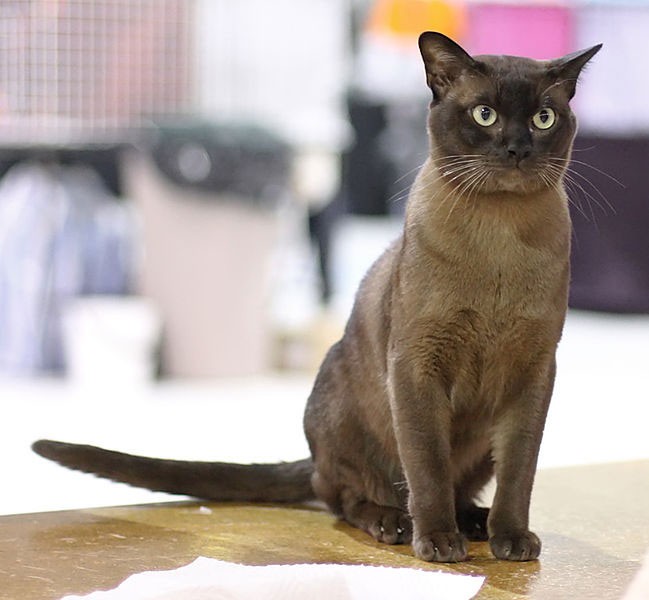

Cornish Rex
Cornish Rex cats have a coat that is extremely fine and sometimes curly. They are often said to be the softest of all the cat breeds. Because of their fine coats, they are best suited for indoor living in warmer climates. They will often settle in warm places such as close to computer monitors and light bulbs. The breed does have one bizarre characteristic: they can sometimes give off a cheesy smell. This is because of scent glands in their paws, which sometimes become blocked if not regularly cleaned.
Exotic Shorthair
The Exotic Shorthair was bred to be a short-haired version of the Persian cat. Its nickname, "the lazy man’s Persian", comes from the fact its coat is easier to care for. The two breeds are very similar in temperament, although the Exotic Shorthair is the slightly livelier. Exotic Shorthairs do not like being left alone and crave the attention of their owner. Many owners will leave the radio on when they go out to comfort their cat.


Himalayan
The Himalayan cat, a long-haired breed, is identical to the Persian, apart from its point coloration—it has a darker head, feet and tail—and its blue eyes. It was created by crossing the Persian with the Siamese. It is named the Himalayan because its colouring is similar to that of other Himalayan animals, for example, the Himalayan rabbit. Because of its Siamese ancestry, it tends to be more active than Persians.
Japanese Bobtail
Japanese Bobtail cats have a "bobbed" tail much like the Manx cat. They are native to Japan and Southeast Asia, and frequently appear in Japanese folklore and art. They come in many colours and patterns. Bobtails are often depicted with their paw raised, for which they are commonly called the "beckoning cat". A Japanese legend tells how a man looked up into the sky to see his cat beckoning to him. Thinking that the animal was delivering a message from the gods, he climbed up to it. Seconds later, the branch where he had been sitting moments before crashed to the ground. This is why Japanese Bobtails are considered bringers of good luck.


Maine Coon
Maine Coons are the largest breed of domesticated cat. They have large bone structure and long, flowing coats. No one knows for sure where the Maine Coon originated from. One theory is that it was the offspring of a wild cat and a raccoon. This is, of course, impossible, although many people still believe that it could be related to the bobcat. This would explain the tufts of hair on the tips of its ears.
The Maine Coon’s fur is water-resistant, making it ideal for harsh, wintry climates. It sometimes curls its long, bushy tail around its face and body for warmth. To help it walk on snow, it has extra large paws with long tufts of hair growing between its toes.
Manx
Manx cats are known for having only a small stub of a tail, or no tail at all. They come in all colours and patterns. The breed first originated in the early 19th century from the Isle of Man, where folklore says they were brought to the island by sea. A local word for the cat is "stubbin". A large proportion of cats on the Isle of Man are still Manx cats. The Manx cat is used on the Isle of Man currency and has also featured on their postage stamps.

There is a myth that the Manx cat is the offspring of a cat and rabbit, which explains why it has no tail and an occasional hopping gait. Despite the absence of a tail, the Manx cat does not seem to have any difficulty with balancing. This is because its sense of balance is controlled primarily by its inner ear, as in other mammals.

Munchkin
The Munchkin is one of the newest breeds of cat. It is characterized by its very short legs. The front ones are generally shorter than the hind ones, which creates a rise from the shoulder to the rump. The legs may also be slightly bowed. Munchkins have often been called "kangaroo cats" because of their tendency to sit on their hind legs. The Munchkins come in a whole range of colours and patterns. Having shorter front legs does not seem to interfere with their running or leaping abilities. The breed has been described as sweet-natured, playful, people-orientated, outgoing and intelligent. They respond well to being handled.
Norwegian Forest
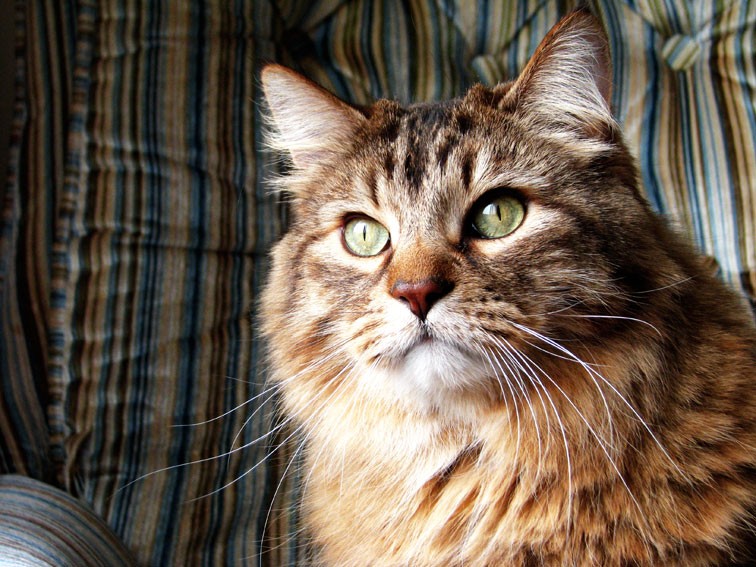
Norwegian Forest cats are native to Northern Europe and are well-suited to cold weather. They have long, glossy topcoats and woolly undercoats for insulation. It is believed that they originated from the breeding of short-haired and long-haired cats that were brought to Norway by Viking traders in around 1000 AD.
Similar in stature to the American Maine Coon, Norwegian Forest cats are big and strong with long legs, bushy tails and sturdy bodies. They are experts at climbing, even up rocky surfaces, and have strong claws. They have plenty of energy too, and can be demanding of attention. The Norwegian Forest cat can become a quick and effective hunter, but it also adapts well to indoor life. Being heavy-boned means it requires more food than most other domestic breeds.
Oriental Shorthair
Oriental Shorthairs are closely related to the Siamese cat. They have many of the same features but come in a wide range of colours and patterns. Oriental Shorthairs are sociable and intelligent. Unlike most other breeds, they prefer to live in pairs or groups.

Persian

Persians are a long-haired breed of cat, known for their round faces and squashed muzzles. These distinctive traits can, however, cause problems with their breathing. It can also affect their teeth, which deteriorate at a faster rate than with other cat breeds. Most cats have dental examinations only a couple of times in their lives, whereas Persians need to have them once a year. Their name refers to Persia (the old name for Iran) where the first cats of this breed were found. Many of the French nobility owned a Persian cat as it was a sign of wealth at the time.
Persian cat can come in a wide variety of colours. Recently it has become quite common to groom the Persian in a "lion cut", in which the body is shaved but the hair is left long around the head, legs and tail, resembling a lion's mane. The Persian has a calm and placid temperament and so is ideal for indoor living.

Peterbald
Peterbalds are a breed from Russia, bred by crossing a Sphynx with an Oriental Shorthair. Although their build is muscular, they are elegant and graceful. Their ears are big in proportion to the size of their heads. Some are born without hair, while those that are born with hair may lose it as they get older. They have a high metabolism and therefore require more food than most other breeds. Cuts and grazes heal quickly in Peterbalds.
Pixie-bob
Pixie-bobs are thought by experts to have originated from the accidental mating of a bobcat and a barn cat in the US state of Washington. Usually quite large in size, they have black fur and skin on the bottoms of their paws, tufts of hair on their ears and white hair around their eyes. The Pixie-bob can tolerate being put on a leash and taken for walks. Frequent head-butting of their owners has also been reported.


Ragdoll
Ragdolls are large and muscular semi-long-hair cats with distinctive, partially darkened coats and blue eyes. They come in six different colours. They are widely known for their docile and affectionate temperament. The breed was so-called because of its tendency to go completely limp when picked up. Some breeders have tried to remove this behavioural trait from the Ragdoll: it is not in the cat's best interests, should it encounter a moving car or a vicious dog.
Russian Blue
Russian Blues have silver-blue, short-haired coats. They usually have green eyes. Some have a small puff of fur above their eyes that slants downwards, giving them a slightly grumpy appearance. Russian Blues first came to Northern Europe in the 1860s when sailors came upon them in the region around Archangelsk on the northern Russia coast. In Russian folklore they are considered good luck charms. Russian Blues are highly intelligent and can be taught to do simple tricks.

Scottish Fold

Scottish Folds are known for their folded ears: they bend forwards and down towards the front of the head, giving the cat an “owl-like” appearance. The cats were originally called "lops” after the lop-eared rabbit. They can still swivel their ears to hear noises around them. Like American Curls, all Scottish Folds are born with straight ears; they usually start to fold within 21 days. Some are now bred to have double, or even triple, folds in their ears. This causes the ears to lie completely flat against their heads.
Scottish Folds are known for sleeping on their backs, which is highly unusual for a cat. They also tend to sit with their legs stretched out and paws resting on their bellies: the "Buddha Position".
Siamese
Siamese cats are a very recognizable breed of Oriental cat. Their blue, almond-shaped eyes, large ears and triangular-shaped heads characterize the breed. They have muscular and slender bodies. The pointed pattern of the Siamese cat (darker snout, feet and tail) is caused by the darkening of the coat in the coolest parts of its body. Siamese kittens are born pure cream or white, with the darker coloration becoming clearly visible by four months old. Because the darkening is related to temperature, those living in warmer climates have lighter coats than those from cooler climates.
Very affectionate, Siamese cats will often bond closely with people. They are highly vocal, with their loud calls sounding like the cries of a newborn baby. Compared to other breeds, Siamese are more dog-like in behaviour: they can even play fetch.


Snowshoe
The Snowshoe cat is a breed from the US, produced from crossing an American Shorthair with a Siamese. The breed is rare because of the difficulty in reproducing the correct coat markings that the breed is known for: white markings on the feet (after which the Snowshoe is named) and an upside-down, white “V” on its face running from the forehead down across its muzzle. Its coat comes in many different colours, but must exhibit the distinctive darker patches that the Siamese has.
Sokoke
Sokoke cats are bred from the wild cats of Kenya, and are one of the rarest breeds in the world. They have long, thin bodies with long legs. As with wild cats, their back legs are longer than their front ones. They have blotchy, striped, short-haired coats, similar to the common tabby. Perhaps because of their recent wild origins, they have a fascination with water and will readily walk through puddles or swim across streams.

Sphynx

Sphynx cats are known for their lack of fur—although they are not completely hairless. A fine layer of down covers their entire bodies, so they can have a variety of colours and patterns. They may have whiskers, although it is usual for them to be absent. As they have almost no coat, Sphynxes do lose heat quicker than other breeds. This makes them excellent lap cats as they love to be petted. The lack of a coat does not make the Sphynx easy to groom, however. Body oils that would normally be absorbed by a cat’s hair tend to build up, so regular bathing is necessary. Exposure to the sun must be limited since they can develop sunburn and skin damage in much the same way as humans.

Toyger
Toyger cats are the result of breeding tabby cats in order to make them resemble “toy tigers”, as the name suggests. The breed was created in order to inspire people to care about the conservation of tigers in the wild. It is not just the markings that make the Toyger look like a miniature version of its much larger relative. Its long, deep body has the low-slung, powerful look of the tiger, along with big bones and high shoulders that give it a tiger-like, rolling gait.
Turkish Angora
The Turkish Angoras is one of the oldest of all cat breeds, originating in the Ankara region of Turkey. The breed has a long, silky coat and an elegant body. It is known for being primarily white, but it can come in many other colours. One defining characteristic is that its tail is often carried upright.
The Turkish Angoras is a playful and intelligent cat. It will often seek out a high position to gain a wider perspective on its surroundings. As in many predominately white breeds with blue eyes, there is a higher risk of blindness so it may need more care than other cats. It sometimes has one eye a different colour to the other. The presence of a blue eye can mean that the cat is deaf on that same side.

pics
Without in any way limiting Q-files Ltd’s exclusive rights under copyright, any use of this publication to “train” generative artificial intelligence (AI) technologies to generate text is expressly prohibited. Q-files Ltd reserves all rights to license use of this work for generative AI training and development of machine learning language models.