
EASY READ The animal kingdom

CITE
We have made every effort to follow citation style rules, but there may be some minor differences. If in doubt, please refer to the appropriate citation style manual.
EASY READ What are amphibians?. (2026). In Q-files Encyclopedia, Life, EASY READ The animal kingdom. Retrieved from
https://www.q-files.com/life/easy-read-the-animal-kingdom/easy-read-what-are-amphibians
"EASY READ What are amphibians?." Life, EASY READ The animal kingdom, Q-files Encyclopedia, 23 Mar. 2026.
https://www.q-files.com/life/easy-read-the-animal-kingdom/easy-read-what-are-amphibians.
Accessed 26 Jul. 2026.
EASY READ What are amphibians? 2026. Life, EASY READ The animal kingdom. Retrieved 26 July 2026, from
https://www.q-files.com/life/easy-read-the-animal-kingdom/easy-read-what-are-amphibians
Life, EASY READ The animal kingdom, s.v. "EASY READ What are amphibians?," accessed July 26, 2026.
https://www.q-files.com/life/easy-read-the-animal-kingdom/easy-read-what-are-amphibians


What are amphibians?
Frogs, toads, salamanders and newts are all amphibians. Most amphibians have smooth, moist skin and live in or close to water. They hatch from eggs laid in water. They breathe and feed under water until they become adults. Their bodies change and they develop lungs, allowing them to live out of the water and breathe air. Frogs and toads lose their tails and grow legs when they become adults, but newts and salamanders simply grow larger.

Frogs


Frogs have long legs. These help them make huge leaps and swim quickly. Adult frogs are carnivorous: they feed on insects, snails or worms. Larger frogs will also eat fish, other frogs and even small mammals. Frogs have small lungs. When under water, they take in oxygen through their skins. They need to keep their skins moist in order to do this.
Some small kinds of frog live in trees. They have pads on their toes that help them to grip on to leaves. A few kinds have large webbed feet. These act like tiny parachutes, which help the frogs glide between trees.


Frog spawn
Frogs lay their eggs in ponds or streams. The eggs, or spawn, look like clumps of jelly. The black “dots” are the embryos. The babies that hatch out look very different from their parents.

Tadpoles
The baby frogs, known as tadpoles, look like little fish with big heads and wriggly tails. Like fish, they breathe with gills. They feed on microscopic plants in the water. After two months, the tadpoles grow back legs and lungs. They lose their gills. To breathe, they come to the water’s surface. A month later, their front limbs appear and their tails start to shorten.
Young adult
Four months after hatching, a young frog’s eyes have grown bigger and its mouth is much wider. Instead of plants, it feeds on tiny creatures. About a centimetre (under half an inch) long, the frog has lost its tail and is now ready for its adult life on land. It will be ready to breed itself when it is four years old.

Toads

Toads have short legs, a fat body and lumpy skin. They live mostly on land, in dark, damp places to keep their skins moist and cool. Toads crawl or hop rather than leap.

Salamanders
and newts
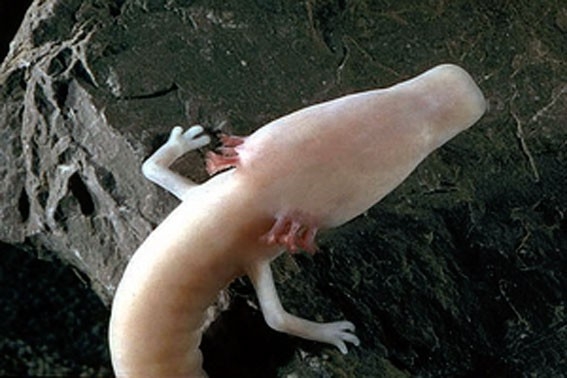
Salamanders are long-bodied amphibians with long tails. They feed on insects, worms, slugs and snails. Some also prey on tadpoles. Some salamanders live in water all the time. The axolotl and the olm even keep their gills into adulthood. Many species are brightly coloured to warn predators they are poisonous. Newts are salamanders with long, flattened tails.
Consultant: Chris Jarvis
Ready to find out more?
Here are some pages in other parts of Q-files you might like to explore:
Amphibians
Frogs
Salamanders and newts
Toads
Amphibians A-Z
pics
Without in any way limiting Q-files Ltd’s exclusive rights under copyright, any use of this publication to “train” generative artificial intelligence (AI) technologies to generate text is expressly prohibited. Q-files Ltd reserves all rights to license use of this work for generative AI training and development of machine learning language models.