
Age of Dinosaurs
Jurassic Period
The Jurassic was the middle period of the Mesozoic Era, the Age of Dinosaurs. It extended from 201 to 145 million years ago. As the Jurassic began, the supercontinent of Pangaea began to break apart. Warm winds blew across the shallow seas, making the climate much wetter than before. Dense vegetation grew rapidly in the swampy lowlands, providing a rich source of food for all plant-eating dinosaurs. New groups of dinosaurs evolved to take full advantage of this plentiful food supply, including the sauropods, which would become the dominant plant-eaters of the Late Jurassic, and the ornithischians, which would dominate in the Cretaceous. Larger, more powerful meat-eaters emerged at the same time. The first birds appeared in the Jurassic Period.
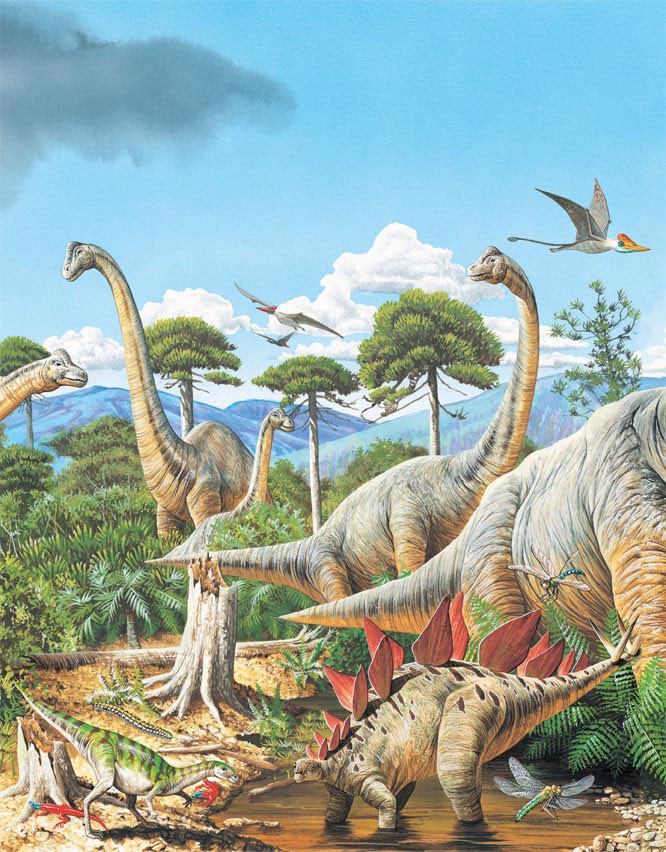
Jurassic world
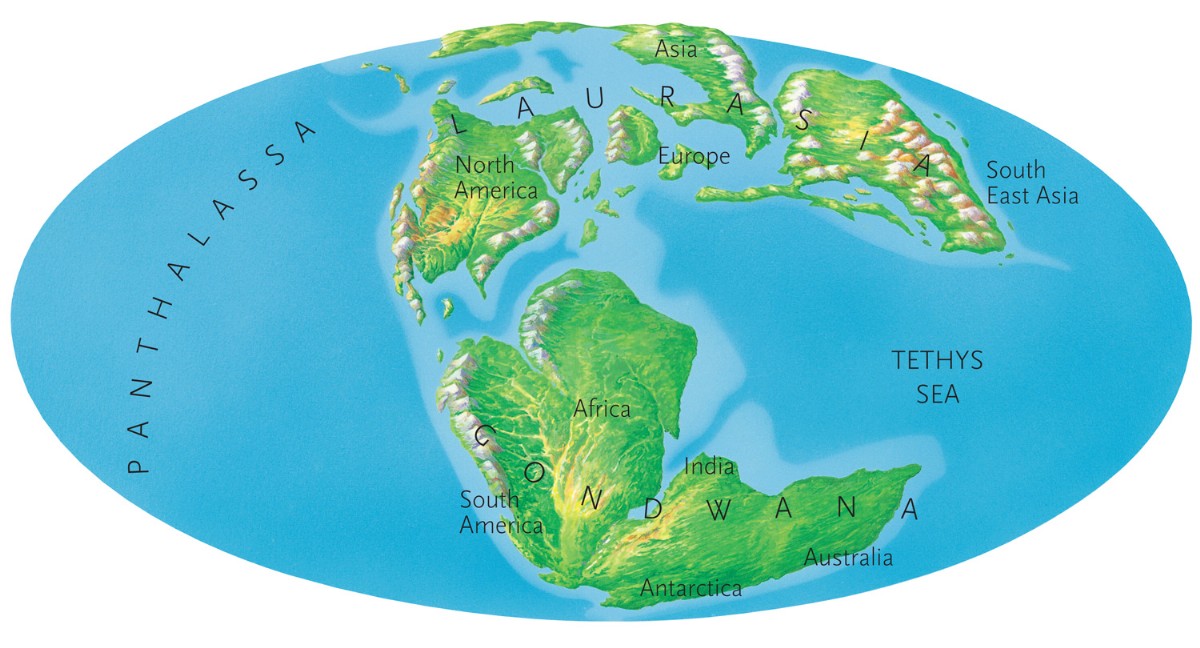
During Jurassic times, the supercontinent of Pangaea began to break up and drift apart. The northern part, Laurasia, was separated into smaller continents and islands by rising seas. Gondwana in the south remained one large supercontinent. As the continents gradually shifted position, so the climates started to change, turning wetter in many regions. Sea levels rose, causing widespread flooding of low-lying lands. Plants, especially conifers, became more abundant, providing a rich source of food for ever-larger species of dinosaur.
Sauropods
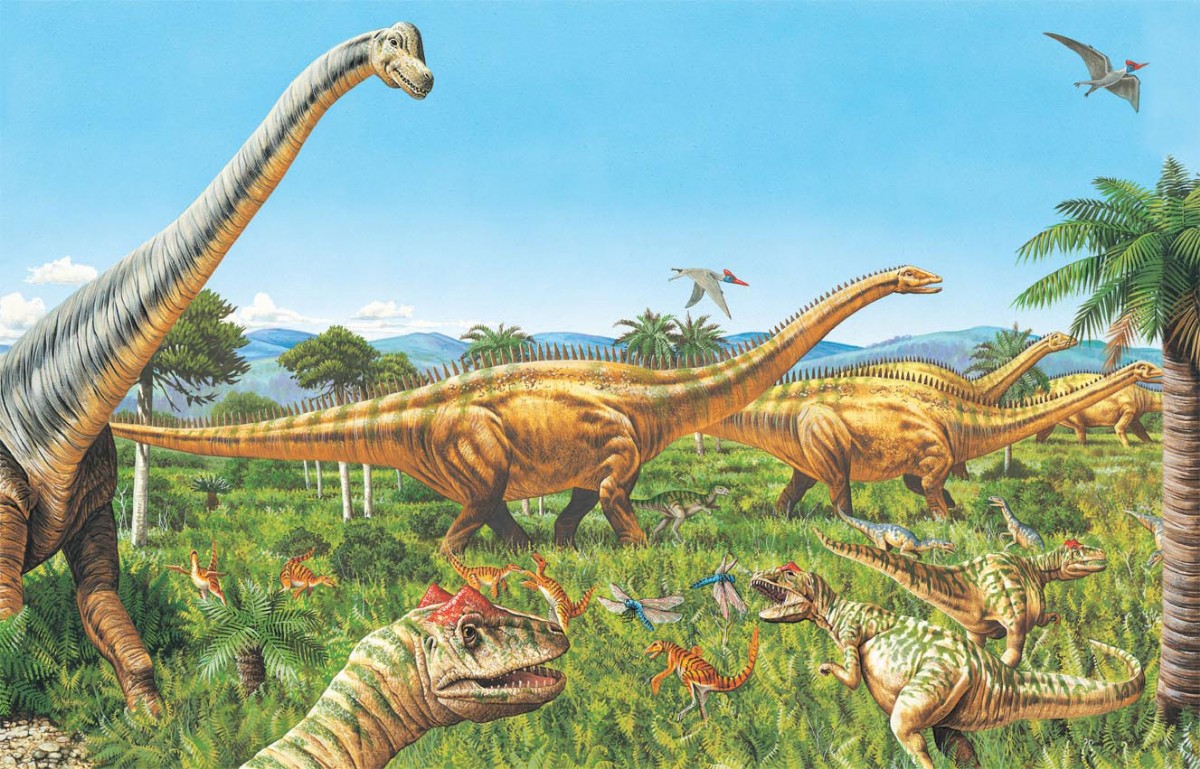
A new type of dinosaur evolved to take full advantage of this plentiful food supply: the sauropod. Sauropods took over from prosauropods as the dominant plant-eaters, culminating in such giants as Diplodocus and Brachiosaurus, among the longest and largest land animals that have ever lived. These enormous creatures, measuring more than 20 metres (65 feet) long, walked on four, pillar-like legs, and had very long necks with equally long, whip-like tails to balance them. Their teeth, shaped like pegs (in Diplodocus), chisels (in Brachiosaurus), or spoons (in Cetiosaurus and Camarasaurus), were perfectly designed for tearing off leaves from trees.
Theropods
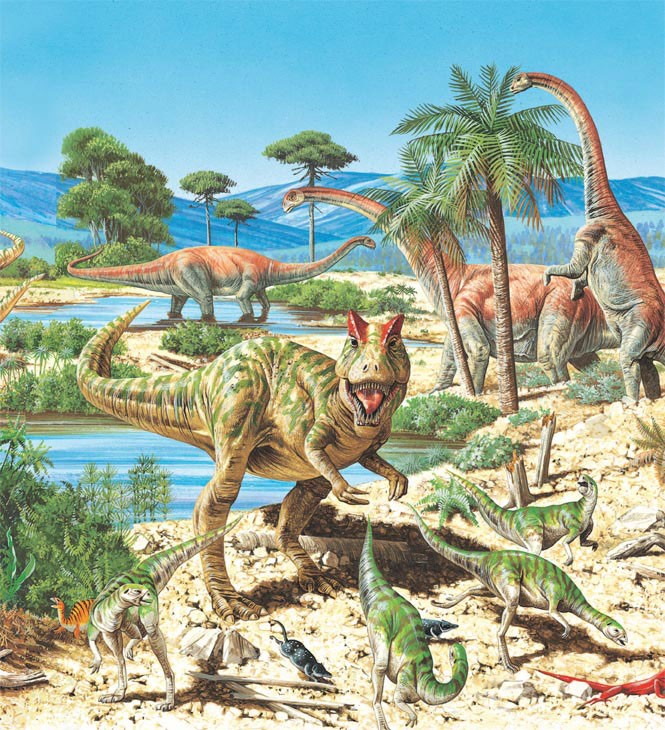
As the sauropods became larger and more numerous, so the meat-eating theropods became more powerful hunters, capable of bringing down a large sauropod, either individually or hunting in packs. Megalosaurus, from Jurassic Europe, was about 9 metres (30 feet) long. Equipped with powerful jaws, it was able to attack even quite large sauropods.
Top predator in North America at the same time was 11-metre (36-foot) Allosaurus. It may have hunted in packs to attack Diplodocus. Any prey trapped in its backwards-curving teeth would have found it hard to escape.
Prosauropods
The prosauropods, which first emerged in the Triassic, survived on into the Jurassic, before sauropods became the dominant plant-eaters. They had long necks and tails, bulky but light bodies, slender limbs and narrow, tiny heads. Massospondylus was typical of its kind. It spent most of its time eating, roaming the forests in herds and rearing up on its hind limbs to browse on leaves in higher branches, using its serrated front teeth to crop them. It swallowed stones to help grind up the tough plant material inside its stomach.

Defence
To defend themselves against big predators, some plant-eaters developed weapons of their own. Stegosaurus, a 9-metre (30-foot) slow-moving dinosaur from North America, had a double row of diamond-shaped bony plates running the length of its back. It also possessed several long spines at the end of its tail, with which it could lash out at its attacker.
The sauropods—simply too big for all but the largest predators—may have protected their young or weak by staying close together in herds, or used their whip-like tails to fend off attackers. Scelidosaurus was protected by bony plates called scutes, studded with parallel rows of spikes. These covered the animal’s neck, back, sides and tail. Even its head has armour made of scutes.

Birds
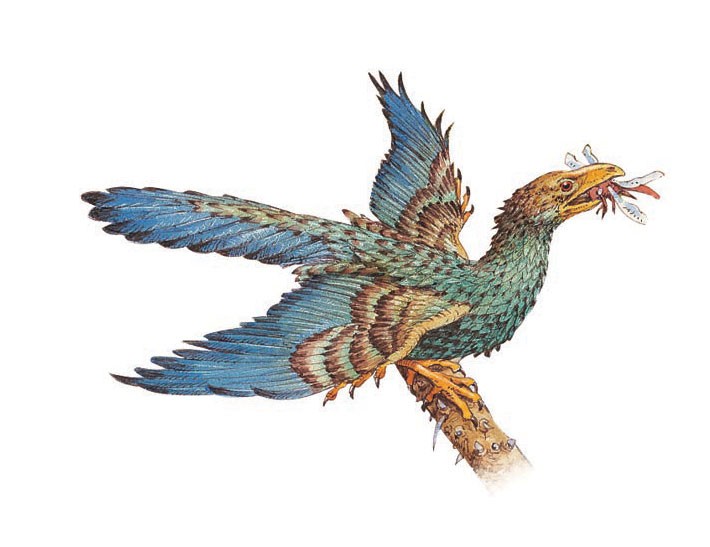
Birds originated during the Jurassic Period. The earliest birds were, nearly all palaeontologists now agree, descended from feathered theropod dinosaurs. Archaeopteryx, which lived in Jurassic Europe about 150 million years ago, had features which belonged to both birds (feathers, wings and the ability to fly, or at least glide) and dinosaurs (teeth, clawed hands and feet and a long, bony tail). Its fossils come from Late Jurassic rocks in southern Germany. The amazing details in these fossils show the impressions made by its delicate feathers.

Archaeopteryx was a maniraptor (raptor for short, a group of small, feathered theropods that include the dromaeosaurs, such as Deinonychus and Velociraptor, and oviraptorids, such as Oviraptor. It lived at the same time and in the same place as Compsognathus, another tiny theropod, although the two creatures were not closely related.
Other very bird-like dinosaurs include Anchiornis, Xiaotingia and Aurornis. They lived in what is now China 160 million years ago (10 million years earlier than Archaeopteryx).
The emergence of ornithischians

The Jurassic saw the emergence of a new kind of dinosaur. The sauropods and theropods were saurischian, or lizard-hipped, dinosaurs. Now a new group, the ornithischians, or bird-hipped dinosaurs, evolved. Unlike the sauropods, many ornithischians were equipped with the ability to chew their food, these plant-eaters quickly multiplied, taking advantage of the ever-increasing variety of plants found in the late Jurassic environment.
Jurassic ornithischians included Stegosaurus and the early ornithopods, a group of bipedal (two-legged) grazers including Dryosaurus and Camptosaurus.

Africa
Some of the biggest Jurassic dinosaurs lived in Africa. One was Giraffatitan, a brachiosaurid. About 25 metres (82 feet) long, it weighed more than 10 elephants. With its long front legs and towering neck, it stood 13 metres (43 feet) tall. Giraffatitan had small, chisel-shaped teeth to chop leaves off conifer trees and the lower, pineapple-shaped trees called cycads.
A much smaller African dinosaur, but very difficult to attack, was Kentrosaurus. Strong bony plates stuck up from its back, and bony points from its tail. With sharp spikes at its tip, this dinosaur’s tail was a dangerous weapon. Kentrosaurus was about the size and weight of a large family car. It belonged to the group called plated dinosaurs, or stegosaurs. Like Giraffatitan it was a plant-eater, but it could only reach plants growing very near the ground.
Antarctica
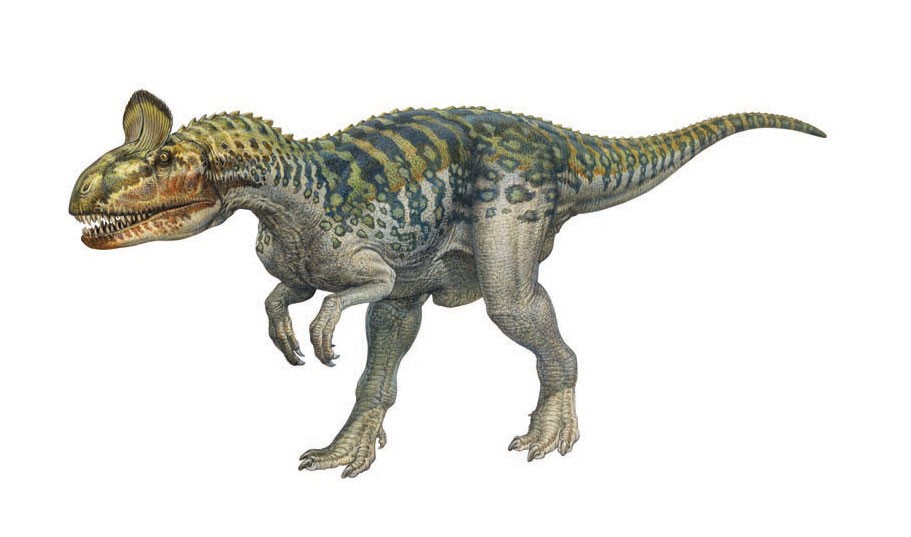
Antarctica is today almost completely covered with thick ice. In Jurassic times, it was warm land blanketed with temperate forests. Cryolophosaurus (“cold crest lizard”) was a 6–7-metre (20–23-foot) theropod that stalked Antarctica at the time. It had a distinctive bony crest on its head.
Consultant: Chris Jarvis