
Aircraft
Airports
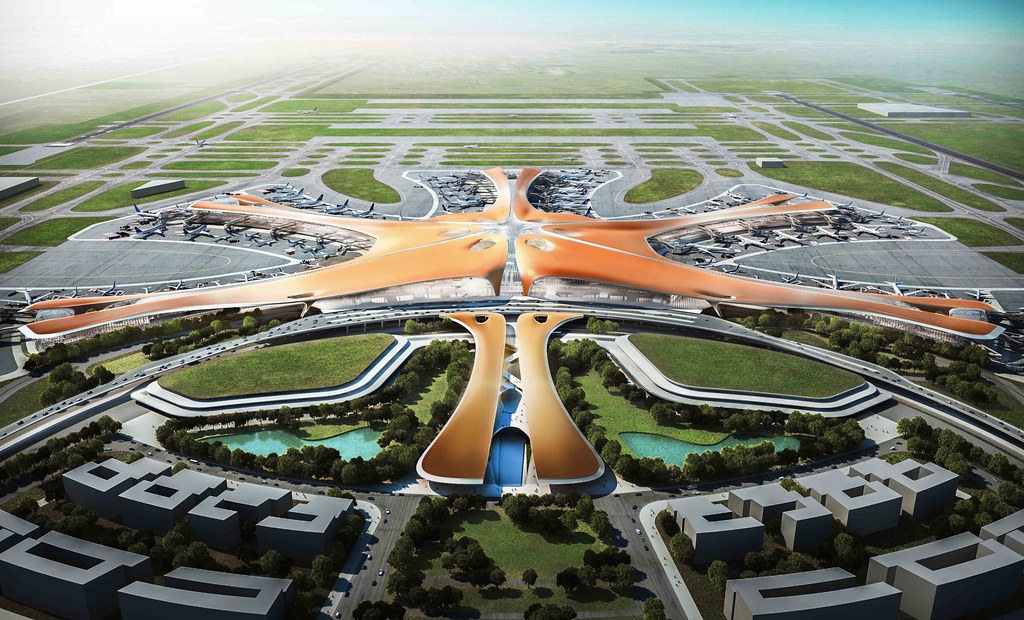
An airport is a place where airliners and other passenger aircraft take off and land. It includes at least one runway along with a terminal building, control tower and aircraft hangars. Large airports often have several terminals, or one that is connected via walkways to different concourses—areas that provide access to the planes. A large airport employs thousands of people. Air traffic controllers work in a control tower, directing all planes to and from runways and deciding when it is safe to take off or land. They have radar equipment to keep watch over the airspace around the airport. Baggage handlers load and unload luggage from the aircraft. Once passengers have disembarked, ground crew prepare the aircraft to fly out again, and refuel it while firefighters stand by.

Airport terminal

Passengers arrive at an airport terminal either to make a flight (departures) or on an incoming flight (arrivals). Some passengers arrive on a flight and depart for another destination on a connecting flight. Departures passengers go first to check-in to drop off luggage. They then go through security where officers use X-ray equipment to check passengers for bombs, guns or other weapons. When their flight is ready, passengers go to the gate and transfer to their plane.
Arrivals passengers collect their luggage from a circular conveyor belt called a carousel in the baggage claim area and go through customs, where officials check that they are not carrying drugs, or goods that require tax to be paid. International passengers must also pass through immigration where they show their passports and any visas that are required.

Preparations for departure
Before an airliner takes off, the ground crew gets to work. The aircraft is refuelled from a tanker, while firefighters stand by. Various vehicles arrive to replenish food, drinks and water supplies. Lavatories are refilled with water and disinfectant.
Luggage checked in at the airport terminal is carried by moving belt to the bag room. Here it is placed in containers and taken to the aircraft for loading by baggage handlers. The containers are loaded aboard using a loading platform that can be raised up to the level of the hold. Following last-minute checks to the airliner’s instruments and controls, it is ready for take-off.


Airport layout
The area where aircraft park next to a terminal to load passengers and baggage is known as a ramp (also known as, incorrectly, "the tarmac"). Parking areas for aircraft away from terminals are called aprons. Once loaded with passengers, the aircraft run (taxi) along the taxiway to the beginning of the runway, from where they take off.
Runway
A runway is an area on prepared for the landing and takeoff of aircraft. It is normally made of asphalt, concrete, or a mixture of both. Runways are named by a number between 01 and 36, representing the compass direction in which that runway points. For example, a runway numbered 09 points east (90°), while one numbered 27 points west (270°). A runway is normally used in both directions, and so it is named for each direction separately. At sea level, a runway of around 3000 metres (10,000 feet) long is considered an adequate length for any aircraft.

Markings across the runway showing the beginning and end of the space for landing and take-off are known as runway thresholds. Overrun areas are constructed at the end of runways as emergency areas to stop planes that overrun the runway, when a landing or take-off go wrong for whatever reason.
Air travel

Air travel has grown enormously since World War II. Until then, only the wealthy travelled by air. The development of the jet airliner in the 1950s made it possible for everyone to fly to destinations across the world. Air routes now link all major cities.
The world’s busiest airport is Hartsfield-Jackson Atlanta International Airport in the United States, with an average of one take-off or landing every 33 seconds and more than 100 million passengers a year. Many of these flights are for people travelling within the United States—about 85% of people travelling long distance within the United States go by air. Dubai International Airport handles more international traffic than any other airport, with more than 87 million international passengers a year.
Consultant: Chris Oxlade