
Road transport

CITE
We have made every effort to follow citation style rules, but there may be some minor differences. If in doubt, please refer to the appropriate citation style manual.
Bicycles. (2026). In Q-files Encyclopedia, Technology, Road transport. Retrieved from
https://www.q-files.com/technology/road-transport/bicycles
"Bicycles." Technology, Road transport, Q-files Encyclopedia, 13 Mar. 2026.
https://www.q-files.com/technology/road-transport/bicycles.
Accessed 5 Nov. 2026.
Bicycles 2026. Technology, Road transport. Retrieved 5 November 2026, from
https://www.q-files.com/technology/road-transport/bicycles
Technology, Road transport, s.v. "Bicycles," accessed November 5, 2026.
https://www.q-files.com/technology/road-transport/bicycles


Bicycles
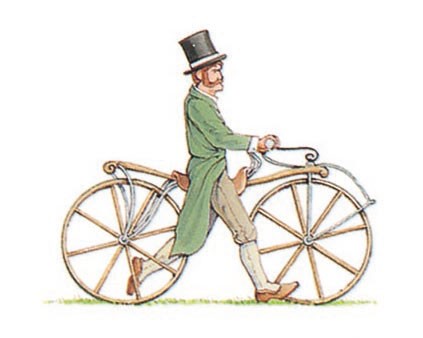
A bicycle is a human-powered vehicle with two wheels. The first bicycle, described by its inventor, Baron von Drais as a "running machine", appeared in 1817. The draisienne, sometimes called a "dandy horse" or “hobby horse”, had no pedals; instead, riders pushed along the ground with their feet. It was the fastest land vehicle of its time. Later in the 19th century pedal-powered bicycles were introduced. The first recognizably modern bicycle, with a lightweight frame, rubber tyres and a chain to drive the wheels, appeared in the 1880s.
History of bicycles
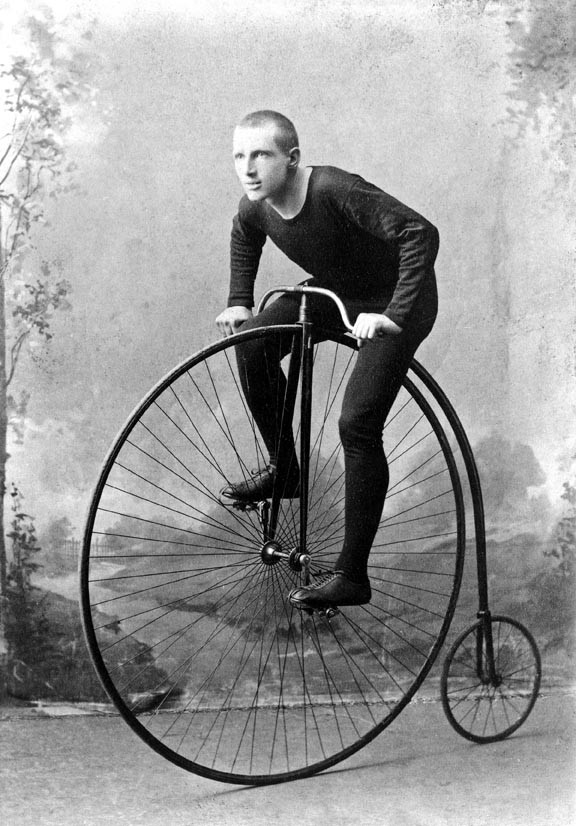
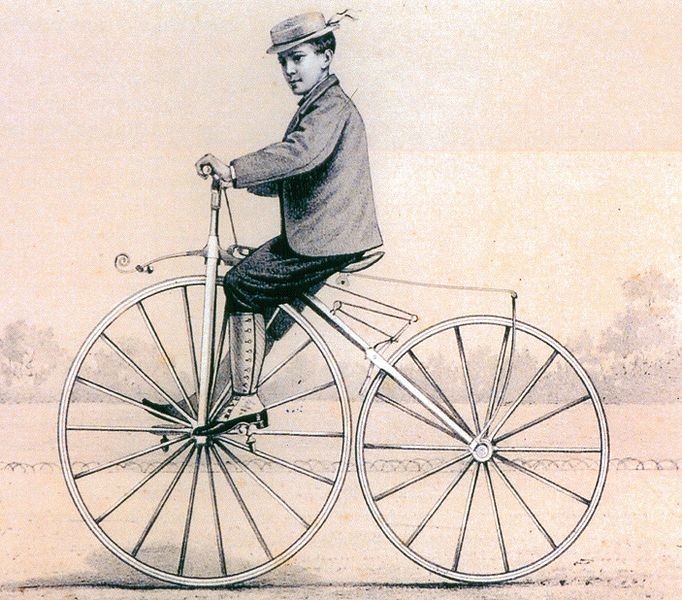
The first pedal-powered bicycle was made by Scottish blacksmith Kirkpatrick Macmillan in 1839. It had pedals connected with rods to the back wheel. In 1861 in Paris, Pierre Michaux built a bicycle made of iron and wood in which the pedals turned the front wheels. The vélocipède, as it was known, was the first popular bicycle. A later type of vélocipède had a steel, hollow-tube frame, wire-spoked wheels and solid rubber tyres. This was called an "ordinary bicycle", but popularly became known as the Penny-farthing because of its vastly different-sized wheels (the huge front wheel was designed to improve the machine's speed).
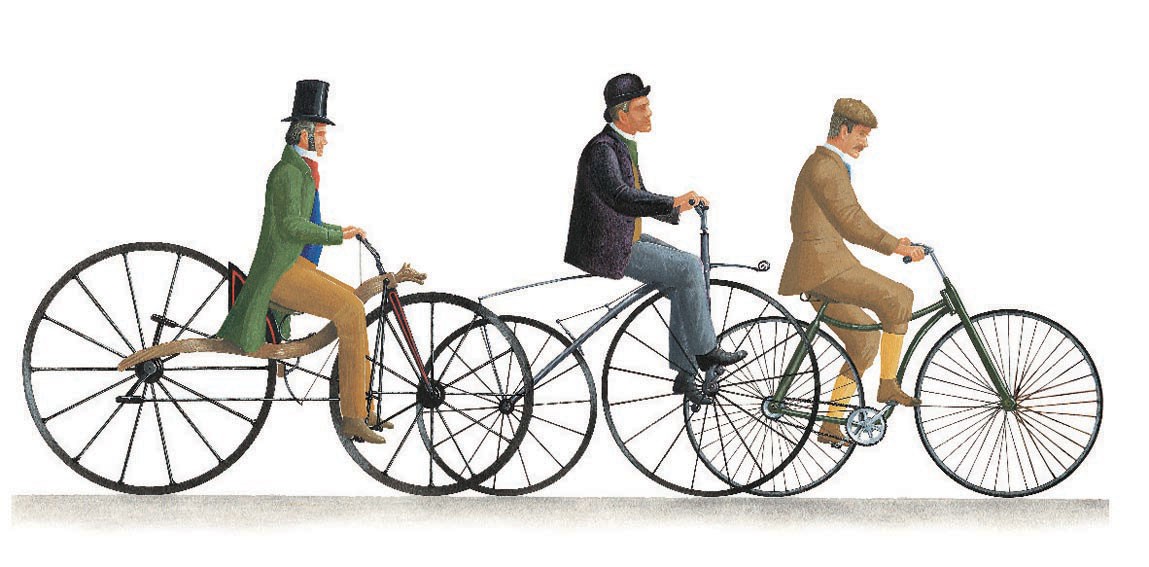
Early bicycles, with their solid wheels, were called “boneshakers”, because they gave people a bumpy ride. Having to pedal and steer the front wheel also made cycling hard work. English inventor John Starley (1854–1901) solved the problem in 1885 with the Rover safety bicycle, which had equal-sized wheels and a chain-driven back wheel. A double-triangle diamond-shaped frame was added shortly afterwards. John Boyd Dunlop, a Belfast vet, introduced air-filled tyres in 1888, giving the new bicycle a much smoother ride.

Parts of a bicycle
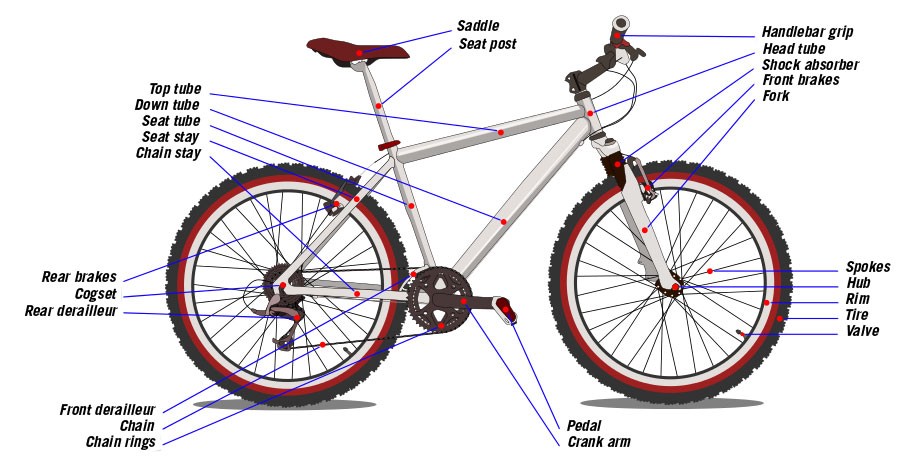
Most bikes have a frame with upright seating—just like the first chain-driven models. They have double-triangle diamond frames. The head tube, part of the front triangle, contains the headset, inside which there is a set of ball bearings that allows the front fork to turn smoothly when steering. The pedals rotate the cranks, which are connected to the front sprocket, or cog. A chain connects this to the rear sprocket, which is attached to the rear wheel. Teeth in both the sprockets teeth fit into the gaps in the chain links. Turning the pedals therefore turns the rear wheel, moving the bike forwards.

Gears
Bikes have more than one rear sprocket, each with different numbers of teeth. These are the bike's gears. The largest rear sprocket is the low gear. A single turn of the front sprocket may only turn the rear one twice: the bike does not move forward much, but pedalling takes less effort. In a higher gear, the rear sprocket is smaller. A single turn of the front sprocket turns this one, say, three times: the bike moves forwards further, but pedalling becomes more of an effort. Changing gear allows the cyclist to keep his or her pedalling speed and effort constant. A cyclist uses a low gear when cycling uphill, a medium gear when cycling on a flat road and high gear when cycling downhill.
In the dérailleur system, there is a device on the handlebars to select a gear and another on the chain to move it sideways from one sprocket to another to change gear.
Ball bearings
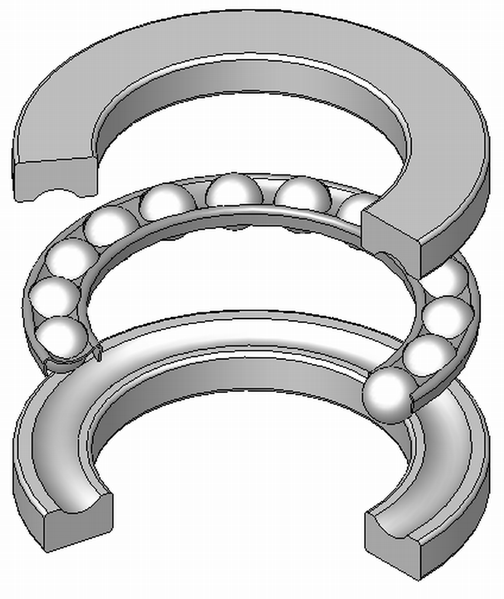
Ball bearings play a vital role in bicycle design. They reduce friction where one part of the machine moves against another—for example, in the head tube, where the handlebars connect to the front fork. A set of metal balls fit neatly into two ring-shaped parts: an outer race and an inner race. As the outer race rotates around the fixed inner one (connected to a shaft), it causes the balls to roll around inside. Each ball spreads out the wear across its entire surface, which is therefore much less than if it were two flat surfaces sliding against each other.
Sports bicycles
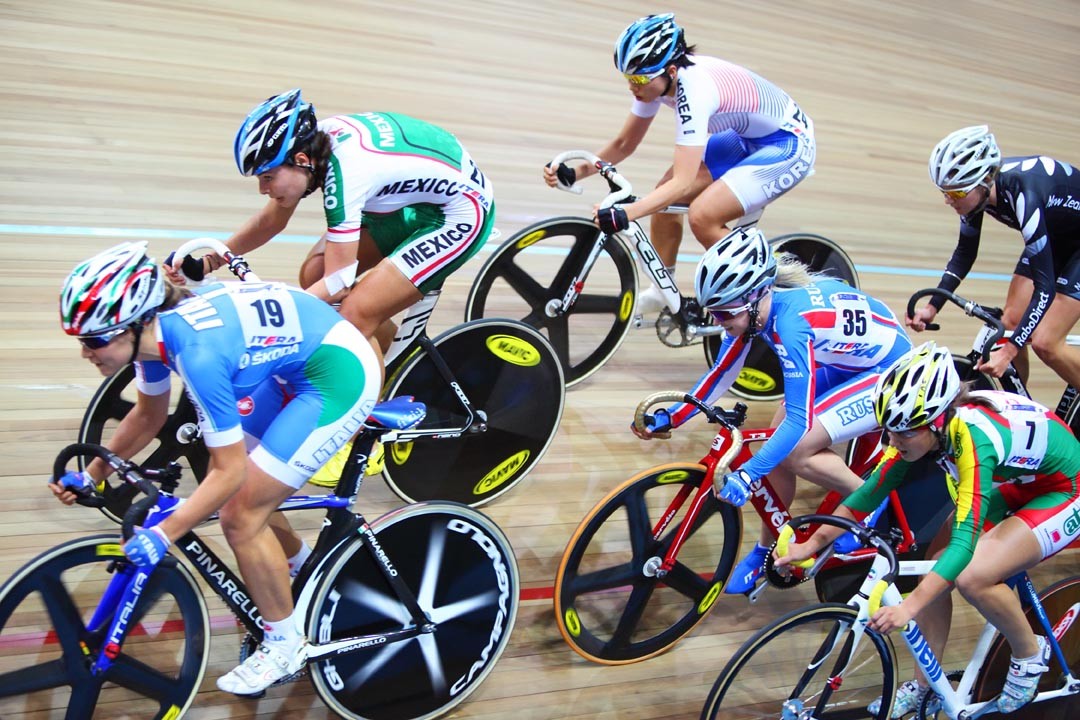

Modern pursuit bicycles used in track races have solid rear wheels. This enables the rider to go even faster: they average speeds of more than 50 km/h (30 mph) over 4-kilometre (2.5-mile) distances. In a recumbent bicycle, the rider leans back on a support and operates pedals set at about about the same level as the seat. The current speed record is 144.17 km/h (89.58 mph), set by Todd Reichert of Canada in 2016.
Other sports bicycles include road bikes, also called racing bikes, which are designed for competitive road cycling. Their drop handlebars are lower than the saddle to put the rider in an aerodynamic posture, while the front and back wheels are close together to give quick manoeuvring. Mountain bikes, cyclo-cross bikes (for races in which riders dismount to navigate obstacles) and cycle speedway bikes (for races on oval dirt tracks) are all designed for racing off-road.
E-bikes
An electric bicycle, or e-bike, is a motorized bicycle. It is fitted with an electric motor used to assist propulsion, powered by rechargeable batteries. There are two types: e-bikes that assist the rider's pedal power (also known as pedelecs) and e-bikes that add a throttle (accelerator) but can still be pedalled by the rider. E-bikes typically have top speeds of between 25 and 32 km/h (16–20 mph), but some can top 45 km/h (28 mph).
The first bicycles fitted with a hub motor, a motor into the hub of the wheel, appeared in the 1890s, but they did not become popular until the 2000s. Hub motors are the most common in modern designs. The stator is fixed to the axle while the magnets are attached to and rotate with the wheel.

Consultant: Chris Oxlade
pics
Without in any way limiting Q-files Ltd’s exclusive rights under copyright, any use of this publication to “train” generative artificial intelligence (AI) technologies to generate text is expressly prohibited. Q-files Ltd reserves all rights to license use of this work for generative AI training and development of machine learning language models.