
Road transport

CITE
We have made every effort to follow citation style rules, but there may be some minor differences. If in doubt, please refer to the appropriate citation style manual.
Early history of cars. (2026). In Q-files Encyclopedia, Technology, Road transport. Retrieved from
https://www.q-files.com/technology/road-transport/early-history-of-cars
"Early history of cars." Technology, Road transport, Q-files Encyclopedia, 13 Mar. 2026.
https://www.q-files.com/technology/road-transport/early-history-of-cars.
Accessed 6 Aug. 2026.
Early history of cars 2026. Technology, Road transport. Retrieved 6 August 2026, from
https://www.q-files.com/technology/road-transport/early-history-of-cars
Technology, Road transport, s.v. "Early history of cars," accessed August 6, 2026.
https://www.q-files.com/technology/road-transport/early-history-of-cars


Early history of cars
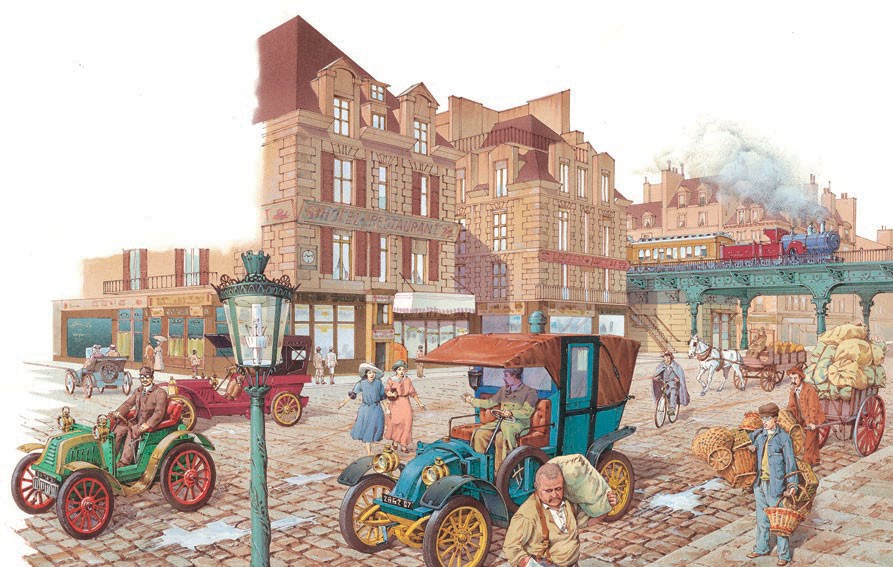
People used carts pulled by horses or other animals for more than 5000 years before the first self-propelled vehicles, steam-powered carriages, were built. The age of the car really started with the development of the internal combustion engine in the late 19th century. Early cars were difficult to operate and were individually hand-built, which made them very expensive. The introduction of cheap, mass-produced cars in the early 20th century quickly made motoring a popular activity.
Steam carriages
Early roads were used mainly by armies or traders who travelled on foot or on horseback. Later, horsedrawn carriages and bicycles also went by road. The first road vehicle that ran on its own power was built in 1769 by a Frenchman, Nicolas Cugnot.
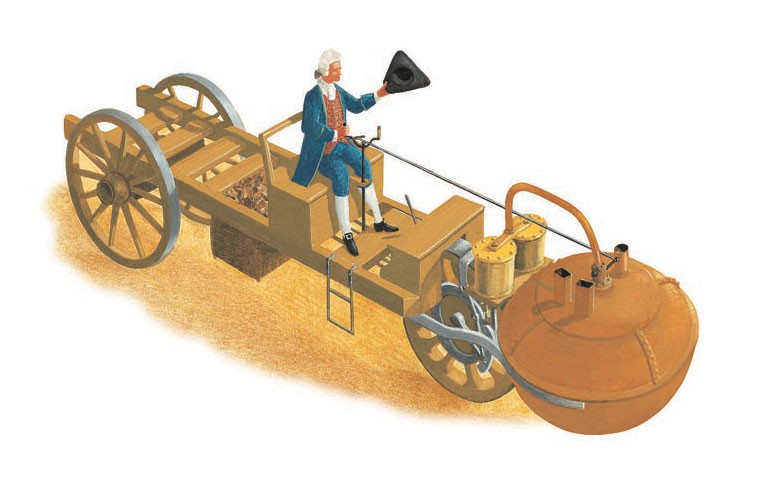
This steam-powered carriage could carry four people, but it moved so slowly it would have been quicker for them to walk. It was hard to steer, and had to stop for refuelling every quarter of an hour. Designed to pull heavy artillery guns, it caused the world’s first motor accident when it crashed into a wall at its top speed of 5 km/h (3 mph). Steam-powered vehicles called traction engines took the place of horses on farms from the 1850s. Cars driven by small steam engines were popular in the USA in the 1890s.
Karl Benz
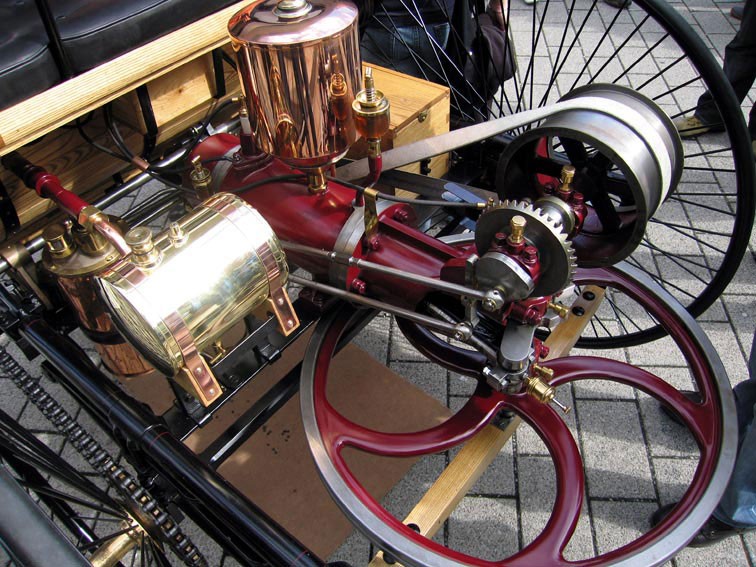
Cars did not become a practical way to travel until petrol engines were invented in the 1880s. In 1885, the German engineer Karl Benz successfully fitted a single-cylinder petrol engine to a three-wheeled tricycle. The water-cooled engine was fixed under the seat. The rear wheels were connected to it by belts and bicycle chains. It could reach speeds of 15 km/h (9 mph).
To begin with, Benz's new car lurched dangerously around the streets of Mannheim, but a smooth ride was soon achieved. The local newspaper reported: “Without the aid of any human element, the vehicle rolled onwards, taking bends in its stride and avoiding all oncoming traffic and pedestrians. It was followed by a crowd of running and breathless youngsters." In 1888, Benz’s wife, Bertha, took the car on a 100-kilometre (60-mile) drive to visit relatives, and so became the first person to undertake a long journey by car.


Gottlieb Daimler
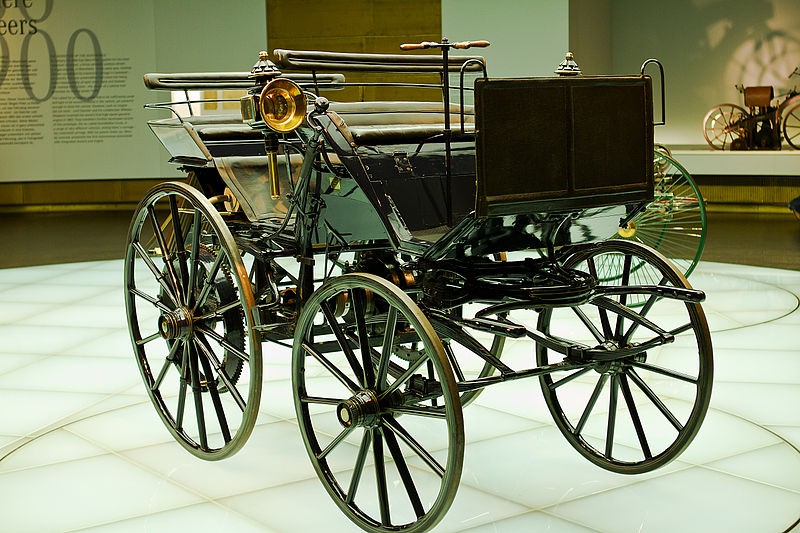
In 1885, a few months before Benz produced his motor-car, another German engineer, Gottlieb Daimler, attached a petrol engine to a wooden-framed bicycle. His 17-year-old son Paul rode the world’s first motor vehicle about 17 kilometres (11 miles) around the streets of Cannstatt, Germany. During the trip, the saddle, fitted too close to the top of the engine, burst into flames. In 1886, Daimler built the first four-wheeled petrol car, a "horseless carriage".
Panhard-Levassor car
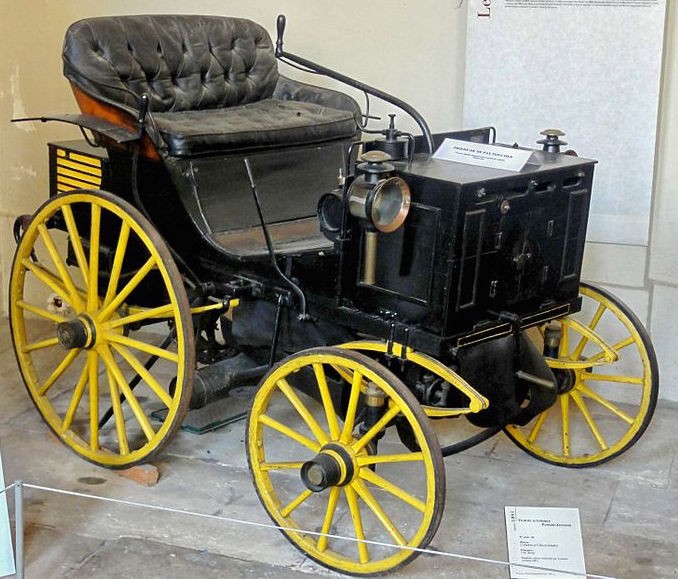
In 1890, two French machine toolmakers, René Panhard and Emile Levassor, began making cars using Daimler engines. Their 1891 model could be described as the first modern car. Fitted beneath a square bonnet at the front, its engine was connected to the rear wheels by a clutch and gears. There was also a radiator at the front to cool the engine. They added a steering wheel in 1894.

Cars of the early 1900s
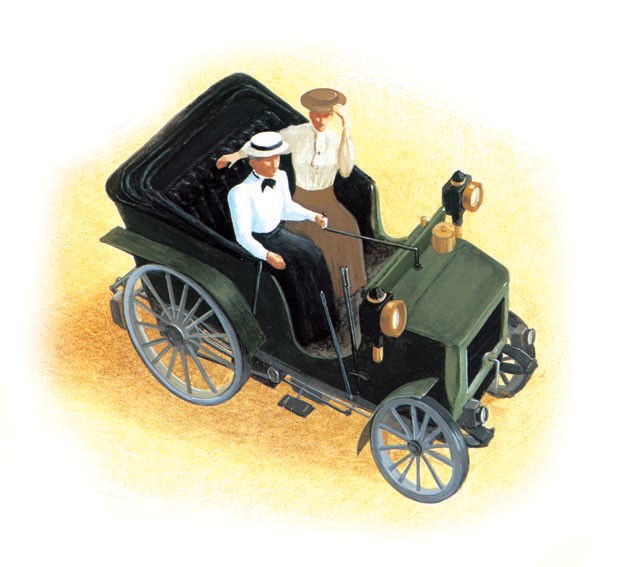
Other modern devices made their first appearances in early French designs: hollow rubber tyres were first used on a 1895 Peugeot and a propeller shaft replaced chain drive in the first Renault built in 1898. By the beginning of the 1900s, modern kinds of engine, tyre, gears and steering had been invented. The first car to include them all was the Mercedes 35 hp, first produced in 1901 by the German company Daimler. Early cars were tricky to operate, slow and hand-built, which made them expensive. The Mercedes was a luxury car that only the very rich could afford.
Ford Model T
The Ford Model T, nicknamed the “Tin Lizzie”, was designed by the American Henry Ford. Production began in 1908. Previous cars had been made individually, but in Ford’s factory a large number of cars were put together at the same time by a team of workers. This way, cars could be produced faster and more cheaply. The Model T was the first inexpensive car.

Electric cars

Many cars produced in the early years had electric motors rather than internal combustion engine. The rechargeable battery had been invented in 1859 and the first practical vehicle appeared in London in 1884. Electric cars held many of the land speed records in the early 1900s. They were cleaner, quieter and less smelly than petrol or diesel cars, and, unlke them, did not need a crank to manually start the engine. But electric cars were slower, more expensive and had shorter ranges than internal combustion engine cars, however, and soon fell into decline.
Consultant: Chris Oxlade
pics

Without in any way limiting Q-files Ltd’s exclusive rights under copyright, any use of this publication to “train” generative artificial intelligence (AI) technologies to generate text is expressly prohibited. Q-files Ltd reserves all rights to license use of this work for generative AI training and development of machine learning language models.