
Road transport

CITE
We have made every effort to follow citation style rules, but there may be some minor differences. If in doubt, please refer to the appropriate citation style manual.
Formula 1 racing car. (2026). In Q-files Encyclopedia, Technology, Road transport. Retrieved from
https://www.q-files.com/technology/road-transport/formula-1-racing-car
"Formula 1 racing car." Technology, Road transport, Q-files Encyclopedia, 2 Jun. 2026.
https://www.q-files.com/technology/road-transport/formula-1-racing-car.
Accessed 5 Nov. 2026.
Formula 1 racing car 2026. Technology, Road transport. Retrieved 5 November 2026, from
https://www.q-files.com/technology/road-transport/formula-1-racing-car
Technology, Road transport, s.v. "Formula 1 racing car," accessed November 5, 2026.
https://www.q-files.com/technology/road-transport/formula-1-racing-car


Formula 1 racing car
Formula 1 is an annual competition in which drivers race on different circuits around the world such as Monte Carlo, Monza, Silverstone and Nürburgring. The cars they drive use the latest technology to maximize speed, road-holding, reliability and safety. A modern race team involves a large number of engineers, technical experts and pit-lane mechanics—as well as the drivers themselves.


Grand Prix
Motor racing began in 1894. The events became known as Grand Prix races. The cars’ weight was limited by an agreed “formula”. The German Silver Arrows, so-called because they were left unpainted to reduce weight, dominated Grand Prix racing in the 1930s. The German-built Mercedes Benz W125 was the most powerful racing car of its day, reaching speeds of more than 300 km/h (around 200 mph) in 1937.
Design
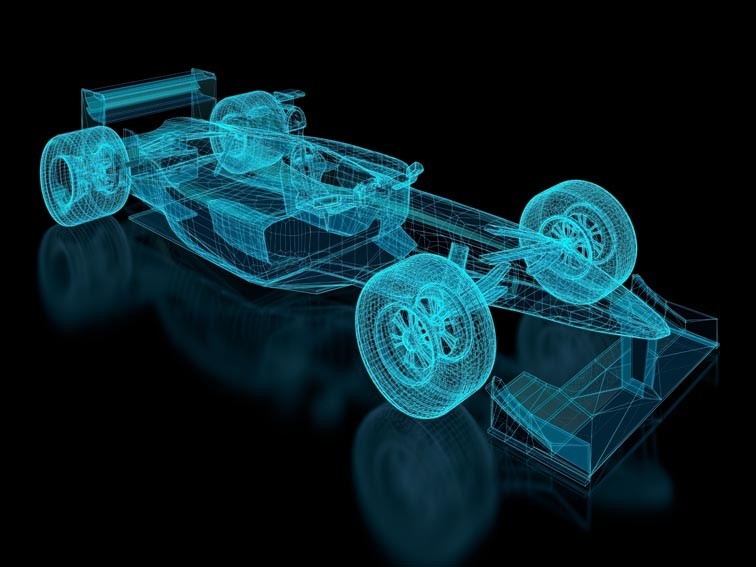
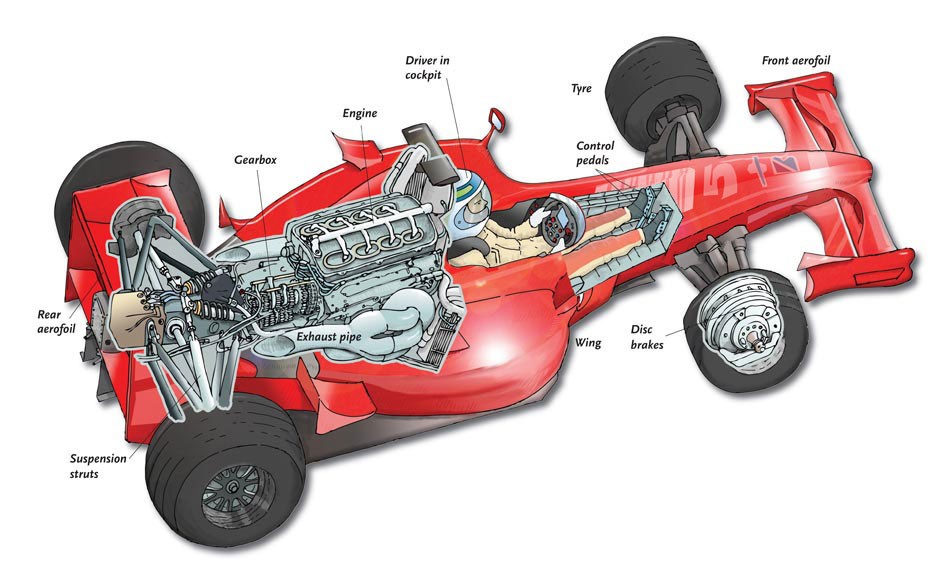
At high speed, the air itself holds back the most powerful vehicle, so a Formula 1 car has a smooth, streamlined shape to keep this air resistance to a minimum. The car must weigh as little as possible. Its shell, called a single-piece monocoque, is made of an extremely light carbon fibre material. Front and rear aerofoils, together with “wings” to the left and right of the cockpit, create a force which presses the car down on to the road. This improves the grip of the tyres. The suspension and steering struts have a curved, streamlined shape which helps to reduce air resistance.
Engine
Since the 2014 Formula 1 season, the cars have been using V6 turbocharged engines. These have three cylinders on either side of the engine set at an angle that forms a “V” shape. The powerful engines get extremely hot during a race and must be cooled constantly. Air is drawn in through intakes to supply cooling air to the radiators.
Tyres and brakes
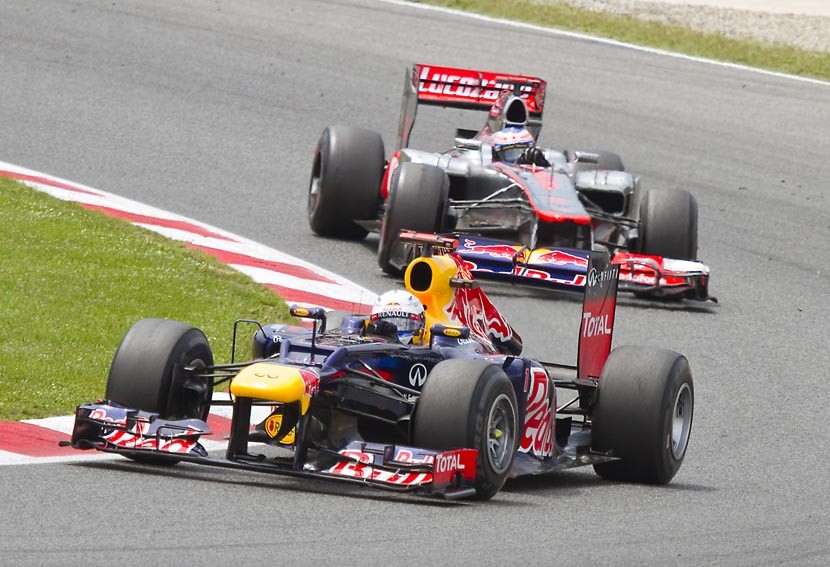
Race teams fit different tyres for different conditions, often changing them during the course of a race. Slick (smooth) tyres have the best grip on a dry track but skid in the wet, so wet tyres are used when it rains. Tyres perform best at high temperatures. A Formula 1 car’s brakes must work at temperatures of 1000°C (1800°F) without parts melting. The car slows from 100 km/h to 0 in about 17 metres (60 mph to 0 in 60 feet), half the distance a performance car can achieve.
Formula 1 cars have a device called a differential fitted to their wheel axles. It allows one wheel to turn at a different speed to the other—vital for cornering. The driver can make adjustments to the differential to improve cornering using the differential controls.
Steering wheel controls
The steering wheel of a Formula 1 car is not like an ordinary car wheel. The controls, a set of buttons, switches and toggles (easy-to-grab switches), are positioned on the wheel itself so the driver’s hands do not have to move far from the grip. On a normal car, the clutch is a pedal and the gears are changed using a stick. Here, the clutch and gears are controlled by hand. They are “paddles” fixed to the back of the steering wheel.

The main display screen gives the driver all kinds of information, including speed, lap times, gear selected, etc. The driver uses buttons top left and top right of the wheel to scroll through. The engine control switches allow the driver to adjust, for example, the fuel/air mixture or sensitivity of the accelerator pedal. The condition of the tyres is very important in a F1 car. The tyre monitor warns the driver if the tyres are wearing out. The warning flags used in the race—blue, red and yellow—also appear as lights on the wheel.
Some of the controls help the driver communicate with the crew in the pits. The driver and his crew talk to one another constantly by radio. When the diagnostic and data check buttons are pressed, the crew can check the car’s performance so they know what adjustments to make in the pits. When the crew calls the car to the pits, the driver presses the pit confirm button to indicate he has understood.
Consultant: Chris Oxlade
pics

Without in any way limiting Q-files Ltd’s exclusive rights under copyright, any use of this publication to “train” generative artificial intelligence (AI) technologies to generate text is expressly prohibited. Q-files Ltd reserves all rights to license use of this work for generative AI training and development of machine learning language models.