
Theatre

CITE
We have made every effort to follow citation style rules, but there may be some minor differences. If in doubt, please refer to the appropriate citation style manual.
Puppet theatre. (2026). In Q-files Encyclopedia, Culture, Theatre. Retrieved from
https://www.q-files.com/culture/theatre/puppet-theatre
"Puppet theatre." Culture, Theatre, Q-files Encyclopedia, 13 May. 2026.
https://www.q-files.com/culture/theatre/puppet-theatre.
Accessed 21 Sep. 2026.
Puppet theatre 2026. Culture, Theatre. Retrieved 21 September 2026, from
https://www.q-files.com/culture/theatre/puppet-theatre
Culture, Theatre, s.v. "Puppet theatre," accessed September 21, 2026.
https://www.q-files.com/culture/theatre/puppet-theatre


Puppet theatre
Puppet theatre dates back to the 5th century BC, when clay marionettes were used in ancient Greek performances, telling stories of great adventures such as Homer's Iliad and Odyssey. A puppet is a model of a human, animal or invented creature controlled by a person called a puppeteer. The art of controlling puppets is called puppetry. Part of a tradition of folklore and storytelling, puppetry is especially important in East Asian and European culture.
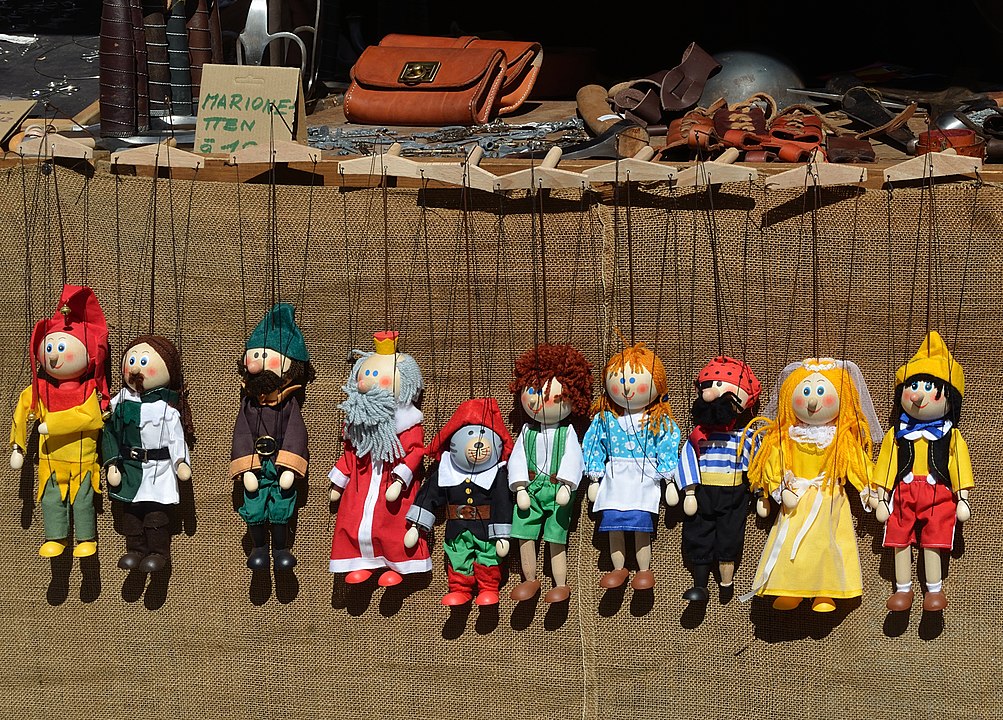

Marionettes
A puppet held up with strings is known as a marionette. The puppeteer (or marionettist) can express a wide range of movement by moving strings attached to its head, arms and legs.
Marionettes were used Medieval Italy to act out Christian morality plays: stories that encouraged people to behave well. Over time, puppeteers introduced comedy into these plays, which caused them to be banned from being performed in church. By the 16th century a new type of theatre had developed called commedia dell’arte, in which actors played the same character time after time, and improvised (made up) their lines as they went along. Puppetry was perfectly suited to this type of theatre, and the performances soon became popular entertainment all over Europe for both adults and children.
In the 1960s, marionettes were combined with electronics to create popular television science-fiction series such as Thunderbirds and Stingray. Their producers developed a technique they called “supermarionation” to make their marionette characters appear more lifelike. Electronics were built into the heads of the puppets so that their mouths could move. The puppets still had strings, but these were largely hidden from the television cameras by special light-reflecting paint.


Hand puppets
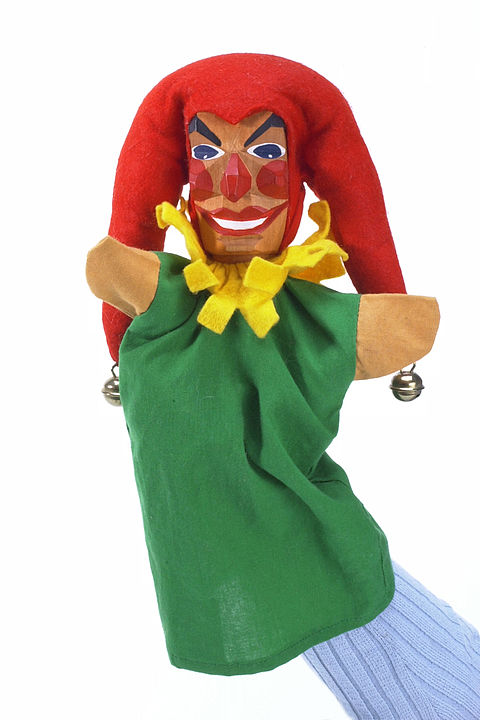
Some of the simplest types of puppet are hand puppets. Finger puppets have no moving parts and are often used to tell stories to children. A sock puppet is larger and fits over the hand. The puppeteer’s fingers and thumb create a moving “mouth” at the top of the sock.
A glove puppet is larger still, with pockets in its sides where the puppeteer’s fingers and thumb can work the puppet’s arms. The characters Sooty and Sweep in the popular 1950s British children’s TV series Sooty are examples of glove puppets.
Live-hand puppets
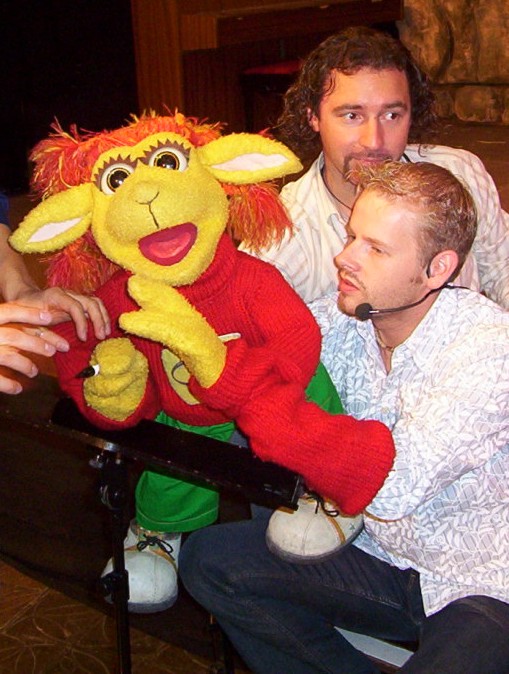
Some large puppets, such as the Sesame Street puppets and Muppets, need two people to operate them. One moves the puppet’s head and one of its hands while the other person places their hand into a glove to control the puppet’s other hand. Known as “right-handing”, this job is often given to newly-trained puppeteers.
Puppets controlled in this way are known as “live-hand” puppets. They can make fine movements with their hands, such as picking up a cup, stroking their chin, or even writing with a pen.

Rod puppets
Rod puppets are controlled by rods that attach to the puppet's head, arms and legs. They are usually only animated from the waist up, with legs either dangling or hidden out of sight. The Muppets, created by American puppeteers Jim and Jane Henson in 1955, are famous examples of these. Rods are also used to control extremely large puppets, sometimes with several puppeteers each controlling a different body part with its own rod.
Little Amal
Little Amal is a 3.5-metre (11 foot) rod puppet. It is the centrepiece of a performance art project, called The Walk, which is intended to celebrate human migration and cultural diversity. Over the course of five months in 2021, Little Amal travelled from the Syria-Turkey border across Europe to the UK. On the way, she walked and took part in events in towns and cities, playing the part of a nine-year-old Syrian refugee fleeing from war. Separated from her family, she walked across Europe to find her mother. The name Amal means "hope" in Arabic. She made a re-appearance in London during spring 2023. Artistic director of the project, Amir Nizar Zuabi, said: "I think she becomes very moving because you can see her thinking; you can see her breathing."

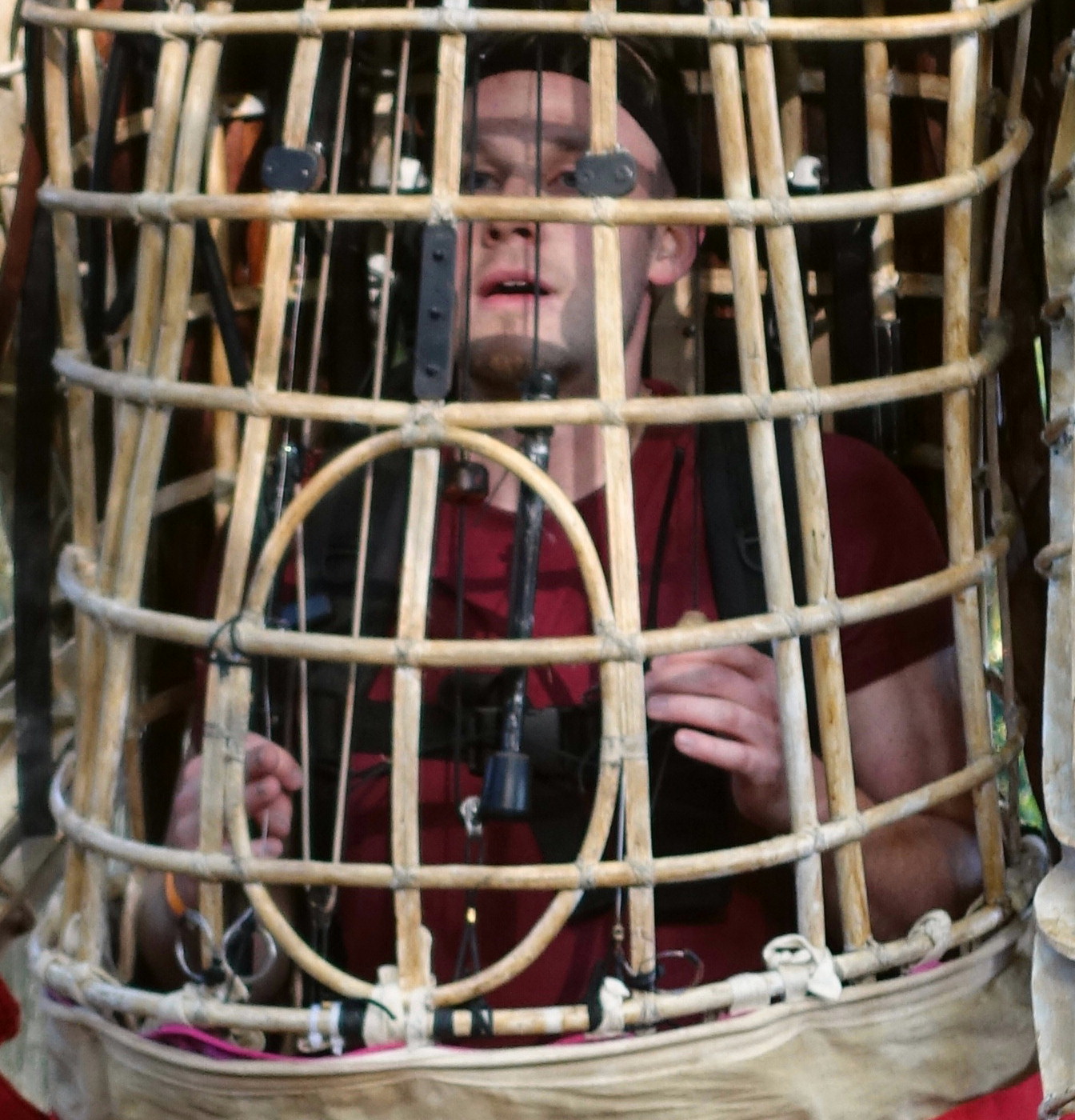
The puppet is controlled by at least three puppeteers: two to move the hands using rods attached to the hands, and one walking on weighted stilts inside the frame (made of cane and carbon fibre) to move the legs, head and mouth. The puppet's eyes are controlled by a small computer (which makes it a partly animatronic puppet, see below). There are actually three identical Little Amal puppets, created to enable events to go ahead at different locations at the same time.
Animatronic puppets


Animatronic puppets are mechanical, robot-like puppets, controlled by humans, computers or a combination of both. Built to resemble a figure, animal or mythical beast, the puppets are used to portray characters in films and plays, or as theme park attractions. Actuators, electric motors designed to move component parts, work like muscles to create realistic movement. The figures are usually made from an internal frame encased in body shells and flexible skins, with eyes, hair etc. to make them appear lifelike.
Film-makers use animatronics to create creatures that do not exist—for example, a monster or a dinosaur—or for use in action sequences that could not be shot using real people or animals. First introduced by Walt Disney in the 1964 film, Mary Poppins, which featured an animatronic bird, animatronic puppets were later used in movies such as Jaws, E.T. the Extra-Terrestrial and Jurassic Park.
Ventriloquism
Ventriloquism is the art of making a puppet seem to talk. The ventriloquist speaks moving his or her own lips hardly at all, while at the same time causing the puppet’s mouth to move quite visibly. Ventriloquists’ puppets are known as “dummies”. Ventriloquism became a popular modern form of theatre in the 1880s when the British ventriloquist Fred Russell came to fame. For the next 60 years he toured the world with his popular character “Coster Joe”, who sat on his knee and appeared to talk with him.

Shadow theatre

In shadow theatre, puppeteers move puppets behind a screen, telling a story with the shadows they cast on the screen. The scene is lit from behind so that only the puppets’ shadows appear on the screen while members of the audience watch from the other side. Shadow theatre dates back to ancient Chinese mythology, but it became popular entertainment in China in the 10th century. The puppets are usually made from leather or cut out from stiff paper. Shadow theatre, with its moving on-screen images, may well have inspired the invention of projected film and modern cinema.

Puppet-making
Puppets have traditionally been made from all sorts of different materials. Hand puppets and rod puppets usually need to be flexible, so they are often made from soft fabrics. Marionettes and shadow puppets, on the other hand, must be rigid so that their separate parts can be moved. For this reason they are made from wood, papier-mâché, leather or ceramic.
To create a typical rod puppet, the puppet-maker starts by sewing and stuffing the puppet’s body using a process similar to making a soft toy. The puppet is then covered with a special fleece “skin” which hides any seams (edges). Rods are sewn into the puppet’s arms at the wrists so they can be moved by the puppeteer. A puppet’s hand sometimes has wire inside its fingers so that they can be bent and moved around objects to grasp them. Puppets with this feature are said to have “posable hands”.
Punch and Judy
Punch and Judy is a traditional puppet show popular in the United Kingdom. Using glove puppets, it tells the story of Punch, his wife Judy, their baby, a policeman and a vicious crocodile. It is a type of comedy known as slapstick, which makes audiences laugh as the characters fall over and fight one another with sticks. As the crocodile sneaks up on Punch, audiences shout out to warn him, “He’s behind you!”

In a Punch and Judy show, all the puppets are usually controlled by a single puppeteer. To make the squeaky sound of Punch’s voice, the puppeteer speaks through a special voice scrambler called a “swazzle”. Punch and Judy shows reached the height of their popularity in England during the 18th century, and are still performed today.
pics

Without in any way limiting Q-files Ltd’s exclusive rights under copyright, any use of this publication to “train” generative artificial intelligence (AI) technologies to generate text is expressly prohibited. Q-files Ltd reserves all rights to license use of this work for generative AI training and development of machine learning language models.