
Castles & knights

CITE
We have made every effort to follow citation style rules, but there may be some minor differences. If in doubt, please refer to the appropriate citation style manual.
Heraldry. (2022). In Q-files Encyclopedia, History, Castles & knights. Retrieved from
https://www.q-files.com/history/castles-knights/heraldry
"Heraldry." History, Castles & knights, Q-files Encyclopedia, 10 Feb. 2022.
https://www.q-files.com/history/castles-knights/heraldry.
Accessed 6 Aug. 2026.
Heraldry 2022. History, Castles & knights. Retrieved 6 August 2026, from
https://www.q-files.com/history/castles-knights/heraldry
History, Castles & knights, s.v. "Heraldry," accessed August 6, 2026.
https://www.q-files.com/history/castles-knights/heraldry


Heraldry
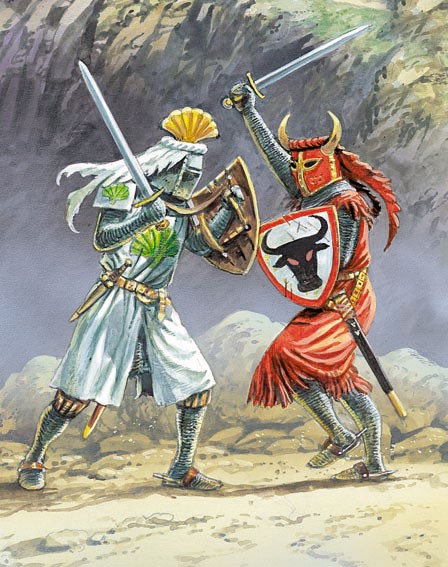
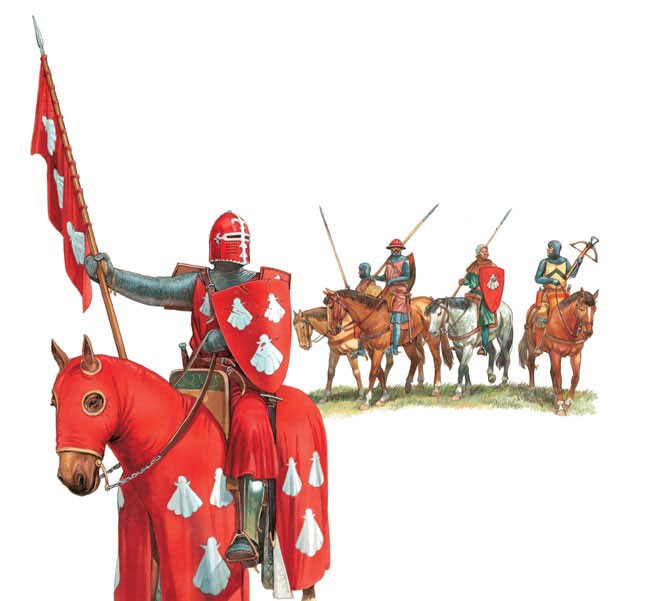
Knights looked the same when clad in full armour. So, to ensure they were not attacked by their own men, or so that they could be easily identified at a tournament, the knights decorated their shield, armour—and sometimes even their horse—with the distinctive design of their own noble family, called arms. The surcoat a knight wore over his armour became known as his coat of arms. The design was contained within the shape of a shield. The system used for designing and recording these coats of arms was called heraldry.
Colours and patterns
Colours used in heraldry were either metals—or (gold) and argent (silver or white)—or tinctures: azure (blue), gules (red), purpure (purple), sable (black) and vert (green). The simplest designs were called ordinaries. These could be divided, subdivided, or varied by having their edges patterned.

Rules of heraldry
Complex patterns, such as furs and semés, were also used. Pictorial symbols, called charges, were frequently added. They often had meanings associated with the person who bore the arms. A rule of heraldry was that a metal charge could only be placed on a tincture field (background), or a tincture charge on a metal field. When noble families became linked by marriage, the escutcheon (the heraldic shield) was divided between the two coats of arms. When their children married, the shield was divided again, or quartered.


Heralds
Heralds were originally messengers sent by kings or noblemen to convey proclamations, such as announcing an attack on a baron’s castle. They also ran and scored tournaments, and so became experts at recognizing different coats of arms. They started to keep records of these, in books called armorials, and soon acquired the responsibility for designing new ones.
Consultant: Philip Parker
pics
Without in any way limiting Q-files Ltd’s exclusive rights under copyright, any use of this publication to “train” generative artificial intelligence (AI) technologies to generate text is expressly prohibited. Q-files Ltd reserves all rights to license use of this work for generative AI training and development of machine learning language models.