
EASY READ The animal kingdom

CITE
We have made every effort to follow citation style rules, but there may be some minor differences. If in doubt, please refer to the appropriate citation style manual.
EASY READ A to Z of marine invertebrates. (2026). In Q-files Encyclopedia, Life, EASY READ The animal kingdom. Retrieved from
https://www.q-files.com/life/easy-read-the-animal-kingdom/easy-read-a-to-z-of-marine-invertebrates
"EASY READ A to Z of marine invertebrates." Life, EASY READ The animal kingdom, Q-files Encyclopedia, 23 Mar. 2026.
https://www.q-files.com/life/easy-read-the-animal-kingdom/easy-read-a-to-z-of-marine-invertebrates.
Accessed 13 Sep. 2026.
EASY READ A to Z of marine invertebrates 2026. Life, EASY READ The animal kingdom. Retrieved 13 September 2026, from
https://www.q-files.com/life/easy-read-the-animal-kingdom/easy-read-a-to-z-of-marine-invertebrates
Life, EASY READ The animal kingdom, s.v. "EASY READ A to Z of marine invertebrates," accessed September 13, 2026.
https://www.q-files.com/life/easy-read-the-animal-kingdom/easy-read-a-to-z-of-marine-invertebrates


A to Z of marine invertebrates
The oceans are home to a wide range of invertebrate animals. Unlike fish, mammals or reptiles, for example, these animals do not have backbones. They include crustaceans, such as crabs, lobsters and shrimps, which have hard outer parts for protection, and molluscs, which have soft bodies, often protected by shells. Crustaceans and molluscs are sometimes grouped together and called “shellfish”.


Bivalves
Bivalves are kinds of mollusc. They have flat bodies contained inside a shell that has two hinged parts. Clams, cockles, oysters, scallops and mussels are all bivalves. To protect themselves from predators, some bivalves bury themselves in the sand or mud. Others, including scallops, swim away from danger, while oysters and mussels remain permanently attached to rocks. To ensure they stay moist when they are out of the water at low tide, they keep their shells tightly shut.

Corals
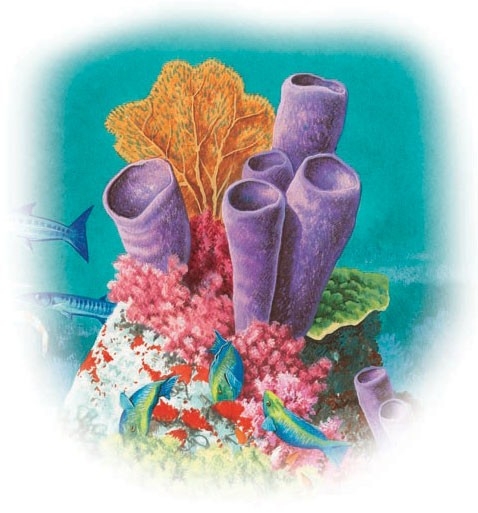
The coral that makes up coral reefs is formed from the hard parts of tiny animals called coral polyps. They live together in huge colonies in shallow warm waters near tropical coasts. They feed on microscopic creatures in the water. Their colours come from algae that live inside them. Polyps build up a cup-shaped skeleton around their soft bodies. When they die, this is left behind. The skeletons may build up into huge coral reefs.

Crabs and lobsters
Crabs and lobsters are crustaceans. They have five pairs of jointed legs (one pair are their claws) and two pairs of antennae on their head. As they grow, they moult their hard shell or external skeleton and grow a new one.

Crabs have round, flat bodies. Their pinching claws are used both for feeding and defence. Most crabs live on the seabed, but some live in sandy burrows on land. They feed mostly on algae, molluscs, worms and other crustaceans. Some also eat the rotting bodies of dead animals and plants.

Different kinds of lobster eat different foods, including fish, molluscs, urchins, worms, starfish and other crustaceans. They use their pinching claws to grab or dig for their prey, and then to slice it up into pieces.
Jellyfish
Jellyfish have bell-shaped bodies and stinging tentacles. They have no heart, bones or brain. Most drift along in the ocean tides and currents. They float with their tentacles hanging down in the water. Each tentacle is armed with stinging cells for killing prey. Jellyfish feed on small fish and other marine creatures that become caught in their tentacles.


Octopuses
Octopuses are molluscs, related to squid and cuttlefish. They are the most intelligent of all invertebrates. To scare off predators, octopuses can change their colour in seconds. They use their long arms for gripping, touching and tasting. Suckers along the underside of these arms help them to grip prey.

To make a quick escape, the octopus sucks water into the body sac behind its eyes, then squirts it out. As the water shoots out backwards, the force of it pushes the animal fowards.
Portuguese
man-o'-war
The Portuguese man-o'-war is commonly mistaken for a jellyfish. In fact, it is not a single animal but a colony of animals, called polyps. Each has a job to do for the colony. Stinging tentacle polyps catch food. The feeding polyps digest it. One large, balloon-like polyp keeps the colony afloat. It floats on the surface, dragging the tentacles below the water, trapping small fish.


Sea anemones
Sea anemones look like flowers, but they are really animals. Their body consists of a sticky foot and a set of stinging tentacles clustered around the mouth. The tentacles are used both to capture prey and to fend off enemies. Sea anemones anchor themselves to rocks in shallow water. Their stinging tentacles point upwards. When another creature comes close and touches them, they fire tiny venomous "harpoons” at the prey. The tentacles then draw the victim into the anemone’s mouth.
Sea snails and
sea slugs
Sea snails and sea slugs are gastropods, types of mollusc. They move about on one large foot. Sea snails—a family that includes limpets, conches, whelks and periwinkles—all have hard shells, while sea slugs do not. Some types of sea slug have bright colours to warn predators that they are poisonous.


Limpets use their foot to attach themselves tightly to rocks at low tide. They do this to stop themselves drying out or from being pulled away by waves. At high tide, they go off grazing for food.
Sea urchins
Sea urchins have spiny shells for protection. They feed on seaweeds and other plants that grow on the seabed. A sea urchin's mouth is on the underside of its body—it eats by climbing on top of its meal. Sea urchins have long suckers, called tube feet, which stick out through holes in their shells. These enable the urchins to move across the seabed.


Shrimp
Shrimp (or prawns) are crustaceans. They have long, narrow abdomens, long antennae (whiskers) and slender, fragile legs. They swim using legs called swimmerets attached to their abdomens. Shrimp are an important food source for larger animals, including fish and whales.
Sponges
Sponges have no mouths, hearts or brains. Like jellyfish, their bodies consist of jelly-like masses. They do not move around but instead live permanently attached to solid surfaces. They feed by straining tiny particles of food from the sea water like a sieve.
Squid


Squid are molluscs. They are related to octopuses and cuttlefish. They have eight arms and two longer tentacles attached to their heads. They have an internal shell, called a pen, which protects their insides. Squid can change their colour in seconds. They use this ability to confuse predators. Squid feed on small fish, crabs, shrimp and other squid. They use their huge eyes to spot prey and their arms and tentacles to capture it. They pull their victim into their mouth where a sharp, horny beak tears it to pieces.
Starfish
Starfish, or sea stars, have mouths on the undersides of their bodies. Most starfish have five arms. They use them to prise open bivalve shells. Once they are open, the starfish pushes its stomach through its mouth into the shells. It then feeds on the soft, fleshy parts inside. If a starfish is attacked, it can lose an arm in order to make its escape. This will grow back later. The suckers, or tube feet, on their arms are used for breathing as well as for moving around.


Worms
Marine worms are long, thin, soft-bodied creatures. There are segmented worms, flatworms and nematode worms (roundworms). Polychaetes, pronounced "polly-keets", are kinds of segmented worm. Each segment of their body has fleshy, tentacle-like parts with bristles—which is why they are also known as bristle worms.
Flatworms are simple creatures that breathe and eat by allowing oxygen and food particles to pass through their flattened bodies.
Consultant: Chris Jarvis
Ready to find out more?
Here are some pages in other parts of Q-files you might like to explore:
Marine invertebrates
Bivalves
Coral polyps
Crabs
Jellyfish
Lobsters
Octopuses
Sea anemones
Sea snails and slugs
Squid
Starfish and sea urchins
Marine invertebrates A-Z
pics
Without in any way limiting Q-files Ltd’s exclusive rights under copyright, any use of this publication to “train” generative artificial intelligence (AI) technologies to generate text is expressly prohibited. Q-files Ltd reserves all rights to license use of this work for generative AI training and development of machine learning language models.