Q-news
NASA’s Artemis II arrives back on Earth after completing flyby of the Moon
NASA's Space Launch System rocket launched the Artemis II mission on 1st April, carrying astronauts to the Moon for the first time in almost 54 years. The 10-day test flight of their Orion spacecraft, which the crew named Integrity, did not land on the Moon itself, but orbited it instead, performing a lunar flyby, before returning to Earth. The mission paves the way for a touchdown by members of the Artemis IV crew, scheduled for 2028. The launch of Artemis II marked the first time since the Apollo 17 mission of December 1972 that humans left Low Earth orbit.
UPDATED 14th April 2026


Lift-off
The mission launched aboard a Space Launch System (SLS) rocket from the Kennedy Space Center at 18:35 local time on 1st April 2026. The four main engines ignited about seven seconds before lift-off, throttling to full power, with the solid rocket boosters providing most of the thrust for the first two minutes. Booster separation occurred at about eight minutes after launch at an altitude of 48 kilometres (30 miles). Orion was now in in a highly elliptical orbit with its apogee (the point farthest from Earth) at 2200 km (1400 miles), nearly five times higher than the International Space Station.
The crew then carried out checks of life support systems on the spacecraft, including the water dispenser, firefighting masks and toilets. At about 50 minutes after lift-off, another rocket engine, the Interim Cryogenic Propulsion Stage (ICPS), ignited, raising Orion to High Earth orbit with an apogee of 70,000 km (44,000 miles). After this burn, Orion entered automated control. The crew carried out more tests ... and had their first meal.
Artemis II crew
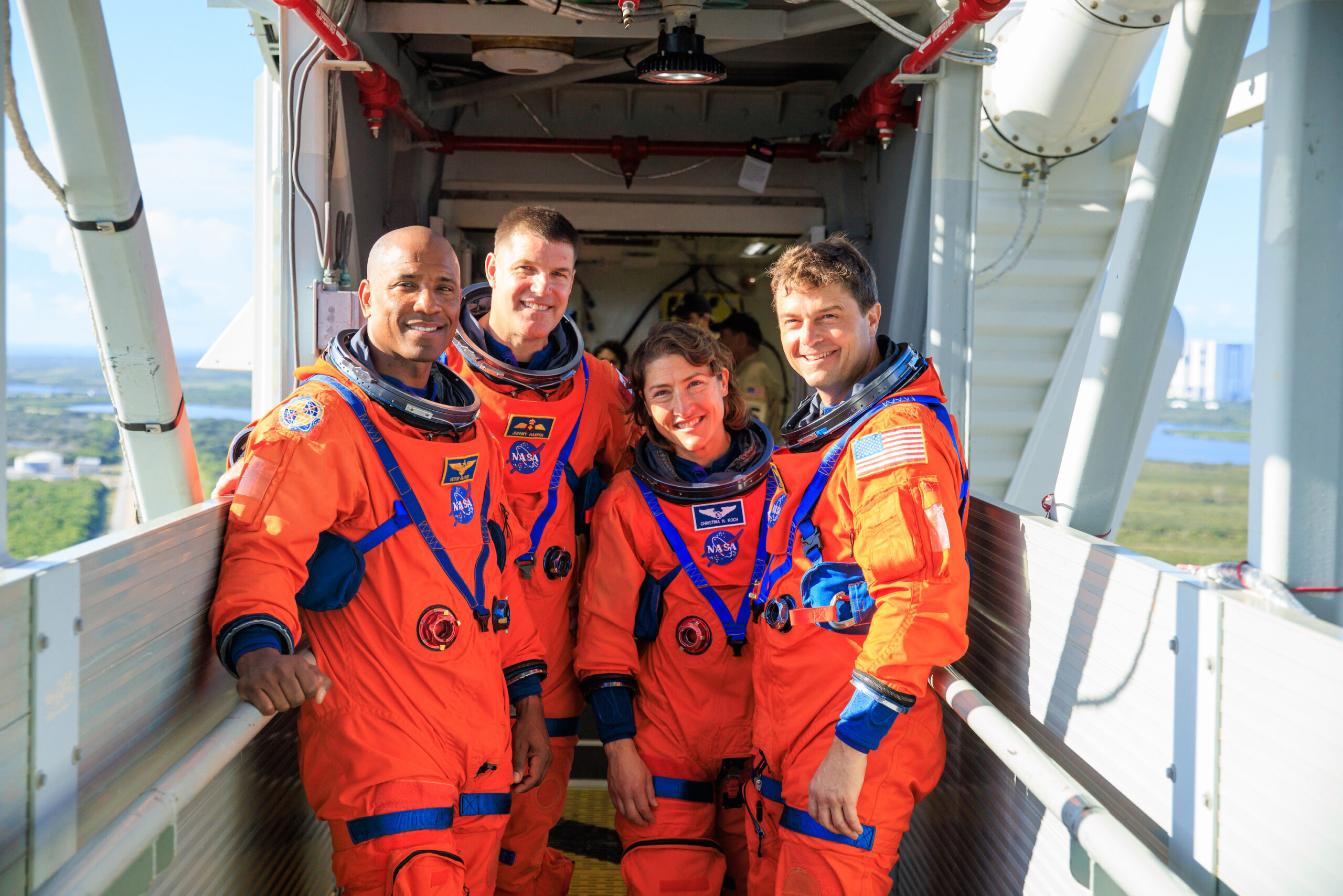
Reid Wiseman (born 1975), selected as commander of the crew for the Artemis II flight, is a US Navy pilot. He has flown one previous space mission, as a crew member on the International Space Station (ISS) in 2014. Victor Glover (born 1976) is a US Navy test pilot who, in November 2020, piloted the first operational flight of the SpaceX Crew Dragon to the ISS. He then served as flight engineer on the ISS for more than six months. Glover is pilot of Artemis II.
Christina Koch (born 1979) took part in the first all-female spacewalk alongside fellow NASA astronaut Jessica Meir in October 2019 while serving as a crew member on the ISS. On 6th February 2020, at the end of the same mission, Koch set the record for longest continuous time in space by a woman: 328 days. An electrical engineer by training, she will be a supporting mission specialist on Artemis II. Jeremy Hansen (born 1976) was a fighter pilot with the Royal Canadian Air Force before joining the Canadian Space Agency. A supporting mission specialist on Artemis II, this is his first spaceflight.
The Artemis II mission included a number of milestones. Two of the crew, Christina Koch and Victor Glover, became respectively the first woman and first person of colour to fly beyond Low Earth orbit. The fourth crew member, Canadian Jeremy Hansen, became the first non-American to do the same.
Mission profile

Following launch, Orion orbited Earth twice, during which the spacecraft picked up speed. When it reached perigee (the point on its orbit nearest the Earth, position 4 on the diagram), it fired its main engine, a procedure known as trans-lunar Injection (TLI), to send it towards the Moon. Orion now flew on what is called a lunar free-return trajectory, to make a direct return back to Earth via the Moon in a figure-of-eight pattern.
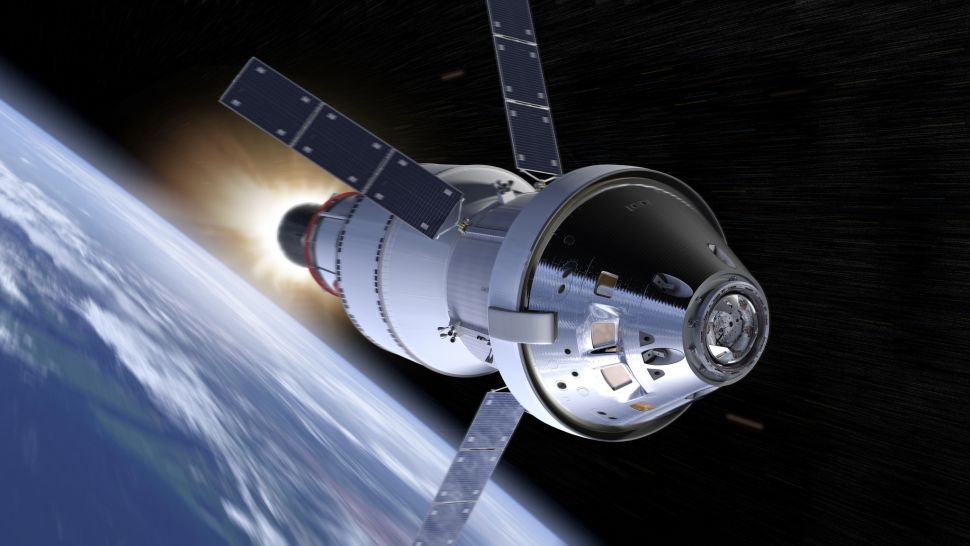
Engines burned at various points to carry out "trajectory corrections". This ensured that the spacecraft kept precisely to its route. NASA's Mission Control in Houston confirmed that all four solar arrays, which provide the spacecraft with electrical power throughout the journey, were deployed successfully soon after take-off.

Objectives
The four astronauts repeated the 1968 mission carried out by Apollo 8, which was the first human spaceflight to reach the Moon, carrying out a flyby just like the Artemis II mission. An Apollo 8 crew member took the "Earthrise" picture that showed our home planet emerging from behind the Moon.
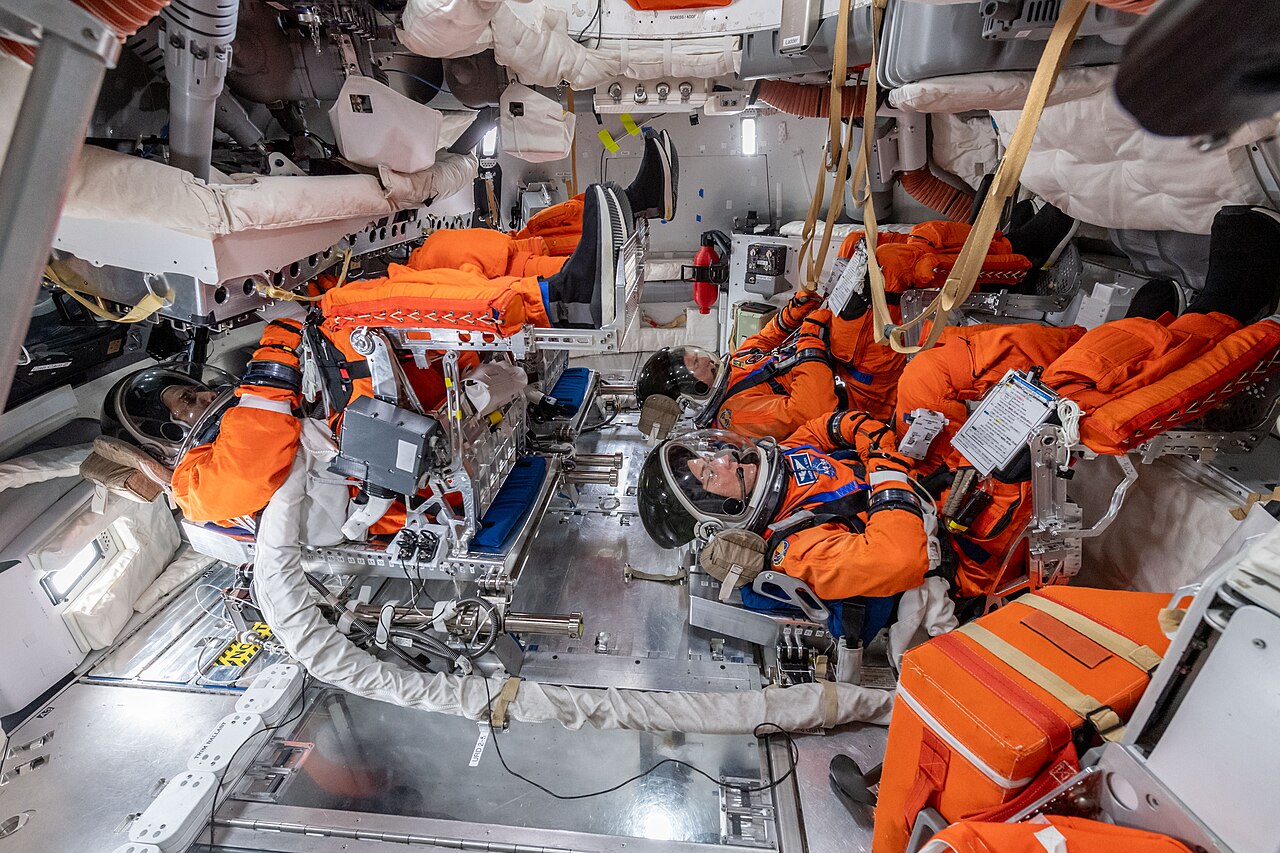
The long journey (386,000 kilometres or 240,000 miles) to the Moon saw the Artemis II crew testing the life-support systems that will be needed for Artemis IV. They had their health monitored at every stage, testing the effects of increased radiation and microgravity. The four lived in the Orion capsule, a space no wider than 5 metres (16 feet), for the entire mission, a period of 10 days.
A key part of the mission was to photograph areas of the Moon’s south pole where Artemis IV is scheduled to land and where a lunar base is planned for the future.
Lunar flyby
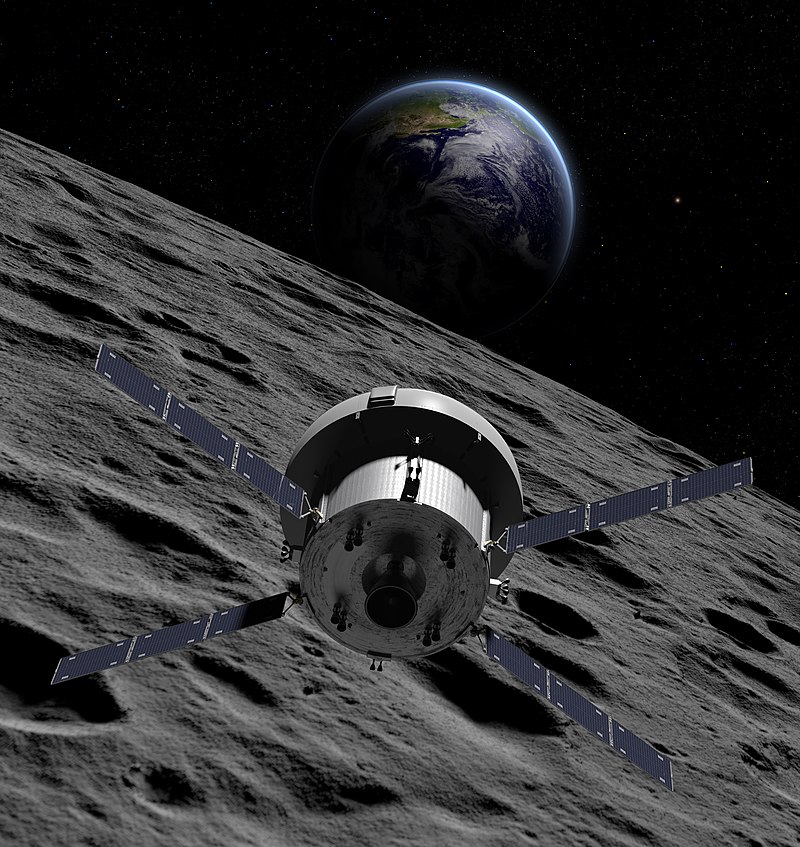
The Artemis II mission carried out a lunar flyby that took the astronauts farther from the Earth than any human had ever travelled. The crew reached their maximum distance of 406,771 km (252,756 miles) breaking the record set in 1970 by the Apollo 13 mission (which was to land on the Moon, but had to abort after an oxygen tank in the service module exploded) by about 8000 km (5000 miles).
On its closest approach to the Moon, Orion came within 6550 km (4070 miles) of the lunar surface. As it passed behind the Moon, Orion experienced a loss of signal for 40 minutes while the Moon blocked out radio signals from Mission Control.


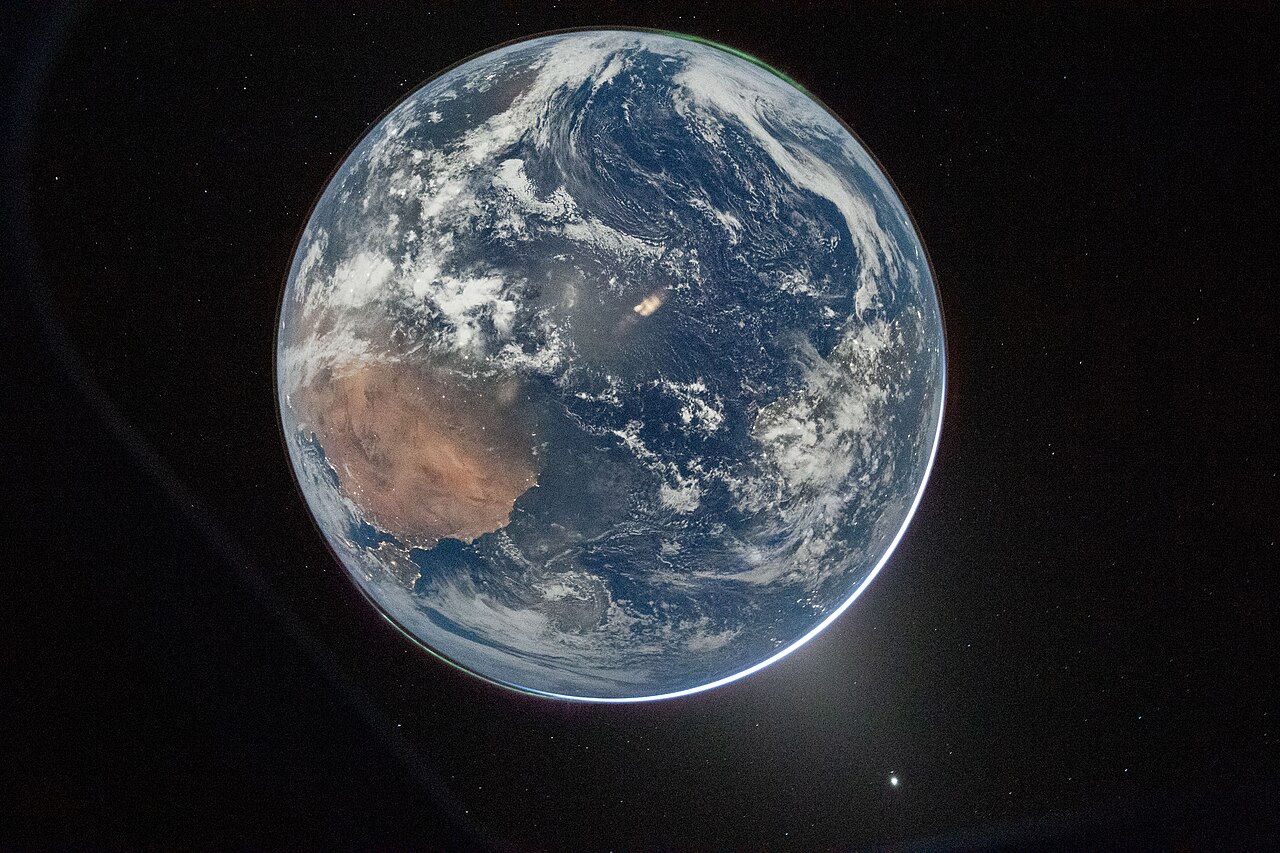
During the flyby, the team observed previously unseen parts of the far side of the Moon, including the Orientale Basin, a 950-km (590-mile) crater. Among the images captured by the crew were those of the Earth setting behind the Moon, and a solar eclipse.
On behalf of the crew, Jeremy Hansen asked Mission Control if they could name two unnamed craters they saw on the Moon. For one they proposed the name Integrity, after the name the crew had given to the Orion spacecraft. For the other, Hansen requested that the crater be named after Reid Wiseman’s wife, Carroll, who died at the age of 46 in 2020 after battling cancer.
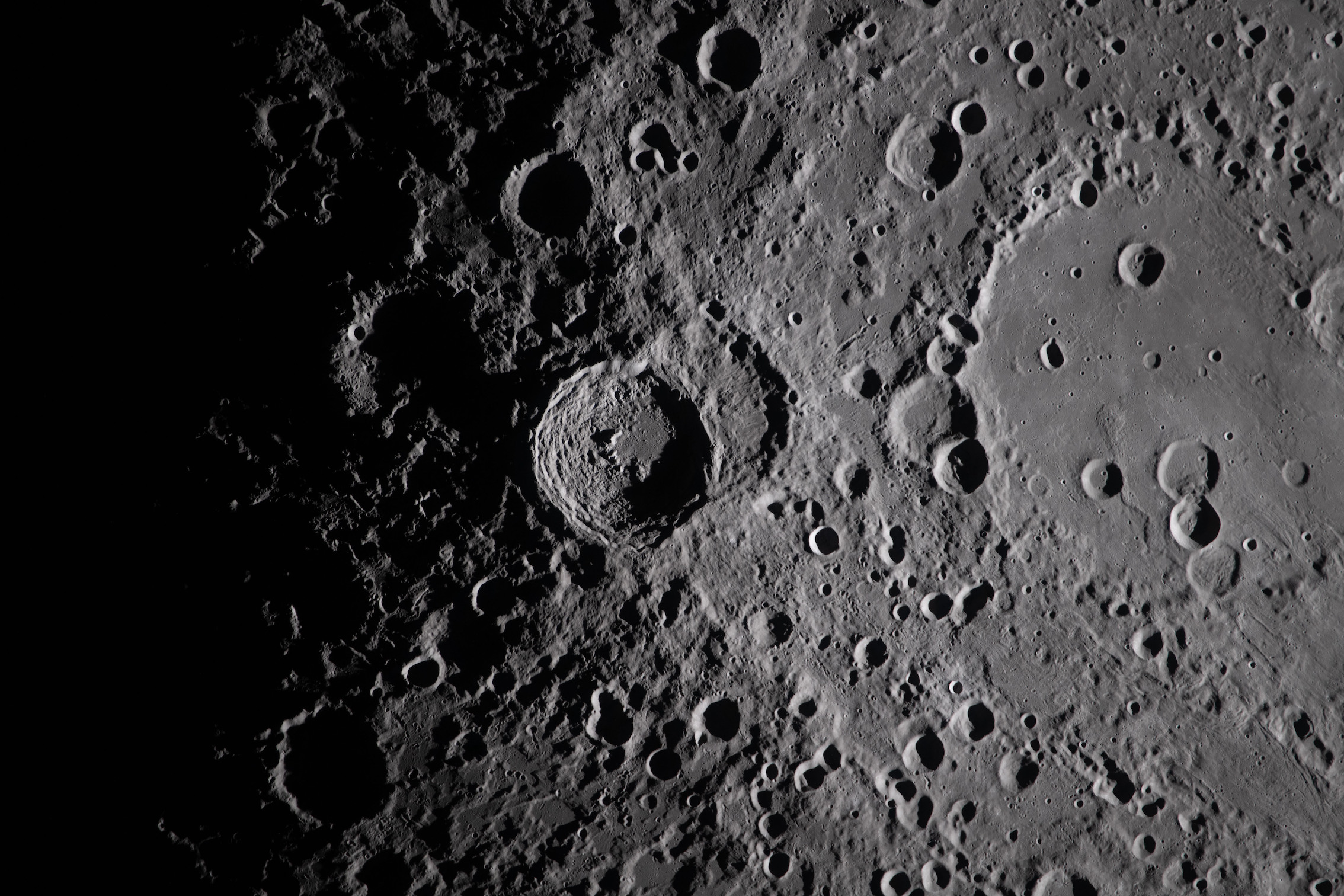
Christina Koch was struck by the Moon's bright craters that shone from the surface like pinpricks in a lampshade. She described her experience of observing the lunar surface with these words: “I just had an overwhelming sense of being moved by looking at the Moon. It lasted just a second or two and I actually couldn’t even make it happen again, but something just threw me in suddenly to the lunar landscape and it became real.” Victor Glover added: “I went straight where Christina went, and I was walking around down there on the surface, climbing and off-roading on that amazing terrain.”

Splashdown
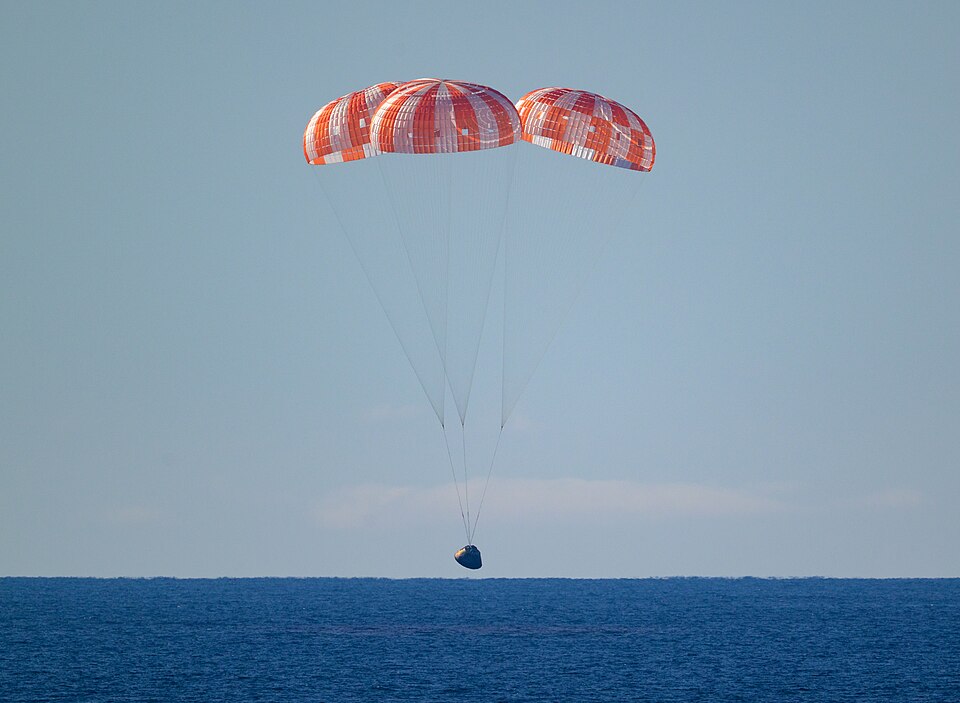
On flight day 10, Orion’s crew module and service module separated. Twenty minutes later, the crew module began its re-entry through Earth's atmosphere, travelling at a maximum speed of 39,693 km/h (24,664 mph). The spacecraft took a steeper trajectory than originally planned to reduce the period during which it was subjected to heating (the heat shield of Artemis I had become damaged during its re-entry). With the help of parachutes, the spacecraft rapidly decelerated. Splashdown occurred in the Pacific Ocean southwest of San Diego. A US Navy boat recovered the crew, attaching an inflatable raft to the side hatch on to which the crew members stepped as they left the capsule. They were then transported by helicopter for a post-flight medical check.