
Q-news

CITE
We have made every effort to follow citation style rules, but there may be some minor differences. If in doubt, please refer to the appropriate citation style manual.
Seven Earth-like planets discovered orbiting around a single star. (2022). In Q-files Encyclopedia, , Q-news. Retrieved from
https://www.q-files.com/news/seven-earth-like-planets-discovered-orbiting-around-a-single-star
"Seven Earth-like planets discovered orbiting around a single star." , Q-news, Q-files Encyclopedia, 10 Feb. 2022.
https://www.q-files.com/news/seven-earth-like-planets-discovered-orbiting-around-a-single-star.
Accessed 13 Sep. 2026.
Seven Earth-like planets discovered orbiting around a single star 2022. , Q-news. Retrieved 13 September 2026, from
https://www.q-files.com/news/seven-earth-like-planets-discovered-orbiting-around-a-single-star
, Q-news, s.v. "Seven Earth-like planets discovered orbiting around a single star," accessed September 13, 2026.
https://www.q-files.com/news/seven-earth-like-planets-discovered-orbiting-around-a-single-star


Seven Earth-like planets discovered orbiting around a single star
Astronomers have discovered seven Earth-sized planets found orbiting a nearby star in the constellation of Aquarius. Three of these exoplanets, as they are called, orbit in what is known as the “habitable zone” of that star, the region in which a planet could be kept warm enough to allow liquid water to exist on its surface—just like our Earth. Lying about 40 light years away from Earth, the parent star, known as Trappist-1, is much smaller and cooler than our Sun: it is classified as a red dwarf, also known as an M-dwarf. Only a little larger than Jupiter, the dwarf star shines with a light about 2000 times fainter than our Sun. The discovery of the exoplanets has raised hopes that finding life beyond our own Solar System is now more likely.
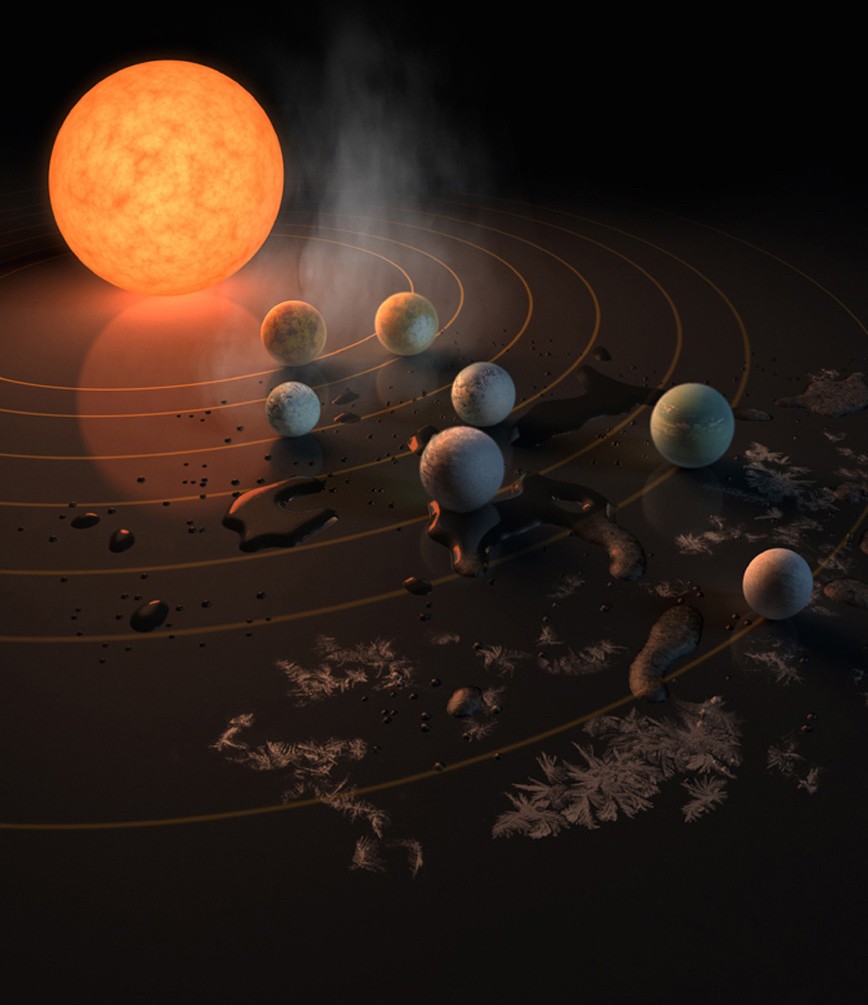
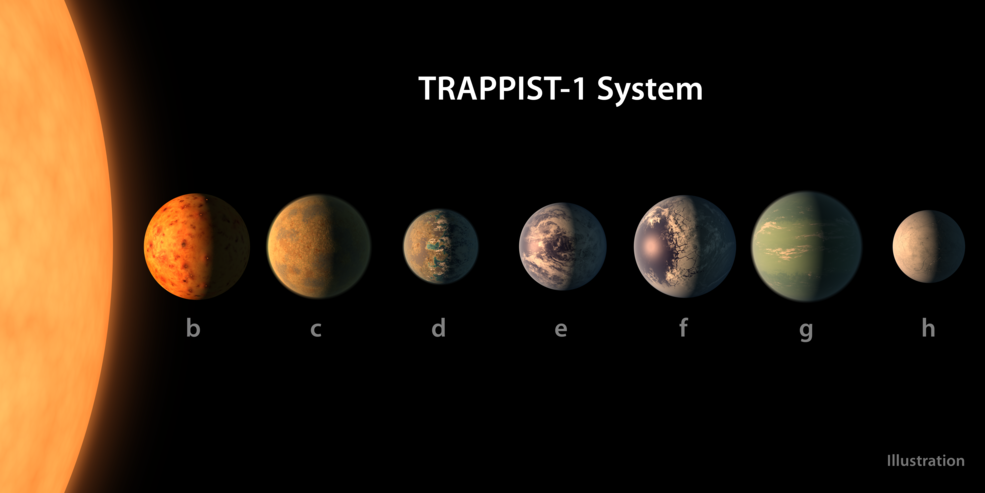

All images NASA/JPL-Caltech
Could life exist there?
All seven exoplanets lie close to their parent star—and to one another. Mercury, the innermost planet in our Solar System, is six times farther from the Sun than the outermost seventh planet is from Trappist-1. The nearest planet orbits the star in just 1.51 days while the outermost takes 12.35 days. Because Trappist-1’s energy is so weak, its habitable zone is much closer than that of the Sun.
Because they are so close to Trappist-1, the planets are likely to be “tidally locked” to it, meaning they show only one face to the star, just as one side of the Moon always faces Earth. The side of the planet facing the star might be very hot while the side facing away is very cold. Red dwarf stars are known to release flares of X-rays and ultraviolet radiation, both of which can be harmful to life (although UV might be vital for producing the chemical compounds that are necessary for life). So it is by no means certain that life has evolved on any of the planets—yet.

The view from the planetary surface
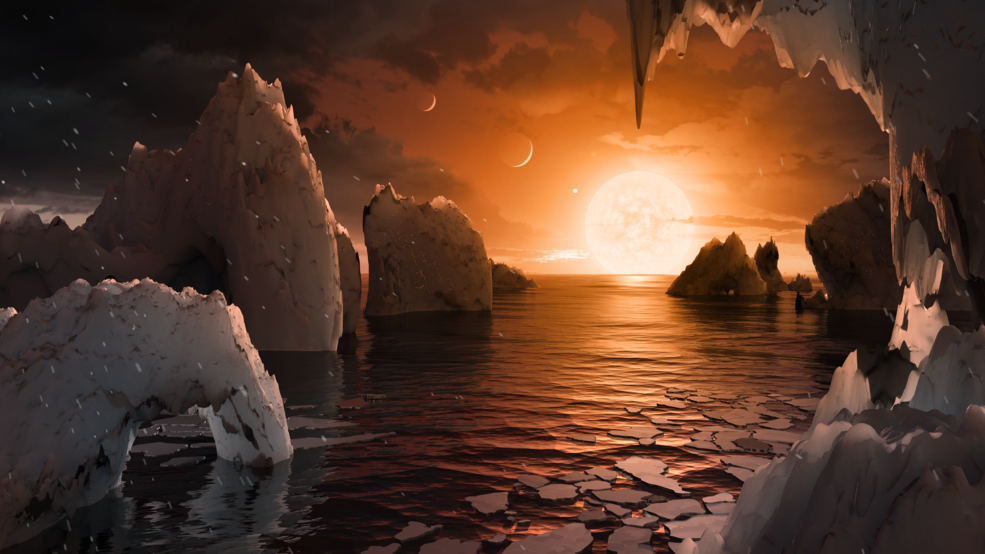
If anyone were to land on the surface of, say, the fifth planet (considered the most habitable of the seven), Trappist-1, a salmon-pink sun, would appear 10 times larger than the Sun in our sky. The other planets would loom up to twice the size of the Moon as seen from Earth.
Discovering exoplanets
The first exoplanet around a Sun-like star was discovered in 1995: a giant planet not unlike Jupiter. Since then, astronomers have been finding smaller and smaller worlds. In August 2016, an Earth-sized world was discovered around Proxima Centauri, the nearest star to the Sun.
The Trappist-1 discovery is the first time that so many Earth-sized exoplanets (their sizes range from 25% smaller to 10% larger) have been found orbiting the same star. So it seems more likely that the Milky Way Galaxy contains millions of such Earth-like worlds, and that the chances of alien life existing somewhere are higher.
How did they find the Trappist-1 planets?
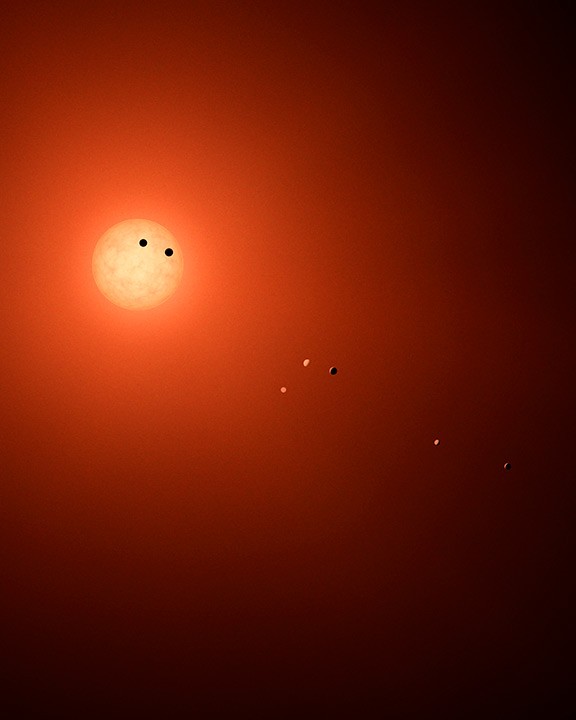
Some of the planets were first detected by an Earth-based telescope: the Trappist (Transiting Planets and Planetesimals Small Telescoperobotic) telescope in the Chilean desert, after which the star is named. Their shadows were observed as they crossed the face of the star. This prompted further investigation, with NASA’s Spitzer space telescope later revealing a total of seven planets circling Trappist-1. The size of each planet was calculated from the amount of starlight it blocked out. Estimated measurements of their masses indicate that at least six are rocky.

What next?
Using the new James Webb Space Telescope (JWST), launching in 2018, astronomers will be able to analyse these exoplanets’ atmospheres. In particular, they will look for water vapour—liquid water is a key requirement for life to exist—along with oxygen and methane. Water can exist without life, however, so the researchers will hope to detect other molecules such as ozone, which could be a surer indicator for biological activity on the planets.
The JWST will also record the planets' temperatures and surface pressures, both key factors as to whether they are able to support life.