
How dinosaurs lived

CITE
We have made every effort to follow citation style rules, but there may be some minor differences. If in doubt, please refer to the appropriate citation style manual.
Discovering dinosaur fossils. (2026). In Q-files Encyclopedia, Prehistoric, How dinosaurs lived. Retrieved from
https://www.q-files.com/prehistoric/how-dinosaurs-lived/discovering-dinosaur-fossils
"Discovering dinosaur fossils." Prehistoric, How dinosaurs lived, Q-files Encyclopedia, 11 Mar. 2026.
https://www.q-files.com/prehistoric/how-dinosaurs-lived/discovering-dinosaur-fossils.
Accessed 6 Aug. 2026.
Discovering dinosaur fossils 2026. Prehistoric, How dinosaurs lived. Retrieved 6 August 2026, from
https://www.q-files.com/prehistoric/how-dinosaurs-lived/discovering-dinosaur-fossils
Prehistoric, How dinosaurs lived, s.v. "Discovering dinosaur fossils," accessed August 6, 2026.
https://www.q-files.com/prehistoric/how-dinosaurs-lived/discovering-dinosaur-fossils


Discovering dinosaur fossils
All we know about the dinosaurs has been gleaned from the study of their fossils. This science is called palaeontology. Much information can be gained—a dinosaur’s size, the way it moved, its diet—particularly when linked to knowledge of how modern animals live. Skin or feather impressions, footprints, eggs and dung are fossils, too, and provide further evidence about the dinosaurs’ lifestyles.

Fossil formation
Fossils form when a dead creature is quickly buried in sediment such as mud, sand or silt, for example, on a river bed or in the sea (1) The soft parts, including the internal organs, skin and muscle, usually quickly rot away, but minerals in the water fill up all the tiny spaces inside the hard parts that remain, such as shell, bones or teeth (2) Over millions of years, the layers of sediment build up and gradually compact into hard rock. The rock layers are often tilted or folded due to Earth movements (3). If that rock layer comes to the surface, perhaps as the result of erosion, the fossil may be revealed and discovered (4).
Not only body parts formed fossils. Signs of animals did too, like footprints made in soft mud by dinosaurs. The depth of the prints and the distance between them, tell us how fast a dinosaur walked or ran.
Where dinosaur
fossils are found
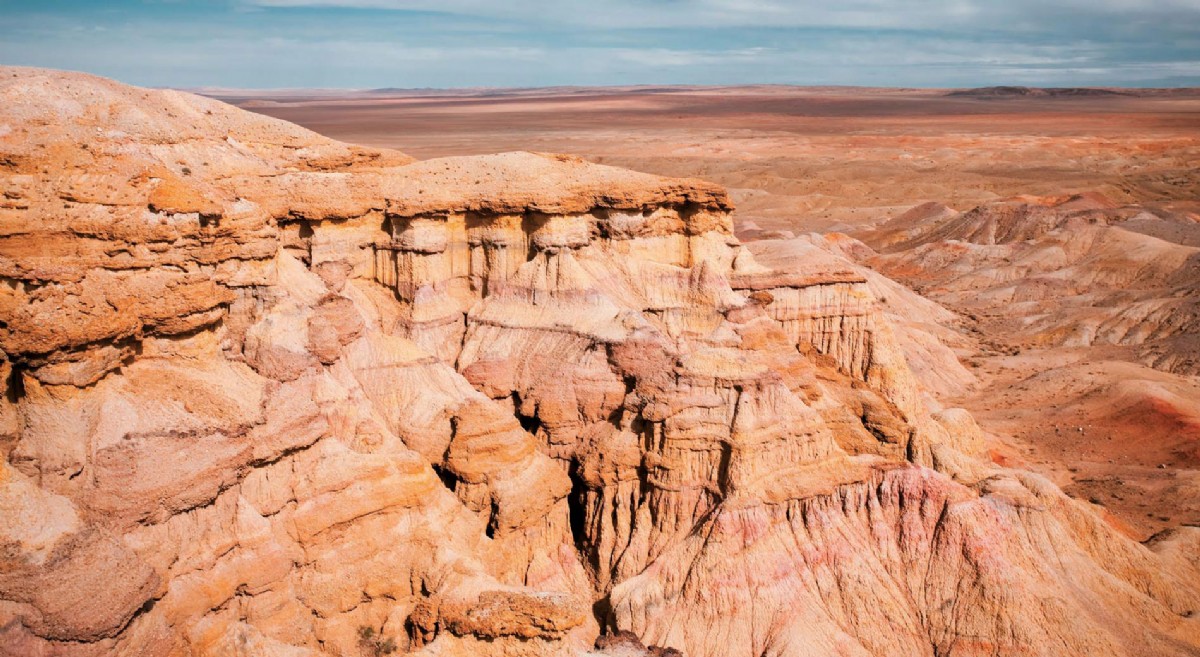
Fossils are formed only in certain kinds of sedimentary rocks. These rocks are made up from sand, mud, the fragments of other rocks, or the remains of once-living organisms, compressed and cemented together. Dinosaur fossils come from rocks of the Triassic, Jurassic or Cretaceous periods. There are only a few places in the world where these rocks are exposed at the surface. They include remote areas such as the Gobi Desert, the American West or western Argentina.
Aids to fossil hunting
Geological maps, aerial photographs and satellite imagery also help to pinpoint likely fossil-bearing sites. Palaeontologists undertaking large-scale expeditions usually investigate certain areas whose geological history they know already, and where they expect to find specimens.

Fossil sites
The first task facing palaeontologists is to find dinosaur fossils in the rocks. Rather than dig holes and hope to find them by chance, they will concentrate their efforts on exposed rocks in certain places.
Fossil-hunting is easiest where rocks are not covered by soil, trees and plants. The fossils can be seen at the surface, or dug out from just beneath. Many dinosaur fossil sites are in bare, rocky areas with hills and cliffs, far from roads or towns.
Where to spot a fossil
The Badlands of the American West have yielded many dinosaur fossils. They are a type of dry terrain where sedimentary rocks have been extensively eroded by wind and water, which leads to fossils being newly exposed. Palaeontologists look for shapes or textures in the rock: bones or teeth have a smoother, shinier outer surface—or even a different colour—to the surrounding rock. Many important finds are spotted by accident.

Excavation site
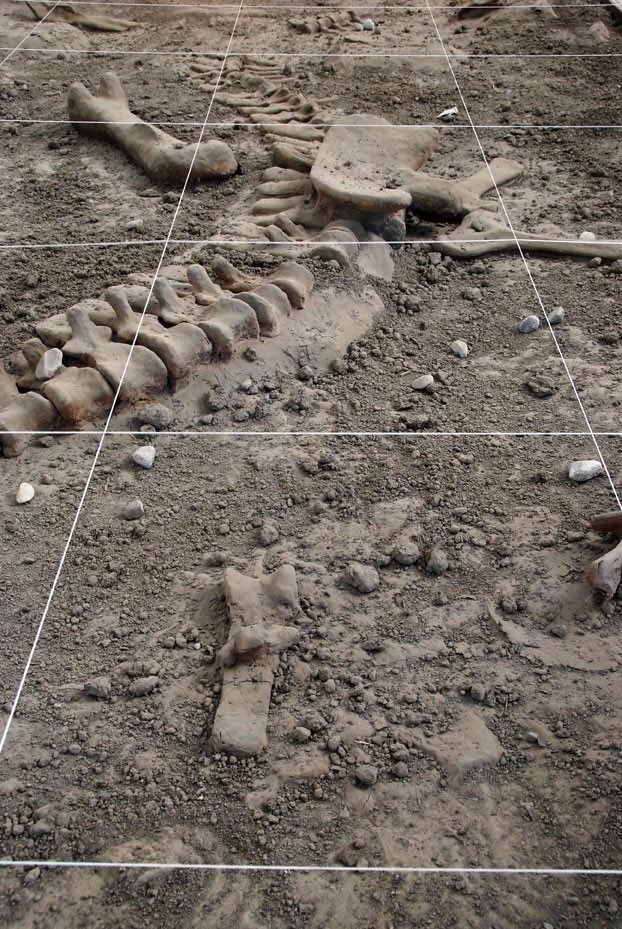
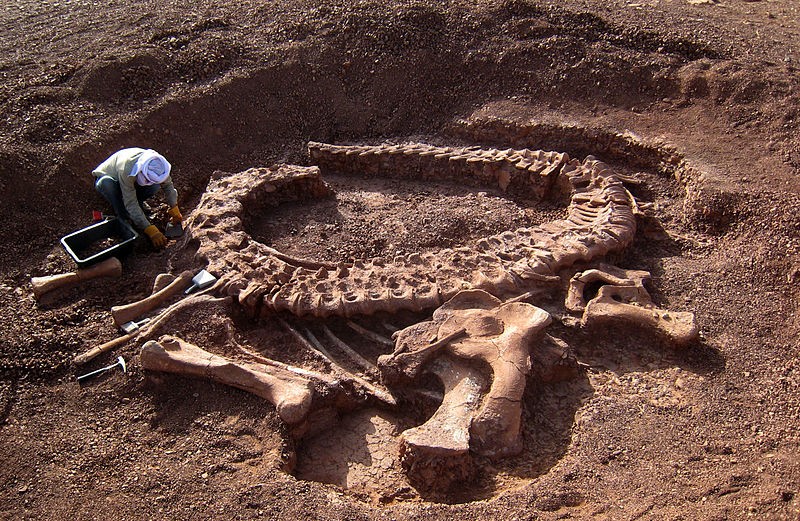
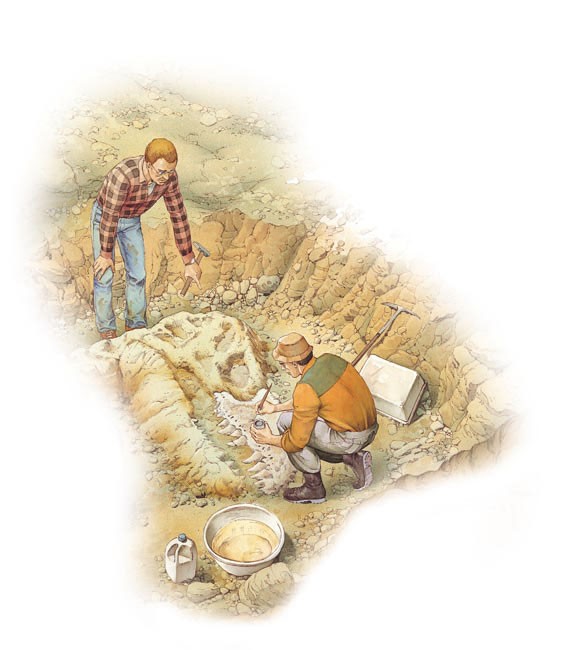
The place where fossils are found is known as the “dig”. Here, palaeontologists, scientists who study fossils, carry out the task of getting the fossils out of the ground. It is often painstaking work.


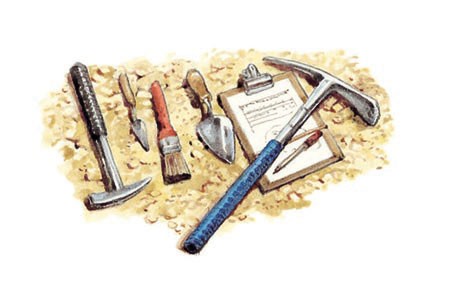
When palaeontologists find a fossil, they carefully scrape away the rock, called the matrix, from around the bones using hammers, chisels and scrapers. Dental picks and other fine tools are used for work on the tiniest, most delicate fossils. The matrix is not normally completely removed from around a fossil until it reaches the laboratory. Extracting a specimen from the rock or removing the rock that lies above it, the overburden, can risk damaging the fossil. Throughout the excavation, scientists take photos and make notes about its exact location.
Most palaeontologists create detailed site maps showing the precise location and orientation (the direction it lies in) of every bone found in its original place. Locating other animal and plant fossils nearby helps to reveal more about the ancient environment and possibly what the dinosaur once fed on.

The discovery of “Sue”
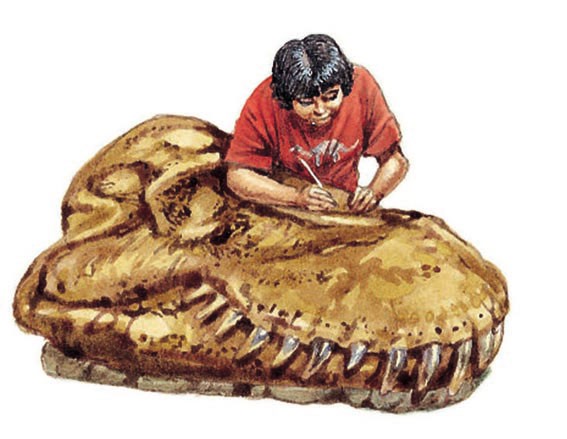
A whole fossil dinosaur, with all the bones in place, next to each other, is an extremely rare find. “Sue” was a fossil Tyrannosaurus discovered in 1990, with almost all her parts present. Her skull, slightly squashed, is 1.5 metres (5 feet) long. Being of solid rock, it weighs about one-third of a tonne.
Usually, the bones, teeth and other fossil parts of a find are squashed, broken and jumbled, with many bones missing. It can take months, or years even, to clean all the rock away and piece the fossils together. Matching parts that are missing are often “borrowed” from another dinosaur of a similar type.
Preparing and
transporting fossils
Before the block containing the fossil is freed from the ground, the palaeontologists coat the bones with glue or resin to prevent them from crumbling. Next, they wrap the surface of the fossils in bandages soaked in plaster of Paris—just as if putting a broken arm in a cast. The fossil is now stabilized: it will be kept together and protected from damage during transport. Now the block is dug out and the underside stabilized. It is now ready for transport back to the laboratory—by road, or even by helicopter if the terrain is particularly difficult for cars or trucks.

Dinosaur lab
Once the blocks containing the precious fossil bones arrive at the laboratory, work begins on removing the rest of the matrix. First, the preparators clear away large pieces of rocky matrix by using a hammer and chisel or a miniature jackhammer, a kind of pneumatic drill. For particularly thick lumps of matrix, a shot-blaster, which fires iron or plastic pellets at the rock, might be used. As each part of the fossil is exposed, the surface is coated with liquid rubber to protect it from the full force of the pellets. If the matrix is made of limestone it might be dissolved away with acid. Although slow, this technique is good for small, delicate fossils, so long as it does not damage them.
Next, the bones are cleaned of all remaining grains of rock using a miniature sandblaster, a dentist's drill or other precision tools, including scalpels and needles. This is painstaking work: it can take years to prepare a whole skeleton.
Making copies
After cleaning and repairing the bones, preparators make exact copies. This is both to make scientific study easier and for the purposes of reassembling a skeleton for display. Rubber moulds of the bones are filled with liquid plastic that solidifies into exact copies. The tiniest details of the originals are preserved in the casts. Missing bones need to be made, too, either by recreating bones from other similar dinosaur fossils, or by producing new ones using computer generated modelling techniques.

The skull belonging to the T. rex "Sue" was copied twice. The first, the research cast, is a replica of the original skull, exactly as it was found with its snout squashed—damage that occurred shortly after death. The research cast allows scientists to study it with all the original details intact. The second copy was pieced back together to create a corrected cast: a reconstruction of what the head would have looked like in life.
Consultant: Chris Jarvis
pics
Without in any way limiting Q-files Ltd’s exclusive rights under copyright, any use of this publication to “train” generative artificial intelligence (AI) technologies to generate text is expressly prohibited. Q-files Ltd reserves all rights to license use of this work for generative AI training and development of machine learning language models.