
Story of humans
Stone Age
The Palaeolithic period, or Old Stone Age, describes the time between the first use of simple tools by early human-like creatures (about 3.3 million years ago) to the start of the Neolithic period, or New Stone Age, when people began to farm the land (11,500 years ago in the Middle East, later elsewhere). During the Palaeolithic, human beings travelled from place to place, eating wild plants and hunting wild animals. The start of farming brought a continuous supply of food, which meant that people could live in the same place all year round. The Neolithic lasted until people started to make their tools from bronze rather than stone. The Bronze Age began around 3300 BC in the Middle East and India, but a little later in Egypt, China and other parts of the world.

Lower Palaeolithic toolmakers
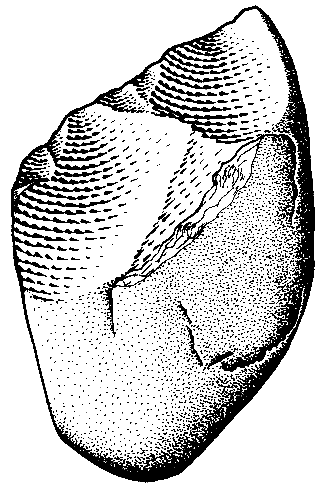
The Lower Palaeolithic began with the appearance of the very simplest stone tools, around 3.3 million years ago, in East Africa. These were large pebbles that had been struck by other stones, knocking off flakes to produce sharp, cutting edges. We do not know which human-like creatures made these first tools, which pre-date the first true humans, Homo habilis, by about 700,000 years. Ape-like australopithecines are known to have lived in the area where the tools were discovered and may have been the first toolmaking hominins (humans or human ancestors).
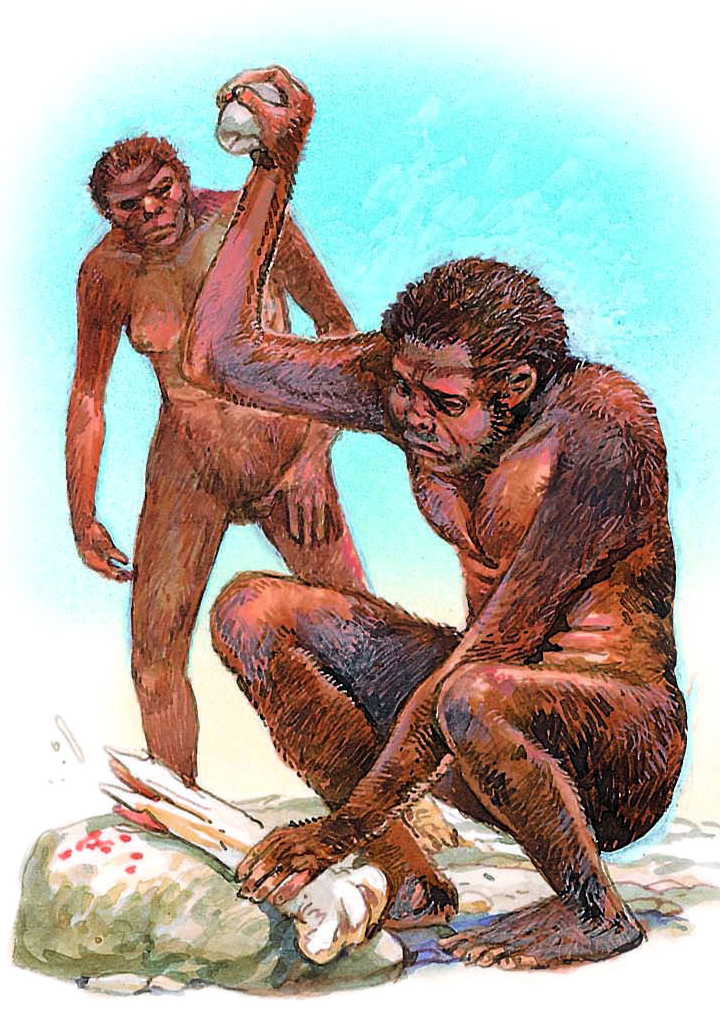
Homo habilis, still quite an ape-like creature, used simple stone tools, called "pebble tools", rather than its teeth or its bare hands, to kill and skin animals for food. It could have also used the tools to smash bones, dig up plant tubers or break open nuts and seeds. Humans, in the form of Homo erectus(or their close relatives) became more skilled toolmakers about 1.7 million years ago. They crafted hand axes, carefully shaping them with soft hammers made of wood, bone or antler, so they had sharp edges for slicing, a blunt end for pounding and a point for skewering. As Homo erectus spread out across Africa, Asia and Europe, so their vital, multi-purpose tool, the hand axe, travelled with them.

Middle Palaeolithic
Homo sapiens—modern humans—probably first emerged in Africa by around 300,000 years ago, marking the beginning of the Middle Palaeolithic. It is likely Homo sapiens evolved gradually from the mingling of different groups of ancient humans from all over Africa. At some point (the dates are uncertain), Homo sapiens began to spread around the globe, probably in a series of migrations. An early wave of human migrants reached Australia at least 65,000 years ago.
Upper Palaeolithic
About 50,000 years ago, there was a marked acceleration in the modernness of human lifestyles and sophistication of the things they made. People started to bury their dead, wear ornaments, use hides to make clothes and create cave paintings. Their tools became more refined, and they hunted and fished using more advanced techniques and equipment. This development, which some scientists describe as a kind of "revolution", marks the beginning of the period known as the Upper Palaeolithic. It coincides with the rapid expansion of modern humans from Africa throughout Asia, Europe and Australia, between 50,000 and 40,000 years ago.

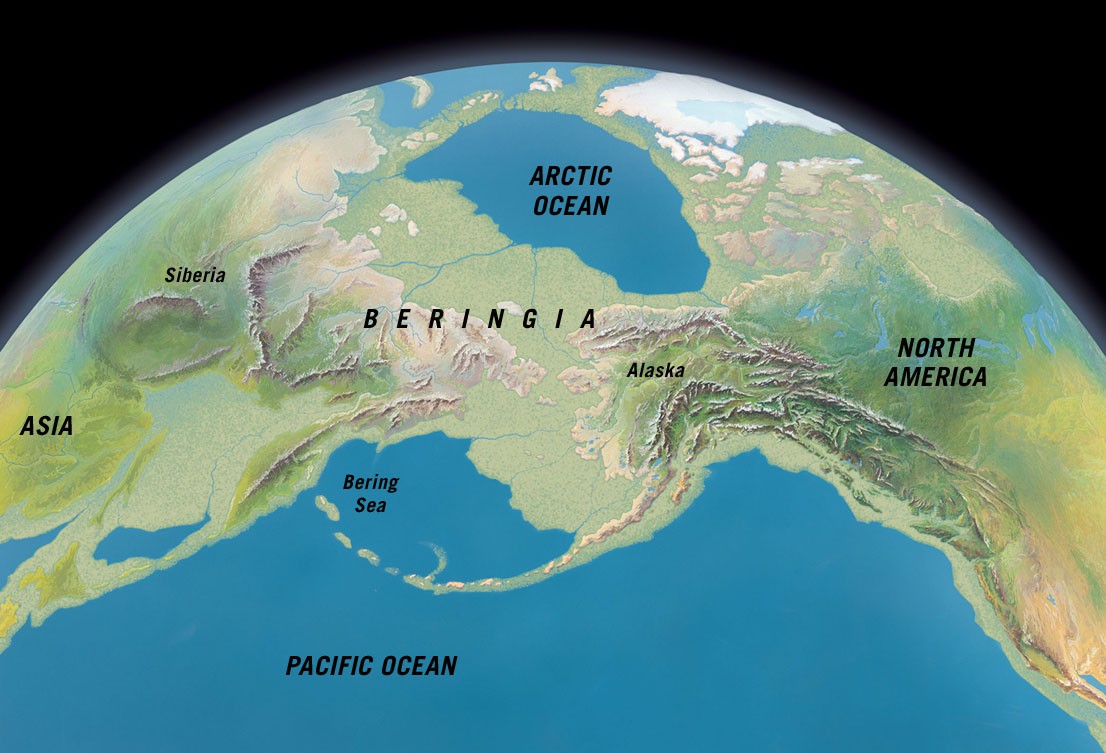
Humans first crossed from Asia into North America after about 26,500 years ago. This was during the last Ice Age, a time when the Bering Sea, which lies between Siberia and Alaska, was dry land. Later, despite the presence of great ice sheets covering Canada, humans began spreading south through the Americas, reaching what is now the southwestern United States 23,000–21,000 years ago. They arrived at the southernmost tip of South America by at least around 14,600 years ago.
Hunters
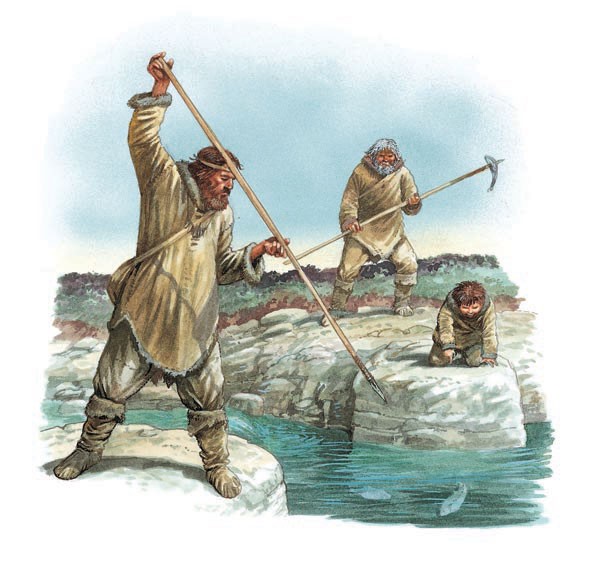
Hunters living in Upper Palaeolithic times became skilled and made effective weapons. They were cunning and learned to use tell-tale signs for finding animals, such as footprints and broken branches. They also managed to trap some of the larger animals by driving them over cliffs or into bogs. As people developed language, they could communicate plans to one another, which also made hunting easier with better results.

The hunters used spears, bows and arrows and knives to kill prey, and fish hooks to catch fish from the rivers and lakes. They did not wander round aimlessly, hoping some animals would come their way. They studied the lie of the land and learned where animals were likely to gather or shelter. They also saw that some animals moved to different areas when the weather got colder or hotter. This study of their environment saved them a lot of time and effort and made life easier.
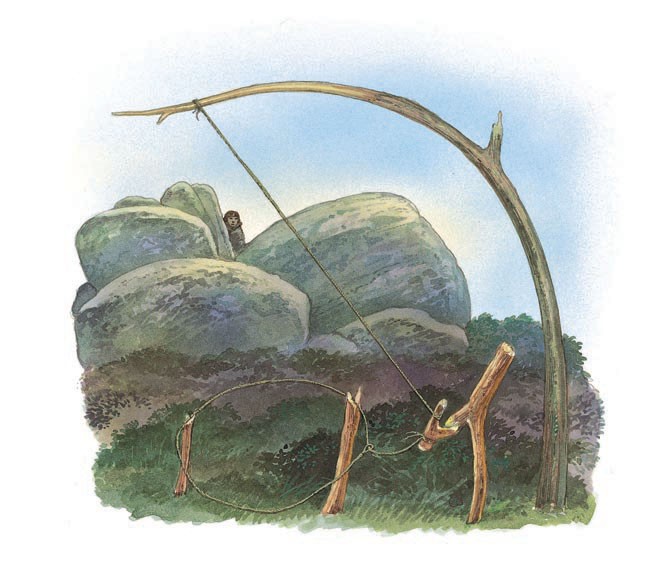
Trapping was a crafty way to catch small animals and birds. Set where there were signs of animal movement, such as tracks, dung or flattened grass, a loop with a slip knot from twisted grass made a simple snare. A springy branch, with a trigger attached, acted as a spring mechanism. An animal passing through the snare would dislodge the trigger. The branch would spring upwards and tighten the loop around the prey.

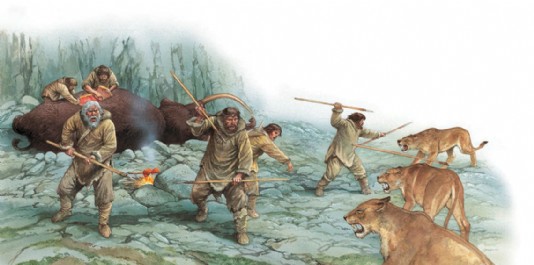
Most people lived in small groups of two or three families (called a "clan"), because the meat from a single woolly mammoth or bison kill went a long way with only a small number of people to feed. Clans sometimes became larger if there was a lot of food around. Each group would have relied on the oldest, most experienced clan members to make decisions and plans for the others.
Spear-throwers
From about 30,000 years ago, stone age hunters in many parts of the world began to use spear-throwers (also known as atlatls—in the language of the Aztecs—in North America, and woomeras by Aboriginal Australians). These were tools that allowed throwers to get much more speed and distance with their weapons.
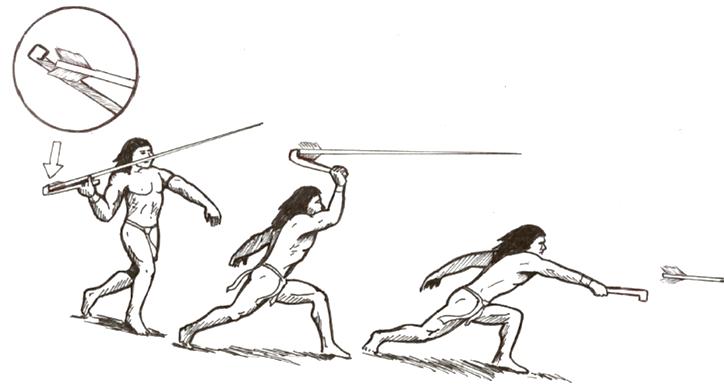
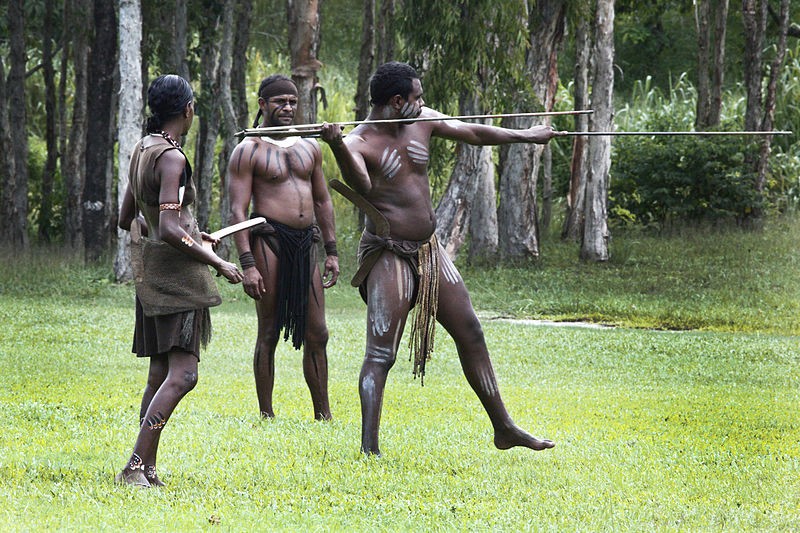
A spear-thrower consisted of a shaft roughly as long as the user's forearm made of wood, bamboo, bone or antler and with a cup or socket at one end. The user gripped the end of the spear-thrower farthest from the cup, which supported the the butt end of the spear, before thrusting the spear towards the target. The throwing arm together with the spear-thrower acted as a lever, with the spear-thrower increasing the length of the lever, enabling the spear to be thrown with greater force. Modern ball throwers—plastic "arms" used for throwing balls for dogs to fetch—use the same principle.
Gathering food
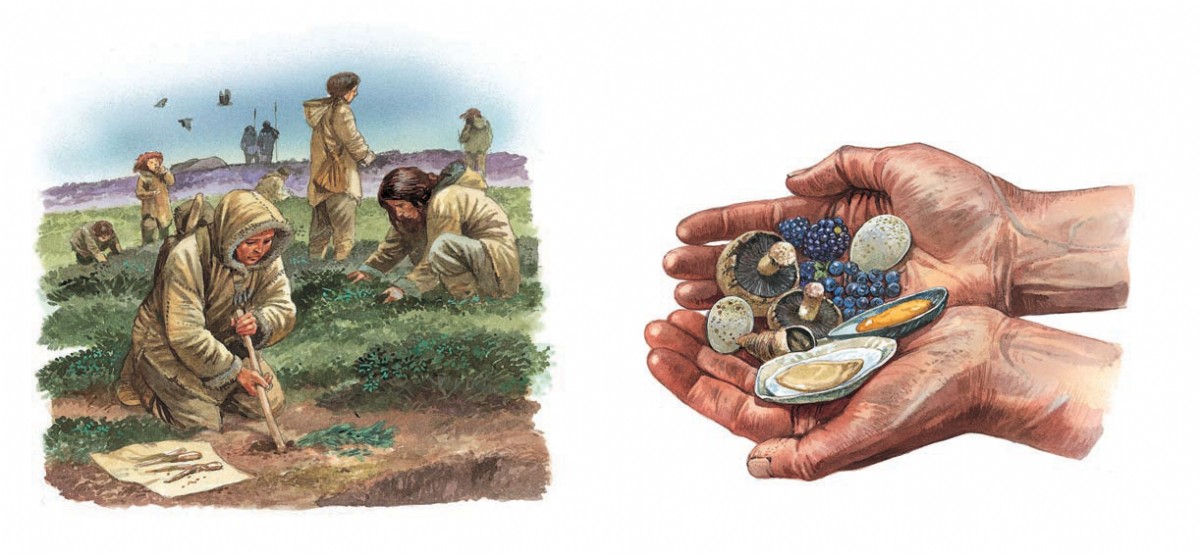
Stone age people are also known as hunter-gatherers. Hunting was important, but plant food was vital, too, because it provided a more varied diet. People came to know where certain nuts, fruit and grasses grew. They learned that bees made honey, which could be used to sweeten food. They dug into the ground to find roots and tubers. Plants provided a regular supply of food during the growing season, which could keep the group nourished if hunting became difficult. Insects, an important source of protein, would have also been gathered. But meat remained an essential part of the Stone Age diet.

Making clothes
Animal skins had many uses, including making clothes. First the skins had to be prepared so that they did not split apart. Each skin was stretched out on the ground and scraped to remove the animal fat. Then it was smoothed with a bone tool to make it supple and easier to work with.
When the skins were ready, they were cut into shape with a stone knife. Holes were punched along the edges so that they could be sewn together using a bone needle and a length of sinew (animal muscle tendon).

Building shelters
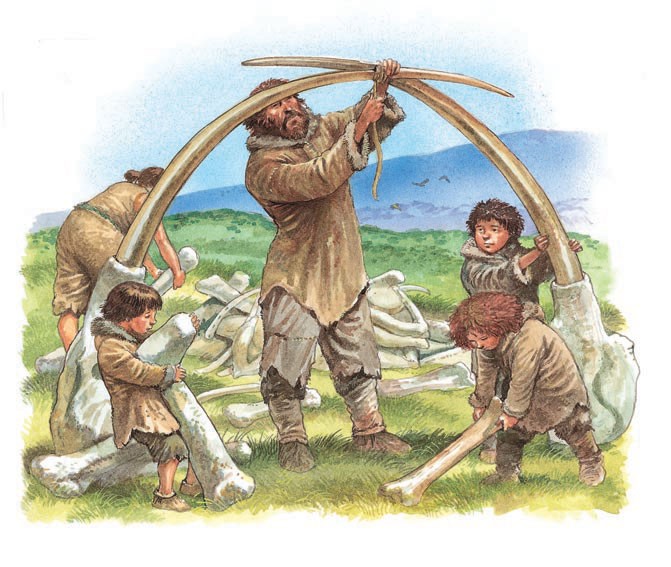
At the end of each day, the group gathered back at camp. Their shelters were made from whatever material was available. Some tents were made from animal skins draped over simple wooden frames. Mammoth-hunters built huts from mammoth bones. Shelters could also be made by weaving branches together to form screens, which were curved round and covered with skins to make cosy huts. The shelters were usually grouped in a circle to protect the group both from wild animals and bad weather. The fire also deterred the animals from approaching.
Consultant: Chris Jarvis
Palaeolithic timeline*
3.8 million years ago
First australopithecines (“southern apes”) evolve in various parts of northeastern Africa. Scientists have found their bones and fossilized footprints. They are believed to be the direct ancestors of modern humans.
3.3 million years ago
First evidence of use of stone tools by human-like species in Kenya, possibly by Kenyanthropus platyops or by Australopithecus afarensis. This is the beginning of the Old Stone Age or Palaeolithic.
2.4 million years ago
Homo habilis, the first known true humans, evolve in Africa. Their name means "handy man" as they use simple stone tools called pebble tools.
2 million years ago
Homo erectus evolves in Africa. These type of humans, or close relatives of them, are thought to be the ancestors of all later humans. They walk upright and are as tall as modern humans, but their brains are a little smaller. Around 1.8 million years ago, some Homo erectus migrate from Africa to West Asia (Georgia), East Asia (China) and Southeast Asia (Java).
1.7 million years ago
First hand axes, or Acheulian tools, appear in East Africa. They are probably made by Homo erectus, or Homo ergaster (a similar, possibly identical) species.
800,000 years ago
A new kind of human called Homo heidelbergensis, has evolved from Homo erectus (probably) in Africa. Heidelbergs have more brain power than their ancestors. As well as gathering fruits and nuts to eat, they hunt large animals, tracking them and ambushing them with stealth and cunning, working together as a team.
700,000 years ago
Some Homo heidelbergensis migrate to Europe. They make tools from animal bone and antler as well as stone. They are expert hunters and have begun to use fire.
400,000 years ago
Neanderthals are living in Europe. They adapt well to life in the cold. They have stocky bodies that help them conserve heat, and large noses that warm the cold air as they breathe. They are successful hunters, using a wide range of stone tools, and they wear simple clothes made from animal skins to keep themselves warm. They also create art and jewellery. Close relatives of Neanderthals, Denisovans, later spread across Asia.
300,000 years ago
The Middle Palaeolithic begins. Homo sapiens (modern humans) evolve in Africa, probably from Homo erectus or its descendants in Africa. Around 270,000 years ago, Homo sapiens spreads out from Africa into Asia and Europe, probably in a series of migrations over many tens of thousands of years.
190,000–50,000 years ago
Homo floresiensis, a species of human, lives on the island of Flores, Indonesia (to where its ancestors may have first migrated 1 million years or more ago). Standing about 1.1 m (3 ft 7 inches) in height, it is nicknamed the "hobbit".
160,000 years ago
First flake tools, known as Mousterian tools, including scrapers, knives and points, are made by Neanderthals in Europe and Homo sapiens in North Africa and the Near East.
55,000–50,000 years ago
Upper Palaeolithic Revolution: a much more advanced Homo sapiens—people who have developed sophisticated language and devised more effective tools, weapons and hunting techniques—emerges in Africa. Migrating to Asia and Europe in far greater numbers than before, they meet Neanderthals and Denisovans on their travels and interbreed. Eventually, their descendants reach all corners of the globe.
40,000 years ago
Neanderthal people decline rapidly in numbers and eventually go extinct.
35,000 years ago
Modern humans in Europe have begun expressing themselves with art. They produce cave paintings, illustrating the animals they hunt. They also make beads and carvings of human and animal figures in bone, antler and ivory.
26,500 years ago
The last glacial period is at its coldest. So much water is locked up in ice sheets covering North America, Europe and Asia that sea levels are up to 120 m (400 ft) lower than they are today. This exposes an area of land about 1500 km (about 1000 miles) wide that today lies under the Bering Sea, between Siberia and Alaska. Modern humans, following their prey animals, such as reindeer and mammoth, cross the Bering “land bridge” from Siberia into Alaska.
23,000 years ago
People start migrating south along the west coast of the Americas as the coast becomes ice-free. They settle all parts of the Americas, eventually reaching the southernmost tip of South America around 14,600 years ago.
11,500 years ago
The last glacial period comes to an end. The Earth’s climate starts to warm up once again, the ice caps melt and sea levels rise. Land once covered by ice starts to become vegetated. New plants grow, especially trees. Animals, such as bison, horses and reindeer, move into these areas, closely followed by human hunters. In southwestern Asia, the Palaeolithic (Old Stone Age) comes to an end as some human cultures start to domesticate animals and plants, and change their lifestyle from hunting and gathering to one of agriculture and settlement. And so the Neolithic (New Stone Age) begins.
* Dates are approximate
*