
EASY READ Science
What are the properties of solids?
Besides their chemical make-up (what kind of atoms and molecules they are made of), solid materials have different qualities or properties. These include, for example, whether they are hard or soft, heavy or light, or shiny or dull. Some materials are stronger than others. Some are denser (have more mass per cubic metre) than others. Some are more elastic (stretchy) than others. Some are more malleable (can be bent or moulded without breaking) than others. Other properties are: how well the material conducts heat and electricity, whether it dissolves in liquid or another liquid or not, and what its boiling and melting points are.

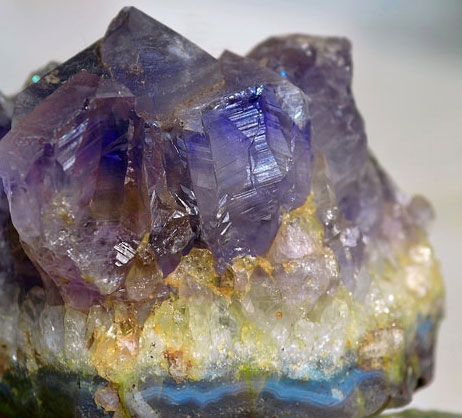
Crystals
Many solid materials are not irregular lumps, but have fixed shapes. Their atoms or molecules are arranged in regular patterns, known as crystals. These have sharp edges and flat sides. Some solids, for example glass, have no regular pattern in their molecules.
Molecules of salt (pictured below, left) are are arranged in a regular pattern forming a cube. Salt crystals (below, right) are therefore cube-shaped.

Stress and strain
Some solids can also be broken up by stress, while others will stretch. Using a force or adding a load to something leads to stress. In a metal, stress causes the layers of atoms to shift out of position, sliding across one another. This is what makes pure metals malleable (bendable). In a pure metal, the atoms can shift quickly—or slowly over a long period of time.
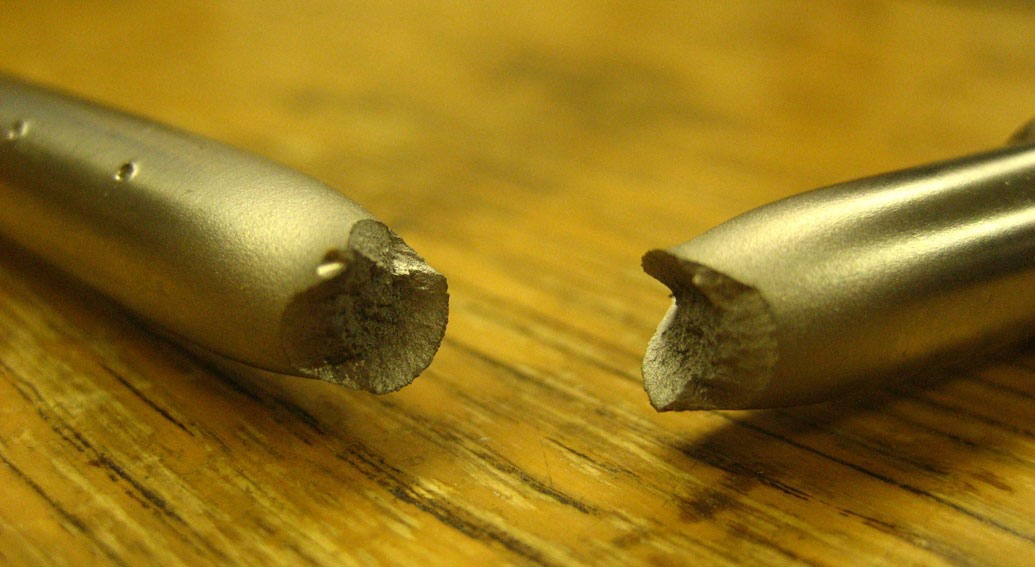
By mixing in atoms of other elements, the atom layers can be fixed into position more securely. This is what happens in metal alloys. Bridges are made of steel. This stronger material is far less likely to break apart than iron. But fixing the layers also makes many alloys brittle (see below) rather than malleable.


Plasticity
There is a limit to how elastic a material can be. If the material is stretched beyond that limit, the material will not return to its original shape. This property of changing shape permanently is called plasticity. (Note: this is not the same as being made of plastic.) Materials such as dough (a mixture of flour and water for making bread) and clay are highly plastic. Other plastic materials, such as most metals, need a great deal of force to change their shapes, unless they are heated.


Brittleness
Some materials, such as glass, break almost immediately when they are struck. They have no elasticity. This property is called brittleness. Other materials become brittle after they have been heated. Clay, for example, becomes brittle after being baked in a kiln.
Conductivity
Material made of crystals, such as metals, are good conductors of heat and electricity. The electrons in their atoms can move easily from atom to atom. Non-crystal materials, like plastics, glass and wood, are poor conductors. They are, however, good insulators—materials that prevent the flow of electricity or heat. This is why plastic, for example, is used to cover wires in an electric cable or in handles for saucepans in the kitchen.

Consultant: Mike Goldsmith
Ready to find out more?
Here are some pages in other parts of Q-files you might like to explore: