
EASY READ Science
What is gravity?
Gravity is an invisible force that attracts objects to one another. Every object in the Universe, from a pen to a planet, has gravity, but bigger objects have more gravity than smaller ones. Every time you jump up in the air, you fall back down to Earth again. This is because the Earth’s gravity is pulling you towards it.


Isaac Newton
The English scientist Sir Isaac Newton was the first person to understand that gravity affects objects in space, like the Moon, Earth and Sun, in the same way that it affects things on Earth—like us. The story goes that he was struck by this idea when he saw an apple fall to the ground. Both the apple and the Earth have gravity, but because the Earth is huge compared to the apple, we see the apple moving towards the Earth and not the other way round.
Newton also realised that the nearer an object is, the stronger is its force of gravity on other objects. The further away it is, the weaker the force. The Earth is very big and very near, so for us its gravity is strong. However, as you travel further away its gravity weakens, although even at the distance of the Moon, it is still strong enough to keep the Moon in orbit around the Earth.
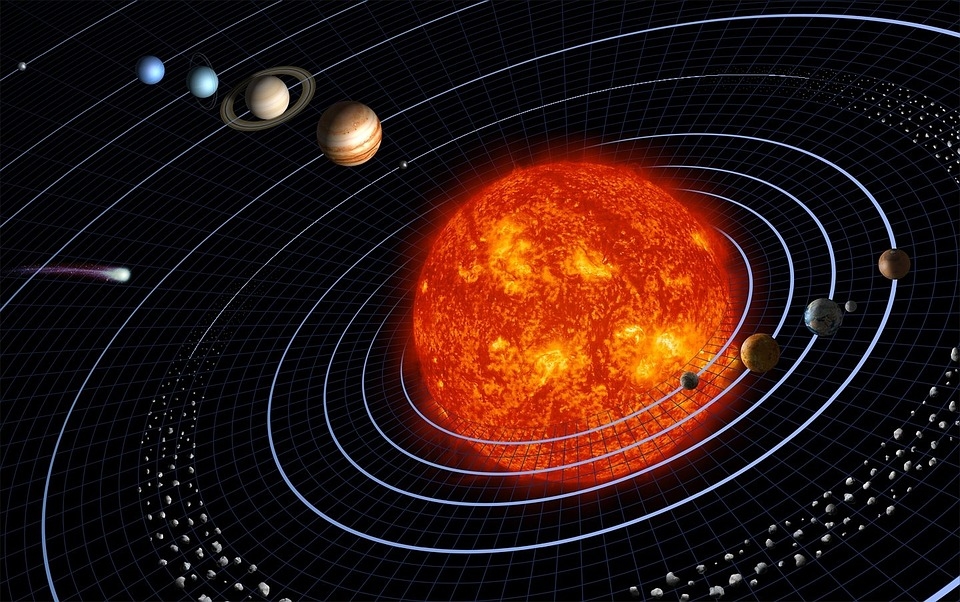
However, the planets remain in their orbits and never collide with the Sun. This is because they are travelling fast enough for their momentum (the tendency for moving objects to carry on moving) to balance exactly the Sun’s force of gravity. In space there is no air resistance to slow the planets down, so they carry on moving at the same speed.
Mass and weight
Weight is a measure of how much gravity is acting on an object. This is different from mass, which is a measure of how much matter (atoms and molecules) a substance contains. An apple would weigh less on the Moon than it does on Earth because the Moon is smaller and so has less gravity. But the apple’s mass would be the same in both places.

Weightlessness
Weightlessness is something you feel when there is no object either pushing or pulling you. When you sit on a seat you experience two forces: the force of the Earth's gravity pulling you downwards and the force of the seat pushing you upwards, known as the contact force. When you are lifted out of your seat on a rollercoaster, you feel weightless for a brief moment—until gravity pulls you back on to your seat.
But if your seat wasn't there, your feeling of being weightless would continue, because there is no contact force (previously provided by your seat) balancing the pull of gravity. You would be in free fall, hurtling towards the ground.
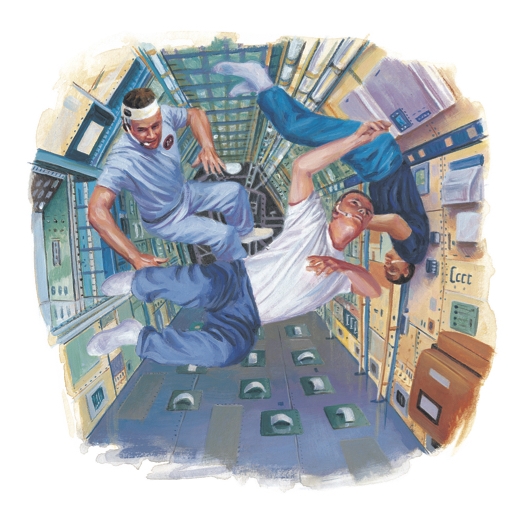
Astronauts on the International Space Station feel weightless because they are in free fall all the time. Gravity still has a strong pull on the Station—it is only about 350 kilometres (218 miles) above the Earth—but because it orbits the Earth at high speed, its momentum balances the Earth's gravity. This is the same as what happens with the planets orbiting the Sun. The Station stays at the same height above the Earth, along with the astronauts safely inside it.

Acceleration
As objects fall to the ground, they get faster and faster: they accelerate. This is due to gravity. On Earth, this acceleration does not continue for very long, because the resistance of the air slows the objects down as they fall. The Italian scientist Galileo proved that, were it not for the effects of air resistance, all objects would accelerate at the same rate, however great their mass. If you were to drop a rock and a feather on the Moon, where there is no air, they would hit the ground at the same time.
Consultant: Mike Goldsmith
Ready to find out more?
Here are some pages in other parts of Q-files you might like to explore: