
EASY READ Science

CITE
We have made every effort to follow citation style rules, but there may be some minor differences. If in doubt, please refer to the appropriate citation style manual.
EASY READ How are colours produced?. (2026). In Q-files Encyclopedia, Science, EASY READ Science. Retrieved from
https://www.q-files.com/science/easy-read-science/easy-read-how-are-colours-produced
"EASY READ How are colours produced?." Science, EASY READ Science, Q-files Encyclopedia, 10 Mar. 2026.
https://www.q-files.com/science/easy-read-science/easy-read-how-are-colours-produced.
Accessed 13 Sep. 2026.
EASY READ How are colours produced? 2026. Science, EASY READ Science. Retrieved 13 September 2026, from
https://www.q-files.com/science/easy-read-science/easy-read-how-are-colours-produced
Science, EASY READ Science, s.v. "EASY READ How are colours produced?," accessed September 13, 2026.
https://www.q-files.com/science/easy-read-science/easy-read-how-are-colours-produced


How are colours produced?
Sunlight—bright white light—is a mixture of all the colours of the rainbow. This is called the spectrum of light. The different colours can be seen when a beam is shone through a shaped piece of glass called a prism. The prism bends the light waves. Red waves bend the least, while violet waves bend the most. Raindrops sometimes act as mini-prisms. They split light into the colours of the spectrum. We see them as a rainbow.



Seeing colours
We see colours because some objects reflect different colours of light. Some reflect mostly one colour. Grass, for example, reflects mostly green light, so it appears green. Others reflect a mixture of colours.
Primary colours
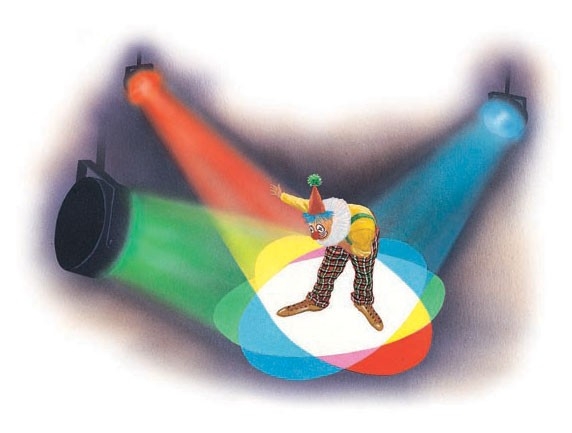
Only three, red, green and blue are needed for our eyes to see every colour there is. These are called the primary colours of light. Many different colours can be made by mixing together primary colours in different amounts. For example, red and green together make the colour yellow. Mixing all three together makes white light.

Consultant: Mike Goldsmith
Ready to find out more?
Here are some pages in other parts of Q-files you might like to explore:
pics
Without in any way limiting Q-files Ltd’s exclusive rights under copyright, any use of this publication to “train” generative artificial intelligence (AI) technologies to generate text is expressly prohibited. Q-files Ltd reserves all rights to license use of this work for generative AI training and development of machine learning language models.