
EASY READ Science

CITE
We have made every effort to follow citation style rules, but there may be some minor differences. If in doubt, please refer to the appropriate citation style manual.
EASY READ What is magnetism?. (2026). In Q-files Encyclopedia, Science, EASY READ Science. Retrieved from
https://www.q-files.com/science/easy-read-science/easy-read-what-is-magnetism
"EASY READ What is magnetism?." Science, EASY READ Science, Q-files Encyclopedia, 10 Mar. 2026.
https://www.q-files.com/science/easy-read-science/easy-read-what-is-magnetism.
Accessed 13 Sep. 2026.
EASY READ What is magnetism? 2026. Science, EASY READ Science. Retrieved 13 September 2026, from
https://www.q-files.com/science/easy-read-science/easy-read-what-is-magnetism
Science, EASY READ Science, s.v. "EASY READ What is magnetism?," accessed September 13, 2026.
https://www.q-files.com/science/easy-read-science/easy-read-what-is-magnetism


What is magnetism?
Magnetism is a force that attracts some objects to other objects. We cannot see it, but it is all around us since the Earth itself is a magnet. Most magnets are pieces of metal, especially iron, that can pull other metal objects towards it. The force is present as a magnetic field around a magnet.


Magnetic poles
The magnetic field is strongest at two areas called the north and south poles. The north pole of one magnet attracts the south pole of another magnet. This is called magnetic attraction. But it pushes away or repels the other magnet’s north pole. This is called magnetic repulsion. The rule is that unlike poles attract, like poles repel.
Earth's magnetic field
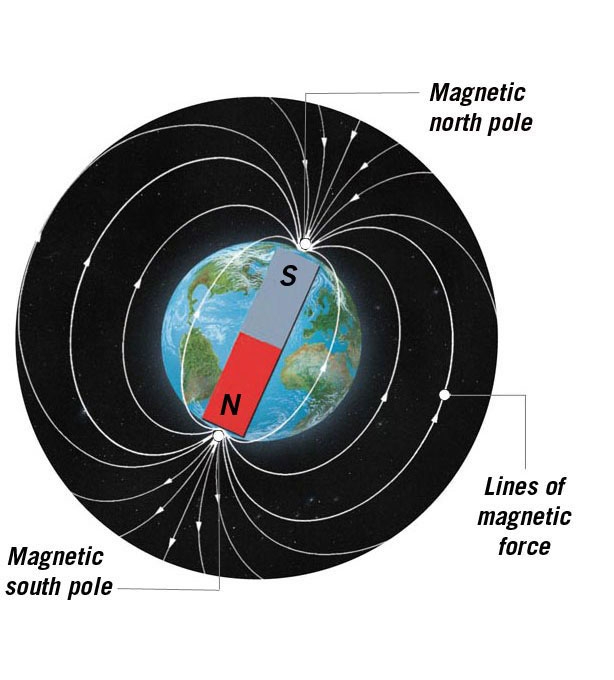
The lines of magnetic force in the Earth's magnetic field run as if there were a bar magnet placed at its centre. The bar magnet is tilted slightly away from the Earth’s axis of rotation, the imaginary line that runs from north to south pole around which the Earth spins. So the North Magnetic Pole and South Magnetic Pole lie a short distance away from the Earth's actual north and south poles.

The north pole of a compass needle points to the Earth's North Magnetic Pole from all parts of the globe.
Uses of magnets
Magnets of different sizes and shapes have hundreds of uses, from holding notes on a refrigerator to being vital parts in electrical generators, motors and loudspeakers. A scrapyard crane uses a powerful magnet called an electromagnet to pick up and drop heavy metal items.


Maglev trains use magnetic repulsion to enable them to float just above a rail. They can go much faster than ordinary trains.
Consultant: Mike Goldsmith
Ready to find out more?
Here are some pages in other parts of Q-files you might like to explore:
pics
Without in any way limiting Q-files Ltd’s exclusive rights under copyright, any use of this publication to “train” generative artificial intelligence (AI) technologies to generate text is expressly prohibited. Q-files Ltd reserves all rights to license use of this work for generative AI training and development of machine learning language models.