
Trains

CITE
We have made every effort to follow citation style rules, but there may be some minor differences. If in doubt, please refer to the appropriate citation style manual.
History of trains. (2026). In Q-files Encyclopedia, Technology, Trains. Retrieved from
https://www.q-files.com/technology/trains/history-of-trains
"History of trains." Technology, Trains, Q-files Encyclopedia, 13 Mar. 2026.
https://www.q-files.com/technology/trains/history-of-trains.
Accessed 20 Sep. 2026.
History of trains 2026. Technology, Trains. Retrieved 20 September 2026, from
https://www.q-files.com/technology/trains/history-of-trains
Technology, Trains, s.v. "History of trains," accessed September 20, 2026.
https://www.q-files.com/technology/trains/history-of-trains


History of trains
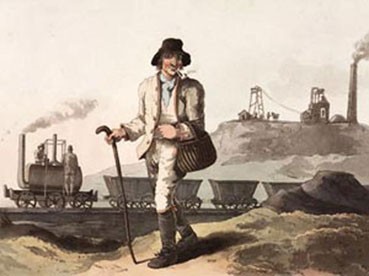
A train is a vehicle that runs on guide rails: a railway track. Miners have used simple wooden or iron railways called wagon-ways for hundreds of years to move rock, coal and ore in trucks. The trucks were pulled and pushed by animals or the miners themselves. The first locomotive powered by a steam engine was built in 1804 by English engineer Richard Trevithick, to haul trucks at an ironworks. The first passenger railway was the Stockton and Darlington Railway in England, which opened in 1825.
The first trains
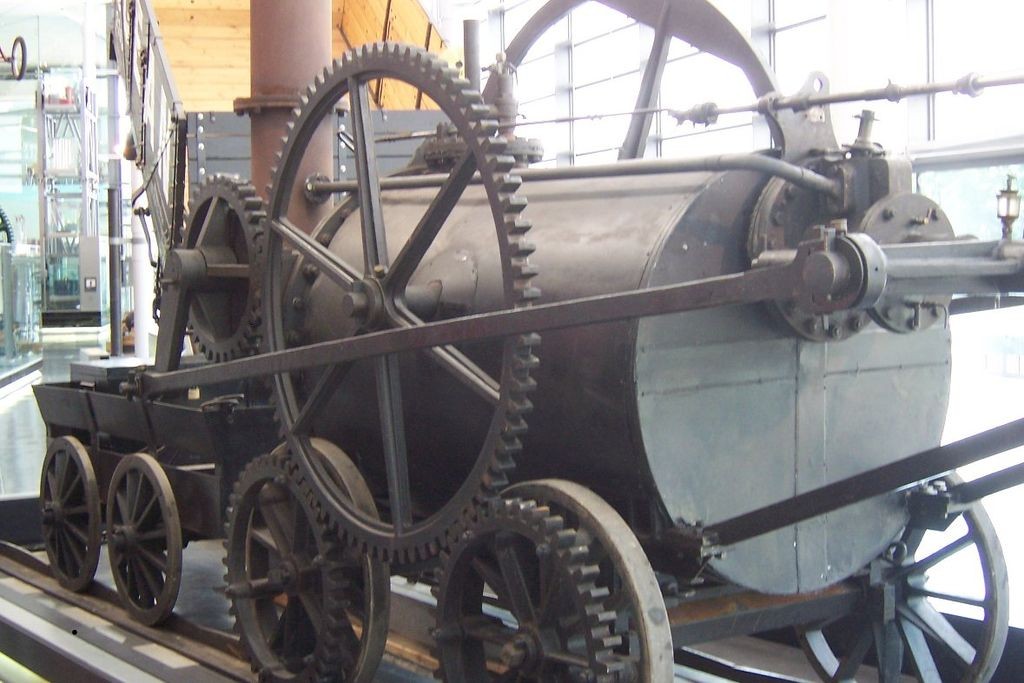
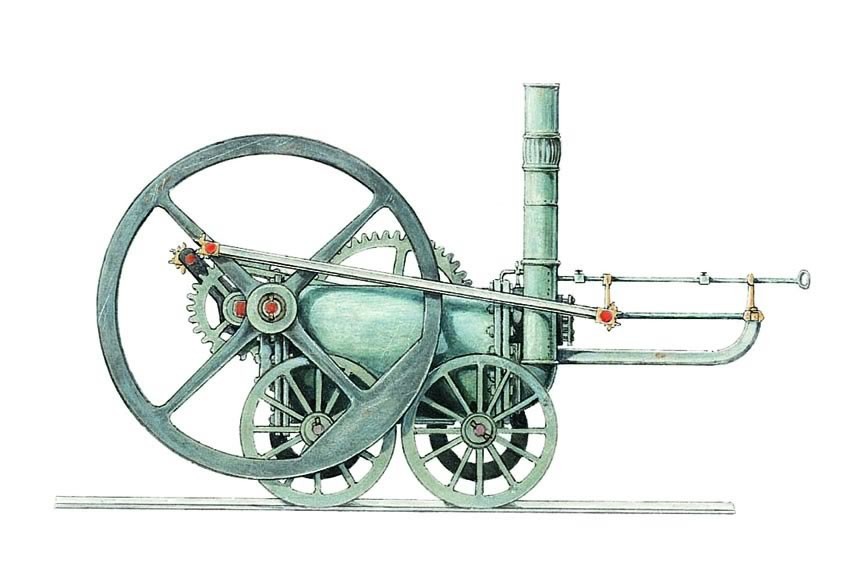
The first steam locomotive to run on rails was built by Richard Trevithick. His four-wheel locomotive made a demonstration run on 22nd February 1804, reaching 20 km/h (12 mph) when empty and 8 km/h (5 mph, a brisk walking-pace) when loaded. Unfortunately, the weight of the train broke the rails. By 1812, stronger tracks had been built between Middleton Colliery and Leeds, England. They carried the first successful steam locomotives.
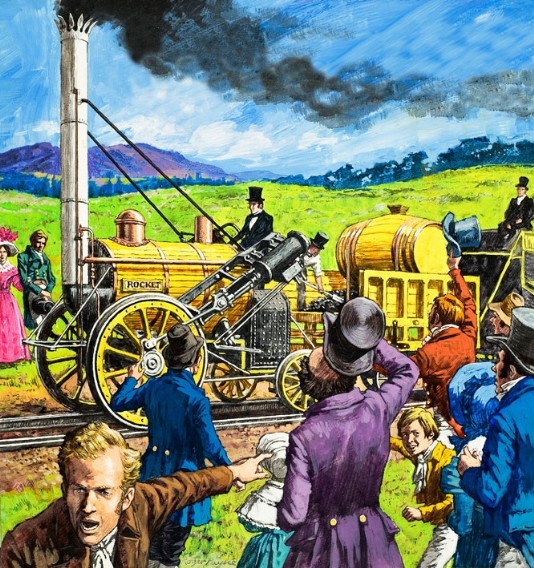
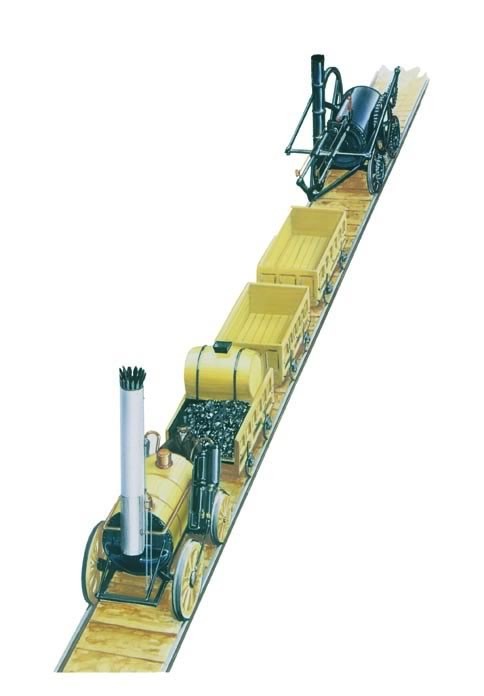
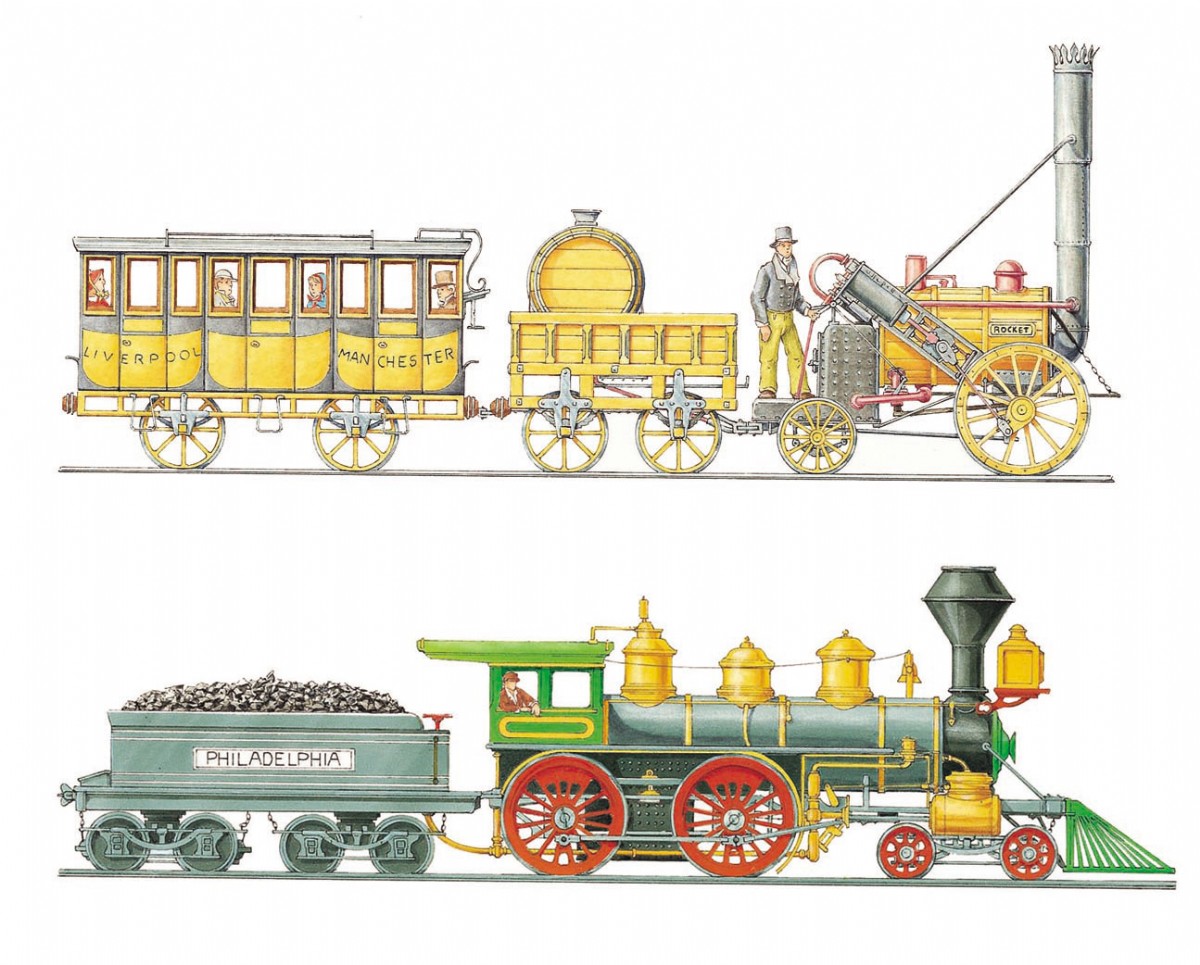
In 1829, while the new Liverpool and Manchester Railway was being built in northern England, a competition was held to find the best locomotive to run along it. The £500 prize was won easily by the Rocket, entered by George and Robert Stephenson. It reached the then breathtaking speed of 46.7 km/h (29 mph)—a world record—and its design was used to make all later steam locomotives. For the first time, people would be able to travel on land faster than by horse. Soon there were railways and locomotives all over the world.
How a steam locomotive works
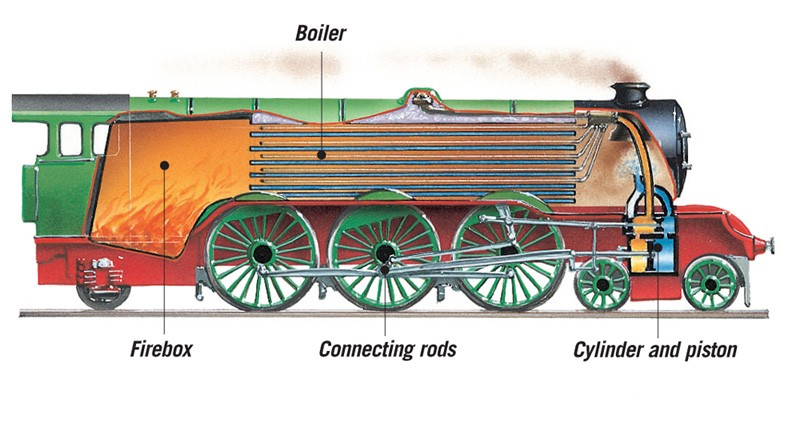
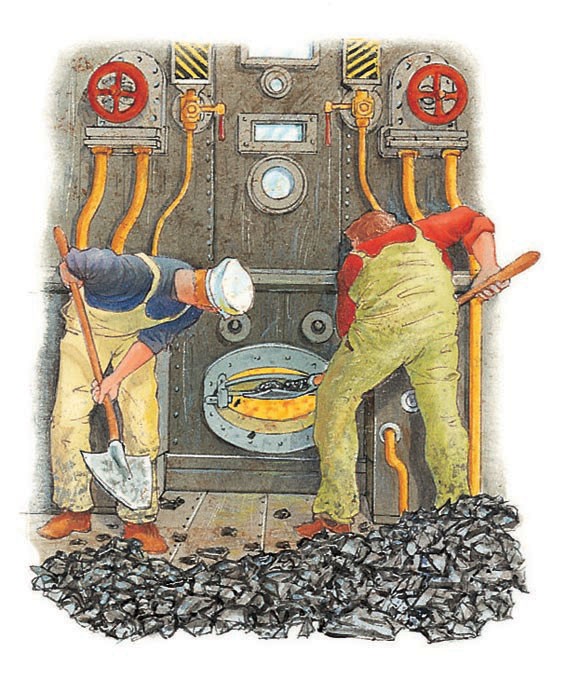
A steam locomotive is simply a steam engine on wheels. Fuel burns in the firebox, creating hot gases that pass along tubes inside the boiler. The heat from the tubes boils the water, creating steam. As more steam collects at the top of the boiler, its pressure builds up, and it escapes along pipes to the cylinders, where, controlled by valves, it pushes the pistons one way then the other (this is called double action). The motion of the pistons, sliding parts with disc-shaped heads, moves the large driving wheels round via a system of linked connecting rods. As well as a driver, steam locomotives needed firemen to keep the firebox supplied with fuel. The fuel (coal or timber) was carried in a tender behind the engine. Some locomotives had a mechanical stoker to supply the fire with fuel. Smoke from the furnace escapes through a funnel.
Spread of the railways
Extensive railway networks were developed during the second half of the 19th century, especially in the USA, Canada, Europe and Russia. Improvements in tracks, including the introduction of steel rails in the 1860s, allowed for heavier locomotives, with increased power and speed. Carriage design also improved, and dining cars and sleeping cars were introduced by George Pullman in the USA in 1865.
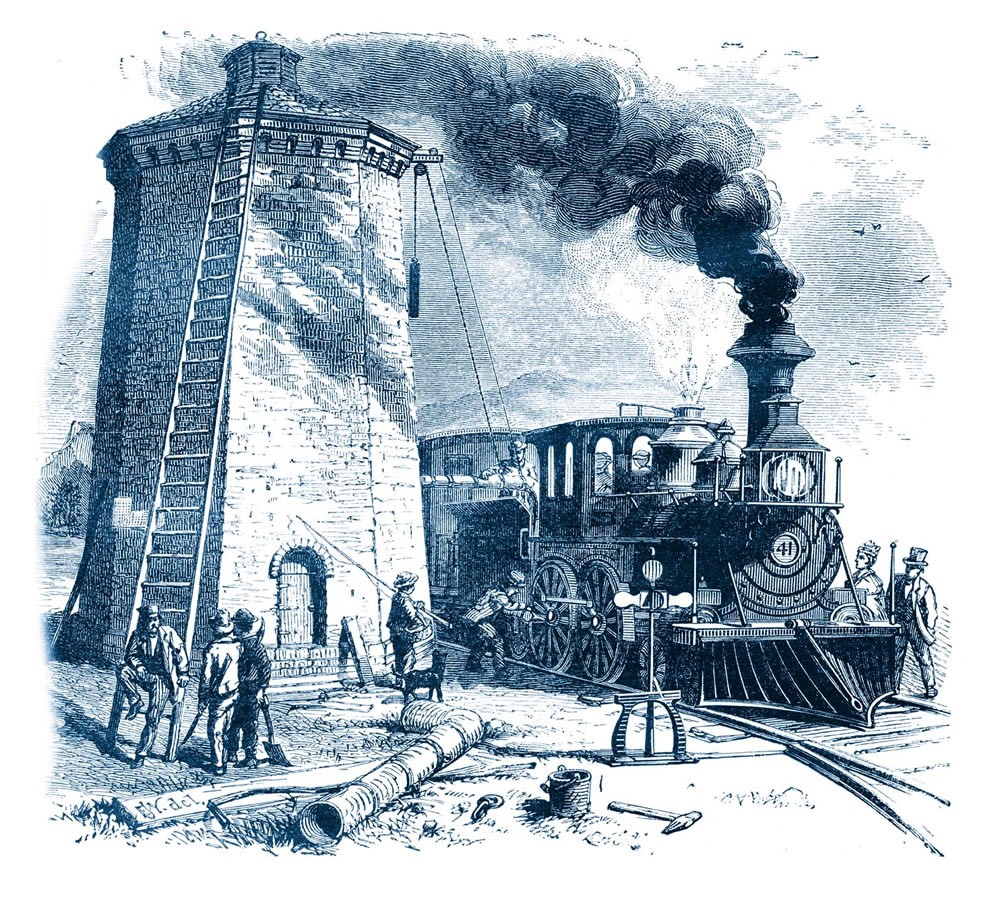
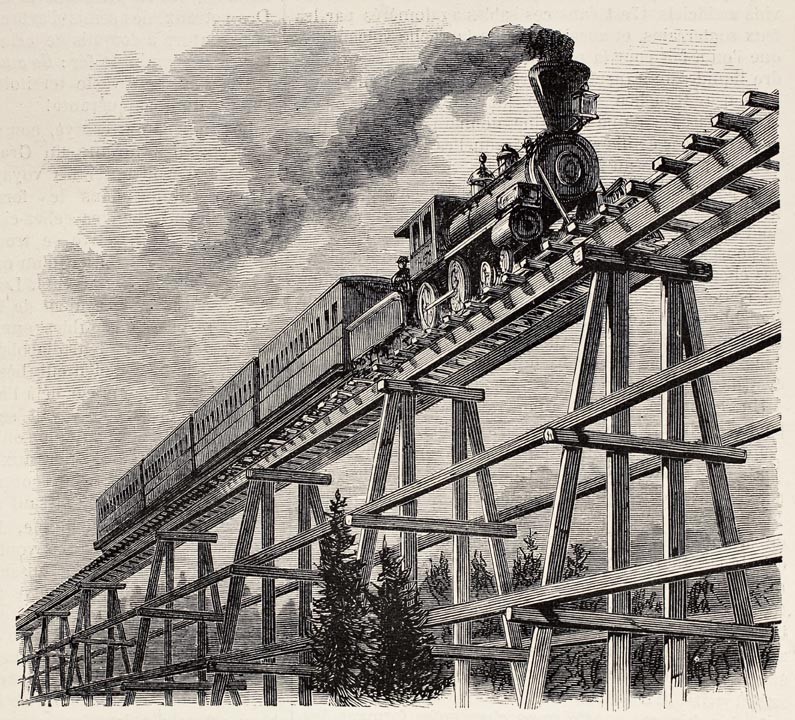
Railway networks relied on other engineering improvements. Long-span steel bridges carried trains over wide rivers, and rock tunnels took them under mountain ranges such as the Alps. From the 1850s the electric telegraph allowed communications between stations so that signalling staff could keep track of where the trains were.
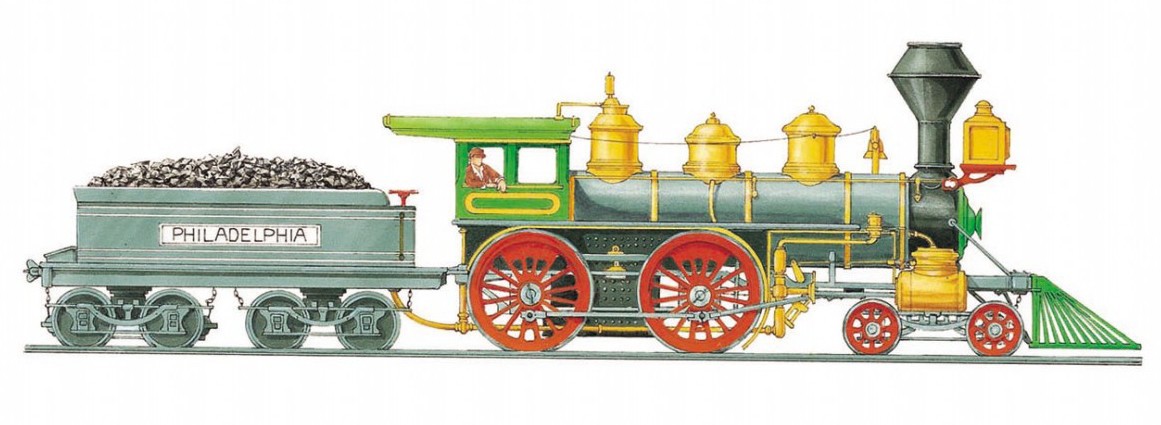
"Big Boy"
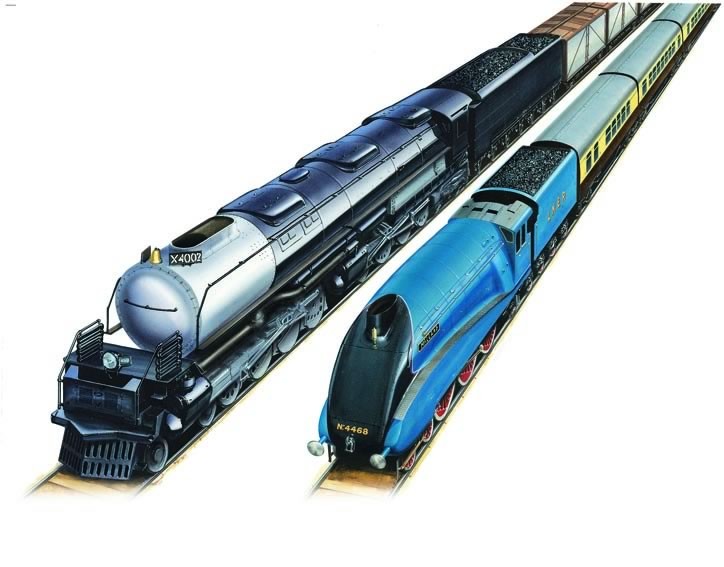
The largest, heaviest and most powerful locomotive was the Big Boy. Between 1941 and 1945, 25 of these giants were built by the American Locomotive Company of Schenectady, New York for the Union Pacific Railroad. They were 40 metres (131 feet) long and weighed more than 600 tonnes. The Big Boy locomotives hauled ore trains with more than 70 wagons—a load six times their own weight—between Wyoming and Utah, USA.
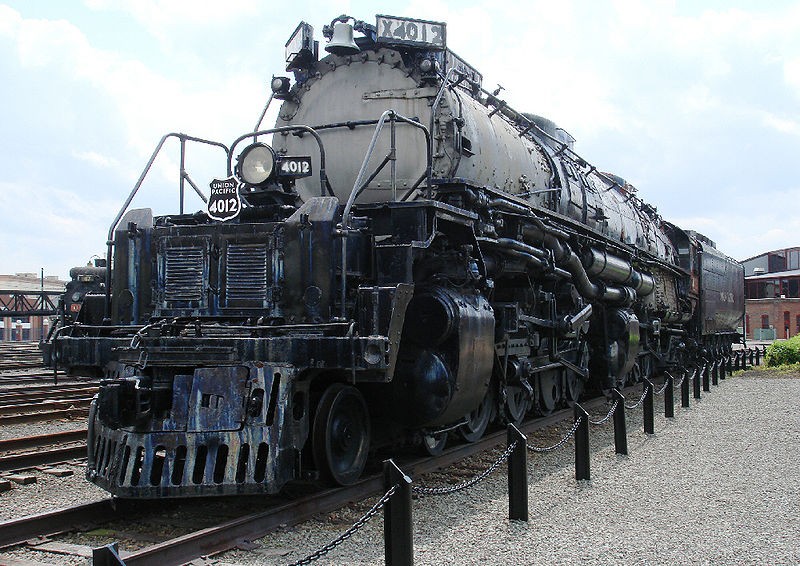
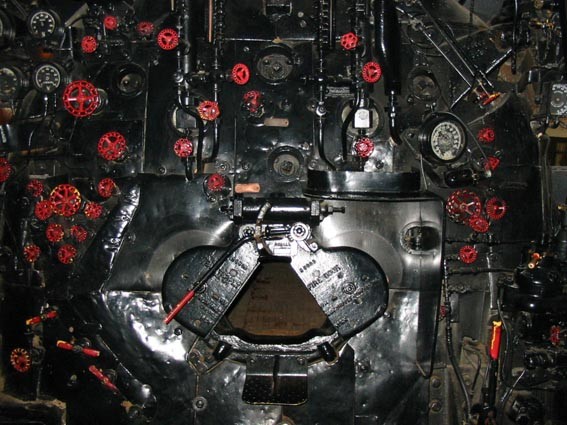
Big Boys had two sets of eight driving wheels. The front set were specially designed to swivel to enable the giant locomotive to go around bends on the twisting mountain railway. No fireman could shovel coal fast enough to keep the furnace stoked up, so a mechanical stoker was used. This machine could deliver 22 tonnes of coal an hour to the firebox. The Big Boys used up a lot of water, too. At top speed they guzzled 50 tonnes of water an hour—about a saucepanful every second.
The fastest steam locomotive
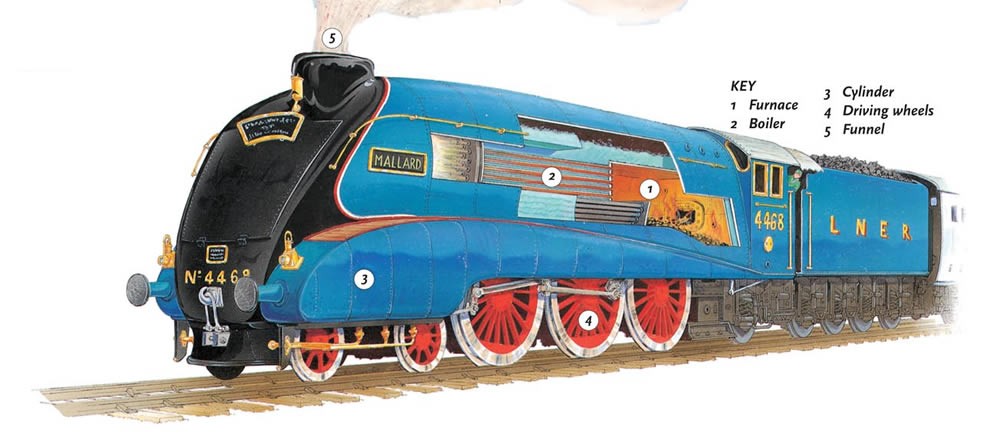
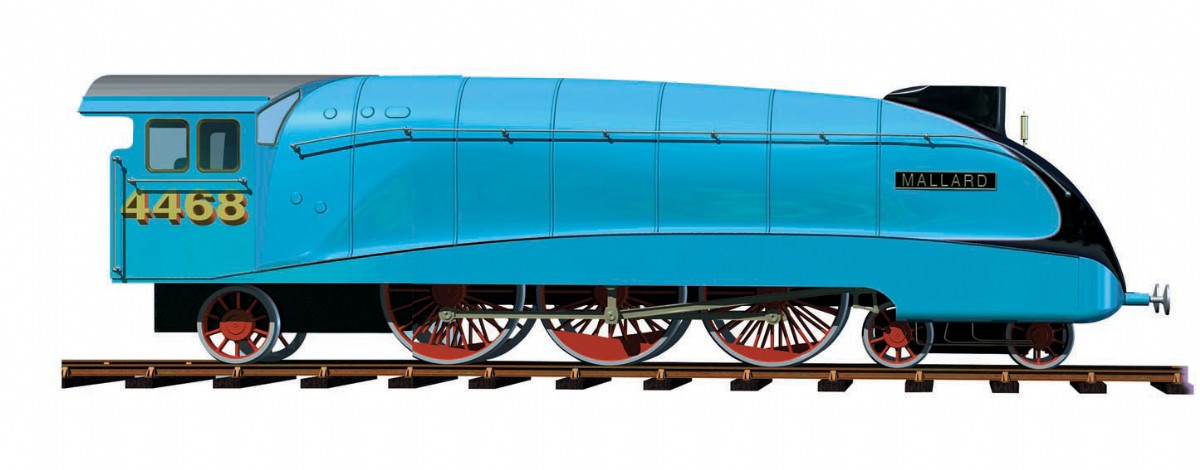
A new world record speed for a steam locomotive was set on 3rd July 1938. The Mallard, a new engine fitted with a streamlined casing, was chosen for the honour. Pulling a seven-coach train between Grantham and Peterborough, England, Mallard was timed at a speed of 201 km/h (145 mph) over a distance of about 400 metres (440 yards). It was damaged during the run, but was repaired and placed in the Railway Museum, York, England. Its record has stood to this day.
Electric and diesel-electric trains
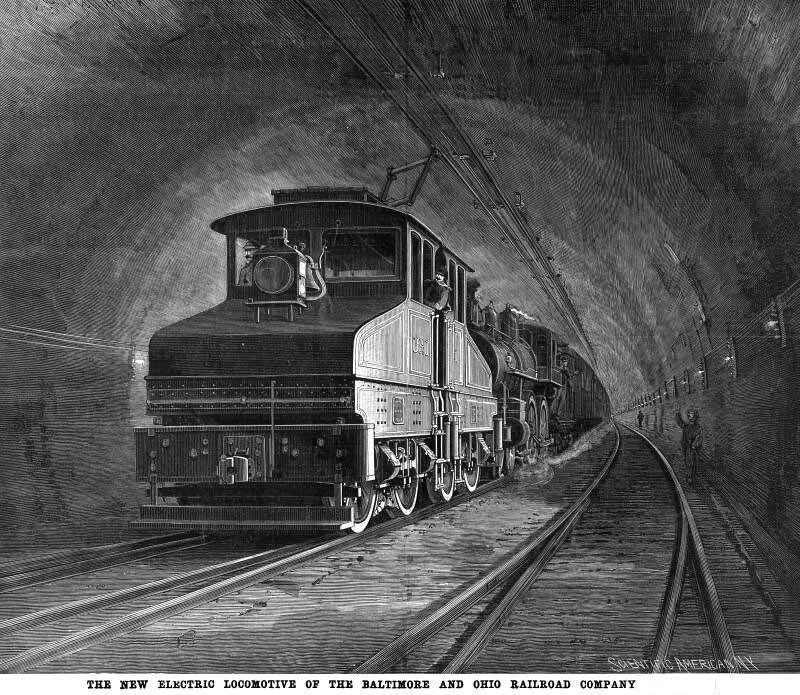
By the 1930s powerful, streamlined steam locomotives could haul passenger trains at high speeds. But steam locomotives are very inefficient. Only about five per cent of the energy in the fuel gets to the wheels, and time is needed to start the fire and get the water boiling. In the 1950s and 1960s, steam locomotives disappeared from most railways and were replaced by electric-powered and diesel-powered locomotives. Electric locomotives ran as early as 1879 in Germany. In 1890 they began pulling trains on underground railways in London, and in 1903 on mainline railways in Europe. Diesel locomotives started operating in the USA in the 1930s.
Consultant: Chris Oxlade
pics
Without in any way limiting Q-files Ltd’s exclusive rights under copyright, any use of this publication to “train” generative artificial intelligence (AI) technologies to generate text is expressly prohibited. Q-files Ltd reserves all rights to license use of this work for generative AI training and development of machine learning language models.