
Ancient Egypt

CITE
We have made every effort to follow citation style rules, but there may be some minor differences. If in doubt, please refer to the appropriate citation style manual.
Afterlife. (2026). In Q-files Encyclopedia, History, Ancient Egypt. Retrieved from
https://www.q-files.com/history/ancient-egypt/afterlife
"Afterlife." History, Ancient Egypt, Q-files Encyclopedia, 26 Mar. 2026.
https://www.q-files.com/history/ancient-egypt/afterlife.
Accessed 13 Sep. 2026.
Afterlife 2026. History, Ancient Egypt. Retrieved 13 September 2026, from
https://www.q-files.com/history/ancient-egypt/afterlife
History, Ancient Egypt, s.v. "Afterlife," accessed September 13, 2026.
https://www.q-files.com/history/ancient-egypt/afterlife


Afterlife
The ancient Egyptians believed in the Afterlife, a place where they went when they died. This was the kingdom of Osiris, god of the dead. To be reborn in the Afterlife required much preparation, especially in finding some way to preserve their dead bodies. The wealthy could afford to have a proper tomb built, while the less well-off were simply buried in pits in the sand. All Egyptians, however, agreed on the necessity to ensure that their king, the pharaoh, completed a successful journey to the Afterlife. To them, the very survival of their land depended on it.

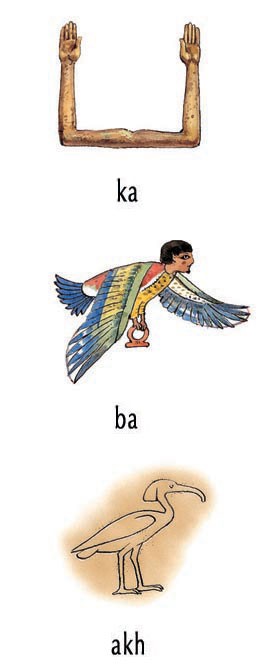
Ka, ba and akh
To the ancient Egyptians, a person’s soul was made up of two important parts, known as the ka and the ba. The ka was a person’s essential “life force” which needed food and drink to survive. On death, it departed the body. The ka was represented in art and inscriptions by upraised arms.
The ba could be described as a person’s “personality”. It was represented by a bird with a human head. The ba needed to seek out the ka, for if a person was to be reborn in the Afterlife, the two parts of their soul had to be reunited. If they did so, a third state of being would be achieved: the akh, a “spirit”. The akh was represented by a crested ibis. For the ka and ba to come together, the body could not be allowed to decay: hence the vital importance of mummification.
The pharaoh was thought of as the ka of the Egyptian people. His ba was his great power. The pharaoh, with his ka and ba reunited, would take his position as a star in the night sky, as a shining spirit.
The journey to the Afterlife

The journey to the Afterlife was a process of judgement by the gods. The god Anubis balanced a person’s heart against the feather of ma’at, truth. If that person had lived a good life, his or her heart would be light and they would pass to the Afterlife. But if the heart was heavy with sin, it would be devoured by the crocodile-headed Ammut.
Consultant: Philip Parker
pics
Without in any way limiting Q-files Ltd’s exclusive rights under copyright, any use of this publication to “train” generative artificial intelligence (AI) technologies to generate text is expressly prohibited. Q-files Ltd reserves all rights to license use of this work for generative AI training and development of machine learning language models.