
Ancient Egypt

CITE
We have made every effort to follow citation style rules, but there may be some minor differences. If in doubt, please refer to the appropriate citation style manual.
Hatshepsut. (2026). In Q-files Encyclopedia, History, Ancient Egypt. Retrieved from
https://www.q-files.com/history/ancient-egypt/hatshepsut
"Hatshepsut." History, Ancient Egypt, Q-files Encyclopedia, 26 Mar. 2026.
https://www.q-files.com/history/ancient-egypt/hatshepsut.
Accessed 13 Sep. 2026.
Hatshepsut 2026. History, Ancient Egypt. Retrieved 13 September 2026, from
https://www.q-files.com/history/ancient-egypt/hatshepsut
History, Ancient Egypt, s.v. "Hatshepsut," accessed September 13, 2026.
https://www.q-files.com/history/ancient-egypt/hatshepsut


Hatshepsut
Queen Hatshepsut (ruled c. 1478–1458 BC) was a pharaoh of the 18th dynasty during Egypt’s New Kingdom period. Her name means "Foremost of Noble Ladies". When her husband Thutmose II died, she took power and was made pharaoh. She wore the traditional clothing of a male pharaoh, including a false beard. Her reign began a long, peaceful era in Egyptian history. She re-established trade with other kingdoms and brought great wealth to Egypt. That wealth enabled her to fund many building projects in a classical architectural style, including Hatshepsut's temple at Deir el-Bahri.


Becoming pharaoh
Queen Hatshepsut was the daughter of King Thutmose I and his primary wife, Ahmose. When the king died, the throne passed to his son (by a minor wife), Thutmose II. In keeping with tradition, the new king married his father's eldest daughter—his half-sister, Hatshepsut. They had a daughter called Neferure. Thutmose II, however, died at a young age. On his death, his son by another wife became pharaoh: Thutmose III. But the child was considered too young to rule Egypt, so Hatshepsut took over on her nephew’s behalf, ruling as regent for six years. Then, in 1478 BC Hatshepsut decided she had had enough of ruling on behalf of the boy and declared herself pharaoh.
Expansion of trade
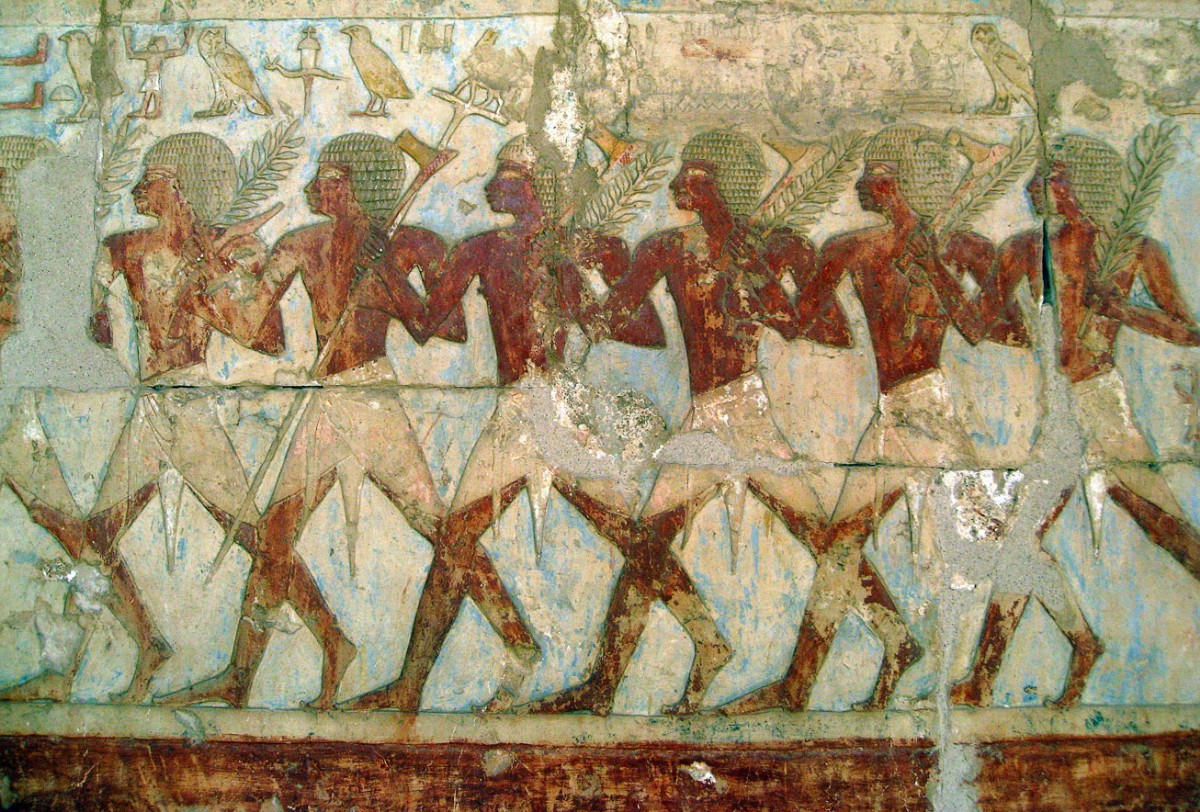
Hatshepsut proved to be one of Egypt’s greatest rulers, bringing peace and prosperity to her nation. Over the course of her 21 years' reign, Hatshepsut greatly expanded trade with other nations, most notably Pwenet, also known as the Land of Punt (probably present-day Somalia). Egypt imported gold, resins, ebony, ivory, skins, frankincense and myrrh—even transporting whole myrrh trees to be re-planted in the Nile Valley. Hatshepsut also took care to provide strong defences to Egypt’s frontiers, both in the south with Nubia and in the north with Syria.


Deir el-Bahri
Hatshepsut’s mortuary temple was built at Deir el-Bahri, next to that of Mentuhotep II, the man who restored Egypt to unity at the beginning of the Middle Kingdom period. Hatshepsut’s temple was designed by her chief adviser, Senenmut. The building's colonnades and its setting, with the cliff face rising directly behind, make it one of the most spectacular monuments of ancient Egypt. Much of what we know about the queen's life is told through the hieroglyphics and paintings found on its internal walls.
Death
When her nephew Thutmose III grew up, Hatshepsut appointed him the leader of her armies—although she remained as pharaoh. He became a brilliant military leader (and later turned out to be one of ancient Egypt’s most powerful pharaohs). But Thutmose never forgave his aunt for taking his rightful place as pharaoh. Later in his reign, he ordered everything to do with her—images, sculptures, references to her in texts, even her temple and other monuments—to be destroyed. Some historians have speculated whether he actually had her assassinated. Analysis of her remains, however, shows that Hatshepsut probably died of ill health—probably cancer—in her fifties.


Consultant: Phillip Parker
pics
Without in any way limiting Q-files Ltd’s exclusive rights under copyright, any use of this publication to “train” generative artificial intelligence (AI) technologies to generate text is expressly prohibited. Q-files Ltd reserves all rights to license use of this work for generative AI training and development of machine learning language models.