
Ancient Egypt

CITE
We have made every effort to follow citation style rules, but there may be some minor differences. If in doubt, please refer to the appropriate citation style manual.
First pyramids. (2026). In Q-files Encyclopedia, History, Ancient Egypt. Retrieved from
https://www.q-files.com/history/ancient-egypt/first-pyramids
"First pyramids." History, Ancient Egypt, Q-files Encyclopedia, 26 Mar. 2026.
https://www.q-files.com/history/ancient-egypt/first-pyramids.
Accessed 31 Oct. 2026.
First pyramids 2026. History, Ancient Egypt. Retrieved 31 October 2026, from
https://www.q-files.com/history/ancient-egypt/first-pyramids
History, Ancient Egypt, s.v. "First pyramids," accessed October 31, 2026.
https://www.q-files.com/history/ancient-egypt/first-pyramids


First pyramids
The pyramids of ancient Egypt were designed as monumental tombs for the pharaohs. Years before the first pyramids were built, pharaohs were buried in smaller tombs. Later, larger and grander structures were erected as burial places, until the first pyramid, the Step Pyramid, was completed in the 2600s BC. Later, perfect, smooth-sided pyramids were built. The last royal pyramid was built for Ahmose I (1550–1525 BC). The pyramids were built on the edge of the Western Desert, part of the Sahara Desert, just at the point where it slopes down to meet the lush lowlands of the Nile floodplain. Most were sited within a few kilometres of the royal capital, Memphis.

Early royal burial sites

Centuries before the first pharaohs, local rulers were buried in pits in the ground, covered by small mounds of sand and gravel. Their bodies were accompanied by figurines (miniature statues), pots and weapons. Over the years, their graves became more elaborate. They resembled underground apartments, divided into separate pits or “rooms” with mudbrick walls. The graves were marked on the surface by stone slabs, called stelae.

Mastabas
Grander burial places were needed for the first kings of Egypt. Called mastabas, these tombs were flat-roofed, rectangular structures with painted “niched” walls. Inside a mastaba there were chambers for storing burial goods and provisions, chapels and an underground burial chamber.
Step Pyramid

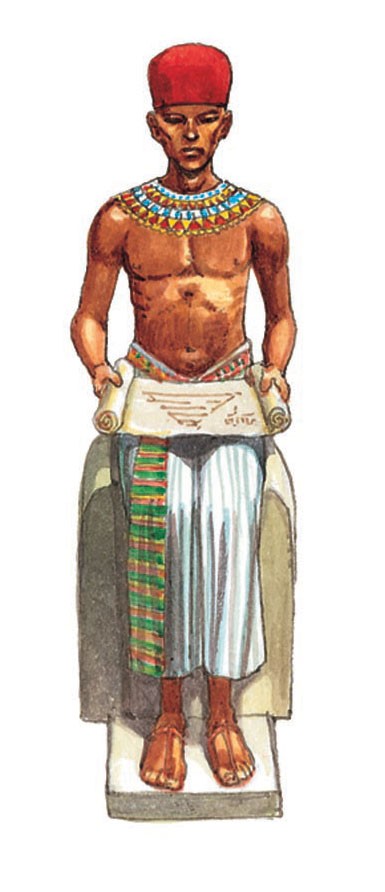
The first pyramid was built for Pharaoh Djoser, designed for him by a brilliant architect called Imhotep. The building was completed during the pharaoh’s 19-year reign, 2630–2611 BC. At the site in Saqqara, on the desert plateau overlooking the royal capital at Memphis, Imhotep built a huge enclosure surrounded by a stone wall, 10 metres (34 feet) high and 500 metres (1600 feet) long. Within the walls was a vast complex of pavilions, terraces and courtyards. Towering over them, rising to height of 60 metres (200 feet) high, was the Step Pyramid.
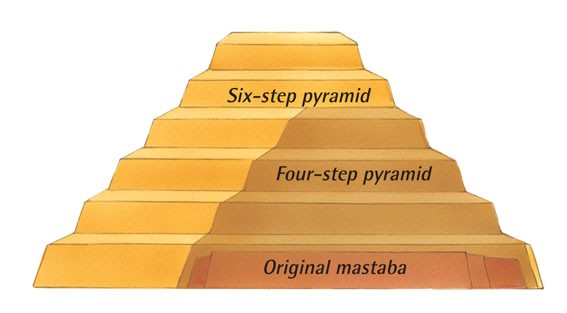
The Step Pyramid was built in stages, beginning with a simple square mastaba. Workers built a central core made of roughly-shaped stones with a fine limestone casing. Then they added sloping upright layers to the core, each layer leaning inwards. The stones they used were bigger and of better quality than in the core.
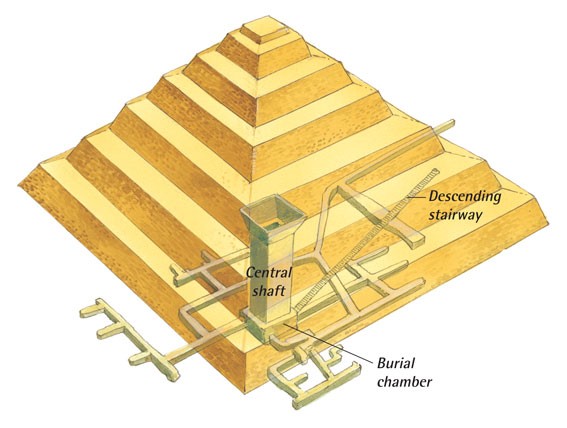
Below the Step Pyramid, the builders carved out a complicated network of shafts, tunnels, chambers, galleries and storerooms, totalling 5.7 kilometres (3.5 miles) in length. The great central shaft, 7 metres (23 feet) square, was dug 28 metres (92 feet) down into the bedrock. Below it lay the granite-walled burial chamber.
Sneferu's pyramids
Pharaoh Sneferu (2575–2551 BC) was the greatest of the pyramid-builders, responsible for the construction of three of them. He was the first to build smooth-sided pyramids. He also introduced the internal design in which a long descending passage ran from the entrance in the north face down to the burial chamber at ground level. Sneferu's first pyramid, at Meidum, was originally a step pyramid like Imhotep’s, and was built using the same construction method. But about 15 years into his reign, Sneferu decided to abandon it.

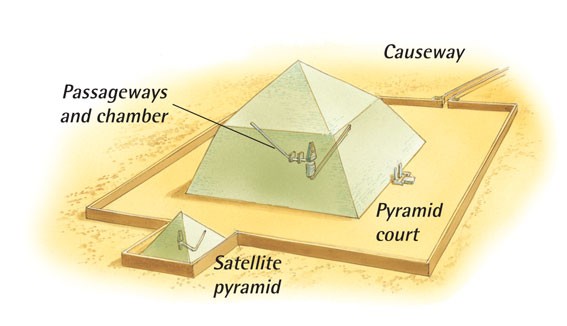
Sneferu turned his attention to another site 40 kilometres (25 miles) to the north of Meidum: Dahshur. Here he commanded the building of a second pyramid. The method of construction in the early stages was, once again, the same as before, but this time the builders ran into problems with subsidence. So, about halfway up, the workers started laying the stones horizontally and the rest of the pyramid was built with a gentler slope. The result was the “Bent Pyramid”.

Perhaps dissatisfied with its imperfection, Sneferu ordered yet another pyramid to be constructed. With a gentler slope planned from the outset, the North or Red Pyramid was successfully completed without mishap.
In the last years of his rule, Sneferu returned to his first project at Meidum and commanded his workers to fill in the steps to make a smooth-sided pyramid, 92 metres (300 feet) high.
Consultant: Philip Parker
pics
Without in any way limiting Q-files Ltd’s exclusive rights under copyright, any use of this publication to “train” generative artificial intelligence (AI) technologies to generate text is expressly prohibited. Q-files Ltd reserves all rights to license use of this work for generative AI training and development of machine learning language models.