
Ancient Egypt

CITE
We have made every effort to follow citation style rules, but there may be some minor differences. If in doubt, please refer to the appropriate citation style manual.
Craftworkers in ancient Egypt. (2026). In Q-files Encyclopedia, History, Ancient Egypt. Retrieved from
https://www.q-files.com/history/ancient-egypt/craftworkers-in-ancient-egypt
"Craftworkers in ancient Egypt." History, Ancient Egypt, Q-files Encyclopedia, 26 Mar. 2026.
https://www.q-files.com/history/ancient-egypt/craftworkers-in-ancient-egypt.
Accessed 8 Oct. 2026.
Craftworkers in ancient Egypt 2026. History, Ancient Egypt. Retrieved 8 October 2026, from
https://www.q-files.com/history/ancient-egypt/craftworkers-in-ancient-egypt
History, Ancient Egypt, s.v. "Craftworkers in ancient Egypt," accessed October 8, 2026.
https://www.q-files.com/history/ancient-egypt/craftworkers-in-ancient-egypt


Craftworkers in ancient Egypt
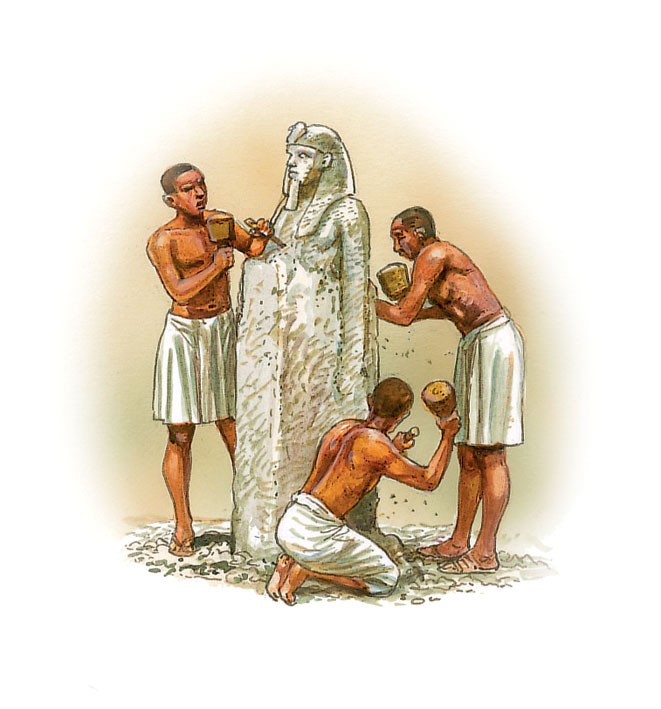
Over time, the farmers of ancient Egypt were able to produce more food than they needed just for themselves. This enabled some people to do types of work other than farming. Many of them set up workshops and became craftworkers. Often a son would learn his father’s craft and follow him into his workshop. Some craftworkers worked for the pharaoh or Egyptian nobles, to make items for their tombs or temples. Despite only having simple tools to work with, the craftworkers of ancient Egypt were highly skilled. There were stoneworkers, carpenters, potters, glassworkers, leatherworkers, spinners and weavers, metalworkers and jewellers.

Deir el-Medina
Most ordinary people of ancient Egypt were farmers living off the land, but some lived in towns, villages and cities. The village of Deir el-Medina was built to house the tomb-builders of the Valley of the Kings and their families. The workers included masons, carpenters, artists and other craftworkers. Their houses were made of mud bricks, but conditions were cramped: people lived several to a room. Storage cellars were dug beneath the houses. The windows were small and set high in the walls to keep the homes secure from thieves.
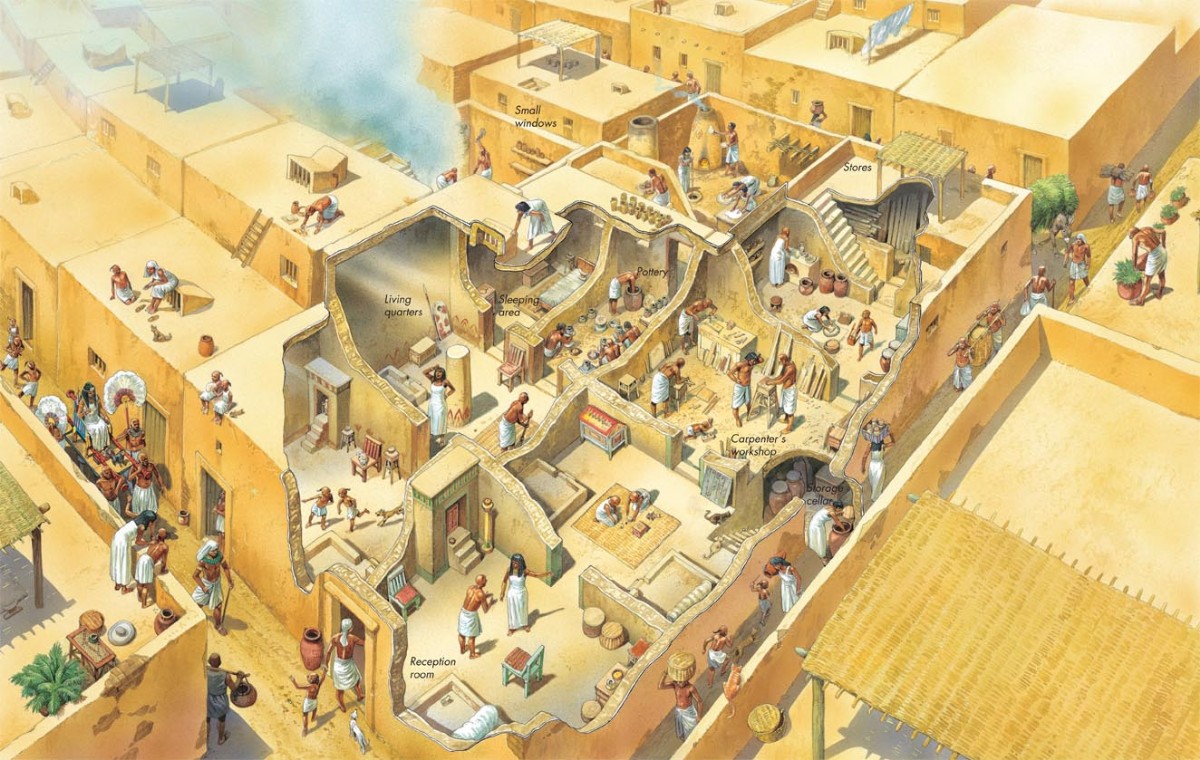
Because the weather was usually hot and dry, roofs and outdoor kitchens were used as extra living and working spaces. Jobs such as drying fish, washing clothes, cooking and baking were all done outside. The streets of Deir el-Medina were narrow and gave access only to some of the houses. People simply walked across the flat roofs, using steps and makeshift ladders to climb from one level to another.
Tombs and temples
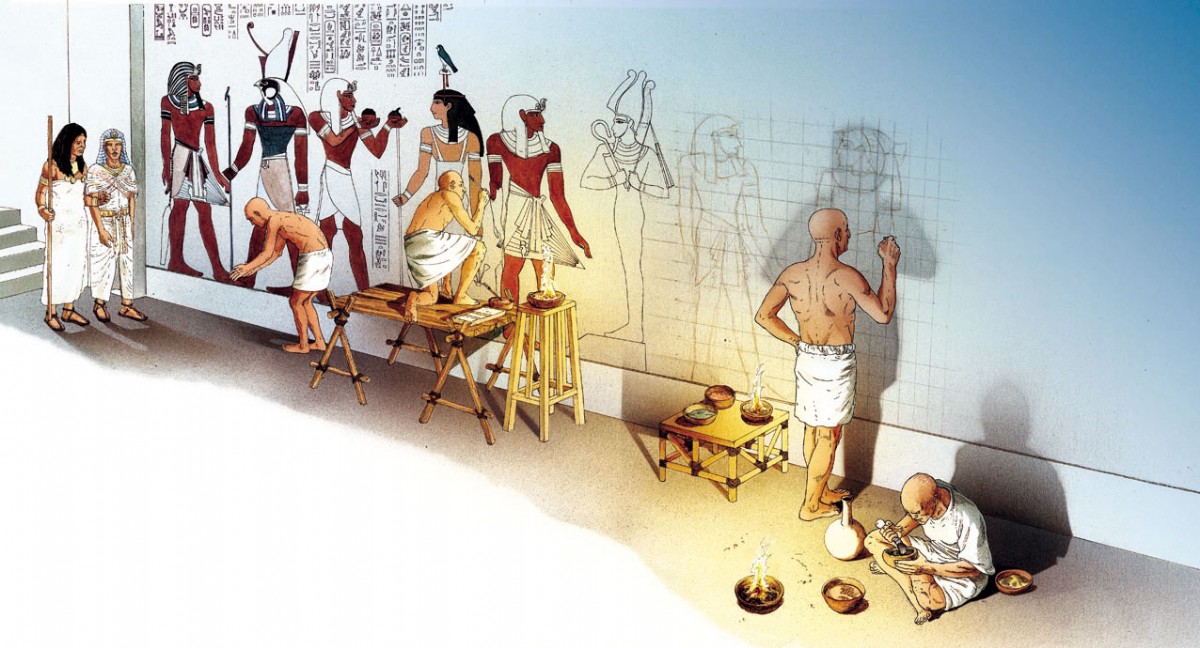
Many craftsmen worked at the temples, where they made items needed for the burial of a pharaoh. Goldsmiths, jewellers and glassblowers made exquisite treasures that would eventually be buried in a tomb. Joiners and boat-builders worked together to build the funerary boats. Painters, sculptors and engravers produced the fabulous decoration on the tomb walls. The workers were paid not with money but with goods such as vegetables, fish, milk and firewood. These were stored in their cellars and later bartered (swapped) for other household supplies.
Consultant: Philip Parker
pics

Without in any way limiting Q-files Ltd’s exclusive rights under copyright, any use of this publication to “train” generative artificial intelligence (AI) technologies to generate text is expressly prohibited. Q-files Ltd reserves all rights to license use of this work for generative AI training and development of machine learning language models.