
Ancient Egypt

CITE
We have made every effort to follow citation style rules, but there may be some minor differences. If in doubt, please refer to the appropriate citation style manual.
Pyramids: how they were built. (2026). In Q-files Encyclopedia, History, Ancient Egypt. Retrieved from
https://www.q-files.com/history/ancient-egypt/pyramids-how-they-were-built
"Pyramids: how they were built." History, Ancient Egypt, Q-files Encyclopedia, 26 Mar. 2026.
https://www.q-files.com/history/ancient-egypt/pyramids-how-they-were-built.
Accessed 6 Aug. 2026.
Pyramids: how they were built 2026. History, Ancient Egypt. Retrieved 6 August 2026, from
https://www.q-files.com/history/ancient-egypt/pyramids-how-they-were-built
History, Ancient Egypt, s.v. "Pyramids: how they were built," accessed August 6, 2026.
https://www.q-files.com/history/ancient-egypt/pyramids-how-they-were-built


Pyramids: how they were built
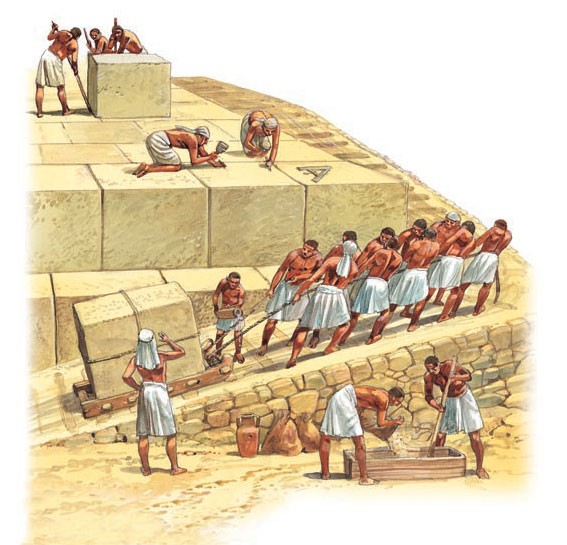
The building of a pyramid was a massive undertaking, employing thousands of workers for 20 years or more. We do not know for sure exactly how the pyramids were built. Our best guess is that, first, the plan of the pyramid was marked out on the ground. Then the ground was levelled and the pyramid built up layer by layer from giant limestone blocks like a massive staircase. The blocks were perhaps then hauled up the pyramid on a spiral ramp built of earth and rubble. The outside of the pyramid was faced with triangular blocks, called casing stones, made of a finer limestone than the building blocks. They were polished by hand until they were completely smooth.

Construction workers
A vast army of workers were needed to build the pyramid. A large proportion of the workforce were peasants. Around 25,000 or so at a time would be drafted in to serve three months’ work on the site, before they were replaced by another workforce.
The workers were organized into small teams of 20-25 men. With one of their number as foreman, they hauled the stones and set them in place. A team could be expected to move an average of 10 stones a day from quarry to pyramid.
Around 4000 men worked at quarrying, cutting, hauling and setting the stones themselves. A large crew would be employed just to build and maintain the building ramps. Carpenters, metalworkers and potters were also needed, along with scribes, surveyors, masons and sculptors—the higher-ranking employees that had to be hired for the project.

Cutting the blocks

The pyramids were built from blocks of limestone. With no iron tools available, the blocks had to be cut from the bedrock using wooden wedges and levers. First, a workman cut a narrow trench in the stone using an axe. Wedges were then driven in along the trench with a heavy mallet. The wedges were soaked with water. As the wood swelled, the stone cracked. The quarry workers then used ropes and heavy timber levers to free the block.
Tura limestone
A fine white limestone, used for the casing stones, came from Tura, a quarry on the eastern bank of the Nile. Granite slabs, also used in building the pyramids, were quarried at Aswan, some 900 kilometres (600 miles) upriver. The best limestone at Tura was obtained from tunnels dug into the face of the cliffs.

The blocks were loaded aboard barges to take them across the Nile from Tura to the pyramid building site. They were stored at Tura until the arrival of the annual Nile flood. At this time, most of the distance between quarry and site could be travelled by river, making transportation of the heavy stones much easier.

Tools
Limestone, the type of rock most used in the construction of the pyramid, is quite a soft rock and could be easily shaped or cut open by copper chisels, saws, axes or wedges. Drilling holes was done by bow drills. A cord was wrapped around the central spindle which had a copper drill bit attached to it. Rotating the bow wound up the cord tightly. Releasing it caused the spindle to spin rapidly, powering the drill.
Measuring instruments
Measuring tools were vital if the incredible accuracy needed to build the pyramids was to be achieved. A set square measured right angles. The plumb bob was used to achieve exact verticals. The square level, an A-shaped wooden frame with legs of equal length, was used for measuring horizontal surfaces.


Choosing a site
For religious reasons, the pyramids had to be built to the west of the Nile, in the place where the sun set: the Land of the Dead. A site on the high desert plateau between Giza in the north and Meidum in the south, overlooking the Nile, was the perfect spot. It lay above the Nile’s valley floor, so did not suffer from flooding, but was still located fairly close to the river, thus enabling some heavy stone blocks to be transported to the site by boat.
Aligning the pyramids

A pyramid had to be aligned so that its sides faced exactly north, south, east and west. By plotting the passage of any particular star across the sky, and using some simple geometry, true north could be pinpointed. Perhaps a priest or other official stood in an enclosure and noted the position of a star just as it rose above the surrounding wall. Later that same night he noted the position where the same star dropped below the wall. The mid-point between the two positions pointed directly due north.
Foundation ceremony
The pharaoh himself might have performed the foundation ceremony. Together with a priestess dressed as the goddess Seshet, they drove posts into the ground at the four corners of where the pyramid would eventually stand.


Levelling the base
It would not be possible for each face of the pyramid to meet exactly at a point at the top if the measurements at its base were not precisely accurate.
Firstly, workers cleared the site of sand and rubble. It might have been possible to leave an area of unlevelled bedrock to form the core of the pyramid itself, provided the ground around it was made perfectly flat.
It was important to ensure that the first layer of slabs had an exactly horizontal upper surface. Using a combination of set squares and careful geometry, each of the all-important corner slabs were positioned to form precise right angles. The other slabs were then levered carefully into place alongside one another.
While the ground was being levelled, workers dug the burial chamber and the underground passage that led to it.


Hauling the blocks
The blocks that would form the next layer were hauled to the site. One idea for how it was accomplished is that teams of workers dragged sleds, each with a block firmly attached, along a “railway” made of wooden boards embedded in the ground and coated with mud. Keeping the track constantly wet would have helped the sled to be dragged along much more easily. Perhaps a ramp, built from close-packed rubble, allowed the teams to haul blocks up to the higher level.
As the pyramid was built up higher and higher, the ramp used by the hauling teams had to be built up with it. The ramp spiralled up on all four sides. On arrival at the top of the ramp, the workers eased each block off its sled and on to wooden logs. They then rolled the block into position, using heavy wooden posts as levers.


The challenge of keeping the pyramid's angle of slope consistently the same and the dimensions of its faces exactly even became harder and harder as the pyramid became taller and taller—as did the physical task of raising and manoeuvring the blocks into position.
Placing the capstone
Soon the flat area at the top measured just a few metres on each side. It was time to place the very highest block, the capstone—also known as the pyramidion, since it was, itself, shaped like a miniature pyramid. After a ceremony, the capstone was perhaps hauled up and levered into place by workers standing on scaffolding. Once the capstone had been secured in place, workers covered it with a coating of gold.


Smoothing the faces
With the capstone in place, the rough structure of the pyramid was now complete. Each of its faces was made up of a number of steps and work to shave away the edges of these steps to produce the smooth-sided pyramid began. Workers started to dismantle the ramps from the top downwards. Chiselmen chipped away at the casing stones down to the slope lines. As they worked their way down the sides, others took over above them, using finer chisels to achieve a perfectly smooth face. They were followed in turn by men using stones and abrasive powder to grind and polish the surface of the casing stones. This produced a shiny white, gleaming finish.
Temples
While the pyramid was being completed, work began on the temples and causeway. As the walls went up, a ramp of rubble was built up inside them, allowing the various stone blocks to be hauled up into position, in the same way as the pyramid was built. When the walls and roof were complete, masons used the rubble as a platform for carving fine details at the tops of the columns, such as lotus buds, papyrus reeds or palm leaves. They would later be painted. As the rubble was removed, the masons worked their way down the columns.

Consultant: Philip Parker
pics
Without in any way limiting Q-files Ltd’s exclusive rights under copyright, any use of this publication to “train” generative artificial intelligence (AI) technologies to generate text is expressly prohibited. Q-files Ltd reserves all rights to license use of this work for generative AI training and development of machine learning language models.