
Ancient Egypt

CITE
We have made every effort to follow citation style rules, but there may be some minor differences. If in doubt, please refer to the appropriate citation style manual.
Valley of the Kings. (2026). In Q-files Encyclopedia, History, Ancient Egypt. Retrieved from
https://www.q-files.com/history/ancient-egypt/valley-of-the-kings
"Valley of the Kings." History, Ancient Egypt, Q-files Encyclopedia, 26 Mar. 2026.
https://www.q-files.com/history/ancient-egypt/valley-of-the-kings.
Accessed 13 Sep. 2026.
Valley of the Kings 2026. History, Ancient Egypt. Retrieved 13 September 2026, from
https://www.q-files.com/history/ancient-egypt/valley-of-the-kings
History, Ancient Egypt, s.v. "Valley of the Kings," accessed September 13, 2026.
https://www.q-files.com/history/ancient-egypt/valley-of-the-kings


Valley of the Kings
The Valley of the Kings is hidden among hills on the western bank of the Nile near Thebes in Upper Egypt. Here, in tombs cut into the rock beneath a pyramid-shaped peak, are buried the pharaohs of Egypt who ruled during its golden age, the New Kingdom (1550–1070 BC), including Tutankhamun and Ramesses II. The Valley may have been chosen as a burial place because only one narrow gorge led into the valley, which could therefore be fairly easily guarded. Egypt’s rulers wanted to ensure that there would be no more tomb robberies, although those efforts were to prove futile.
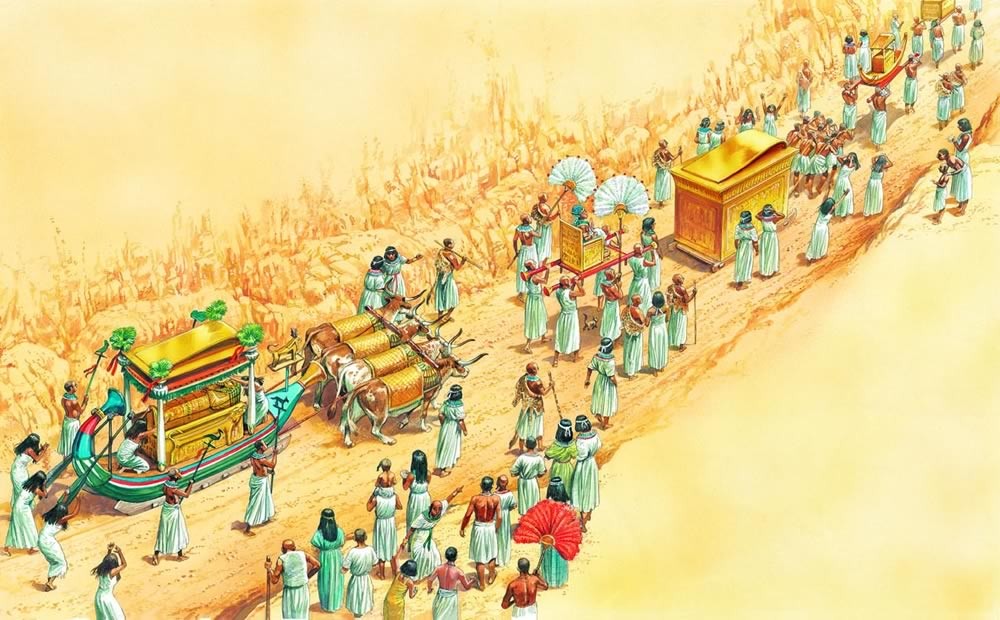

Underground tombs
By the time of the New Kingdom, pyramid tombs had gone out of fashion—perhaps they were just too difficult and expensive to build. From now on, the pharaohs would be buried in tombs dug in the ground. The winding Valley of the Kings, near the great city of Thebes, became a favoured royal burial place.

The tombs were carved out of the soft limestone and shale rock by stonecutters. Plasterers, painters and other craftsmen created beautifully ornate interiors. It took years to make and prepare a tomb, which could have many rooms and passages, so the pharaoh usually started having his built as soon as he began his rule.
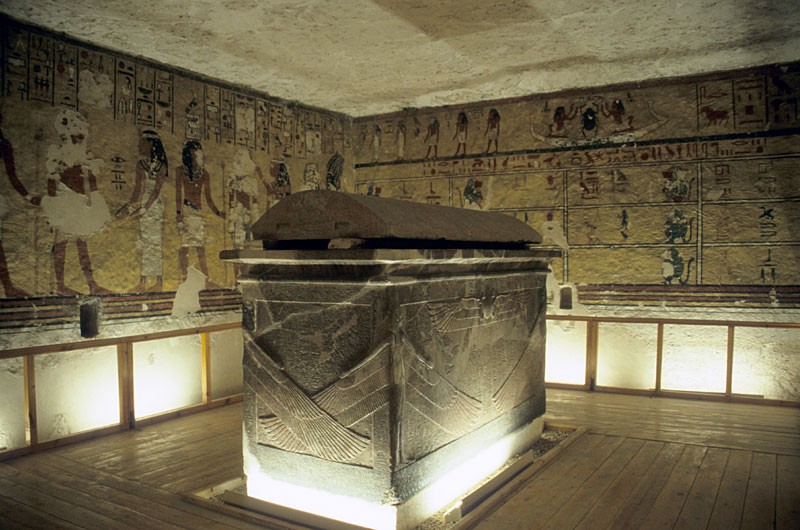

Inside a tomb
No two tombs were exactly alike, but they all shared a basic plan. Behind the entrance were a series of staircases and descending passageways. Paintings on the walls showed the journey of the sun at night, or, as the Egyptians believed, through the underworld. A well shaft, which acted both as a drain—should the tomb ever be flooded during a rare storm—and as a hindrance to robbers, led vertically down from one of the passageways. Beyond a pair of pillared halls lay the burial chamber itself.
Grave robbers

Pharaohs’ tombs proved irresistible to grave robbers, who tried to break in and steal the gold and treasures. But it was a risky business; if the robbers were caught they would be sentenced to death. Sometimes, the underground passages were filled with sand and rubble to deter grave robbers. Despite this, nearly all the royal tombs in the Valley of the Kings were cleared of their treasures, with the exception of that of Pharaoh Tutankhamun, whose tomb remained largely intact (despite two early break-ins) until it was discovered by British archaeologist Howard Carter in 1922.
Consultant: Philip Parker
pics
Without in any way limiting Q-files Ltd’s exclusive rights under copyright, any use of this publication to “train” generative artificial intelligence (AI) technologies to generate text is expressly prohibited. Q-files Ltd reserves all rights to license use of this work for generative AI training and development of machine learning language models.