
Ancient Egypt

CITE
We have made every effort to follow citation style rules, but there may be some minor differences. If in doubt, please refer to the appropriate citation style manual.
Tutankhamun's tomb. (2026). In Q-files Encyclopedia, History, Ancient Egypt. Retrieved from
https://www.q-files.com/history/ancient-egypt/tutankhamuns-tomb
"Tutankhamun's tomb." History, Ancient Egypt, Q-files Encyclopedia, 26 Mar. 2026.
https://www.q-files.com/history/ancient-egypt/tutankhamuns-tomb.
Accessed 6 Aug. 2026.
Tutankhamun's tomb 2026. History, Ancient Egypt. Retrieved 6 August 2026, from
https://www.q-files.com/history/ancient-egypt/tutankhamuns-tomb
History, Ancient Egypt, s.v. "Tutankhamun's tomb," accessed August 6, 2026.
https://www.q-files.com/history/ancient-egypt/tutankhamuns-tomb


Tutankhamun's tomb
Pharaoh Tutankhamun died aged only 19. The shrines enclosing the stone sarcophagus where his coffin was placed were fitted into the burial chamber inside his tomb. The other chambers were filled with goods and treasures that the pharaoh might need in the Afterlife. It was intended, of course, for the pharaoh’s mummy to lie inside his tomb for ever. But the abundance of gold and jewellery would usually attract robbers—probably within only a few years of the pharaoh’s burial. But, incredibly, after two early break-ins, during which few treasures was stolen, Tutankhamun’s tomb remained undisturbed for more than 3000 years until it was discovered in 1922. Inside the tomb were statues, furniture, jewellery and many other precious items left exactly as they had been placed all those centuries before.


Discovering the tomb
On 4th November 1922, British archaeologist Howard Carter, who was carrying out excavation work in the Valley of the Kings, discovered steps that he hoped would lead down to Tutankhamun's tomb (later given the official name KV62). He sent a message to the man who funded the expedition, Lord Caernarvon, to come to Egypt.
On 26th November, accompanied by Caernarvon and his daughter Lady Evelyn Herbert, Carter chiselled a small hole in the doorway to the tomb and peered in. Caernarvon asked him, "Can you see anything?”. Carter, who caught a glimpse of gold treasures by the light of a candle, replied, “Yes, wonderful things!"
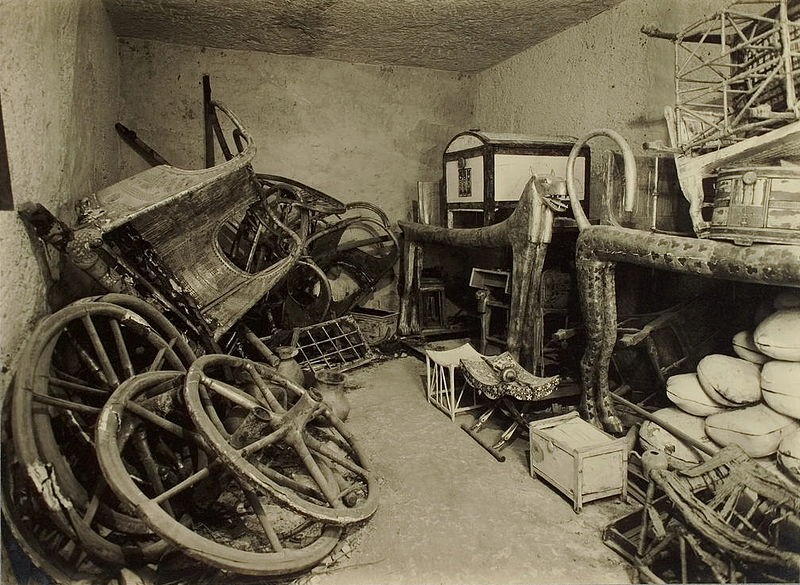
The tomb had been robbed and resealed twice soon after its completion. It was, however, densely packed with treasures—most of them in disarray. On 16th February 1923, Carter opened a doorway—which remained sealed and therefore probably undisturbed by the robbers—inside the tomb. It led to a burial chamber, where he found the sarcophagus of Tutankhamun. It took eight years for the contents of the tomb to be carefully recorded and transported to the Egyptian Museum in Cairo.

Sarcophagus
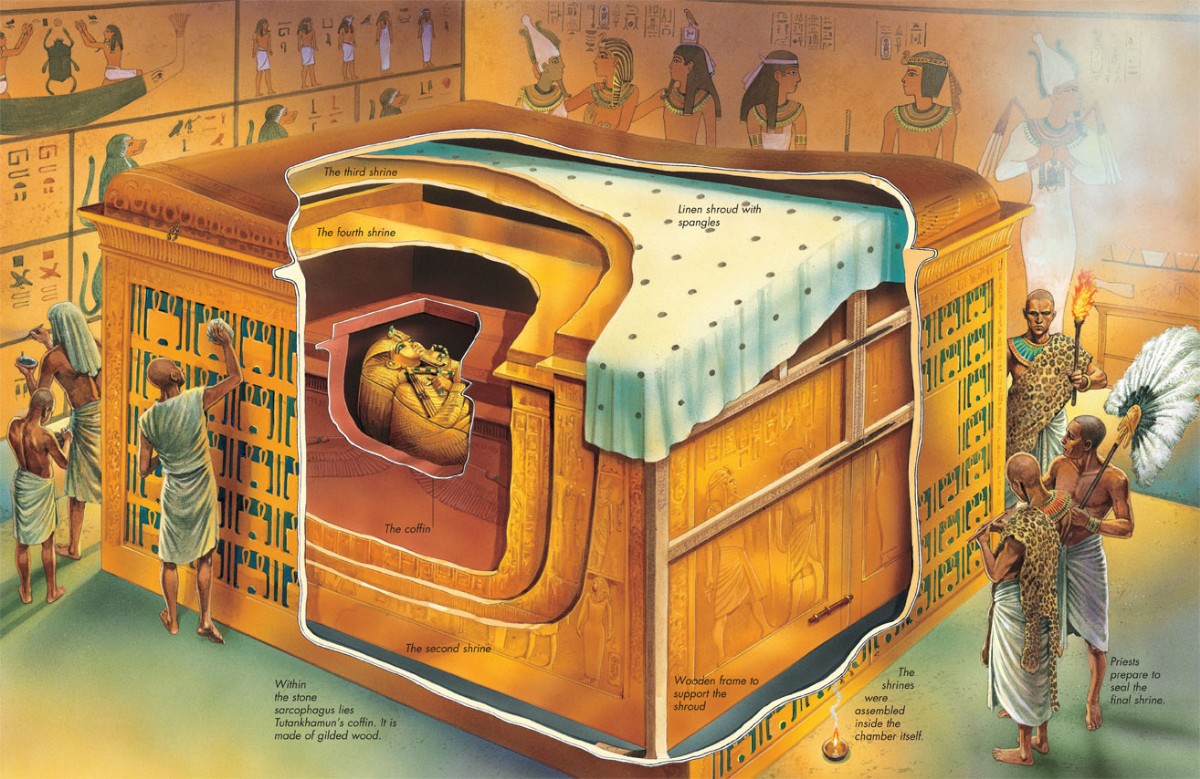
Tutankhamun's funeral took place around 1323 BC. Inside the burial chamber, his coffin was lowered into a sarcophagus, a large box made of a hard rock called quartzite. The lid was of red granite. The sarcophagus was decorated with exquisite carvings. Standing at each corner was a god with winged arms outstretched to envelop the box.
The priests covered the sarcophagus with a linen shroud as they said prayers for the dead king. Then they lowered the lid.
Shrines
The burial took several more days to complete. Next, a series of four shrines (wooden cabinets) were built one outside the other, encasing the sarcophagus. The panels, each covered with a layer of gold leaf, were fixed in position. The outermost shrine was made of gilded cedarwood. Just before the final shrine was put in place, the priests erected a wooden frame. On this they hung a linen shroud decorated with spangles to represent the starry sky. Finally a stone wall was built, sealing the burial chamber off from the rest of the tomb. The shrines only just fitted inside the small burial chamber.
Tomb treasures
The tomb contained other chambers, used for storing the pharaoh’s treasures and other objects. For most pharaohs' tombs, many of the walls of the chambers and linking passageways would be decorated with hieroglyphic inscriptions and scenes of the pharaoh’s funeral and his journey into the Next World. Only the burial chamber in Tutankhamun's tomb had decorated walls.

Things the pharaoh might need on his journey into the Afterlife were placed in the tomb. They included: papyri inscribed with texts, including spells the pharaoh might need to protect himself; small figurines called shabtis, to act as his servants; a variety of beautiful objects, including model boats and chariots, statuettes, jewellery and amulets; jars of linen, oil and perfumes; furniture, such as chairs and couches; musical instruments; writing materials; weapons; offerings of food and wine; a canopic chest (encased inside a golden shrine) containing the pharaoh’s canopic jars.

The mummy
Tutankhamun's body had been wrapped in linen bandages. Placed both inside and outside the wrappings were many jewels, including amulets or charms, most of them made of gold. They included a small vulture, worn around the collar. The mummy was covered by an ornate shroud. Sewn on to it were a pair of gold hands, clasping the symbols of kingship: the crook and the flail.
Over the head lay a beautiful face mask, expertly fashioned from solid gold and inlaid with glass and precious stones. The mask showed the pharaoh as Osiris, the god of the dead. The eyes were made from quartz and obsidian, a glass-like stone. He wore the nemes headdress that signified his kingship. At Tutankhamun’s burial, priests had poured fragrant resins over his body before placing the gold mask over his head and shoulders.
Three coffins
The mummy of the dead pharaoh was laid in a coffin made of solid gold. Again, he was shown as the god Osiris and his crossed arms clutched a crook and flail. A cobra, Wadjit, the symbol of Lower Egypt, and the vulture-goddess Nekhbet of Upper Egypt both rose from his forehead. A thick, black resinous fluid was poured over the gold coffin.
This coffin was laid inside a second coffin. It was made of gilded wood and plaster, inlaid with lapis lazuli, a semi-precious blue stone. It was decorated with a red and blue feather-like pattern, called rishi, which symbolized the soul.

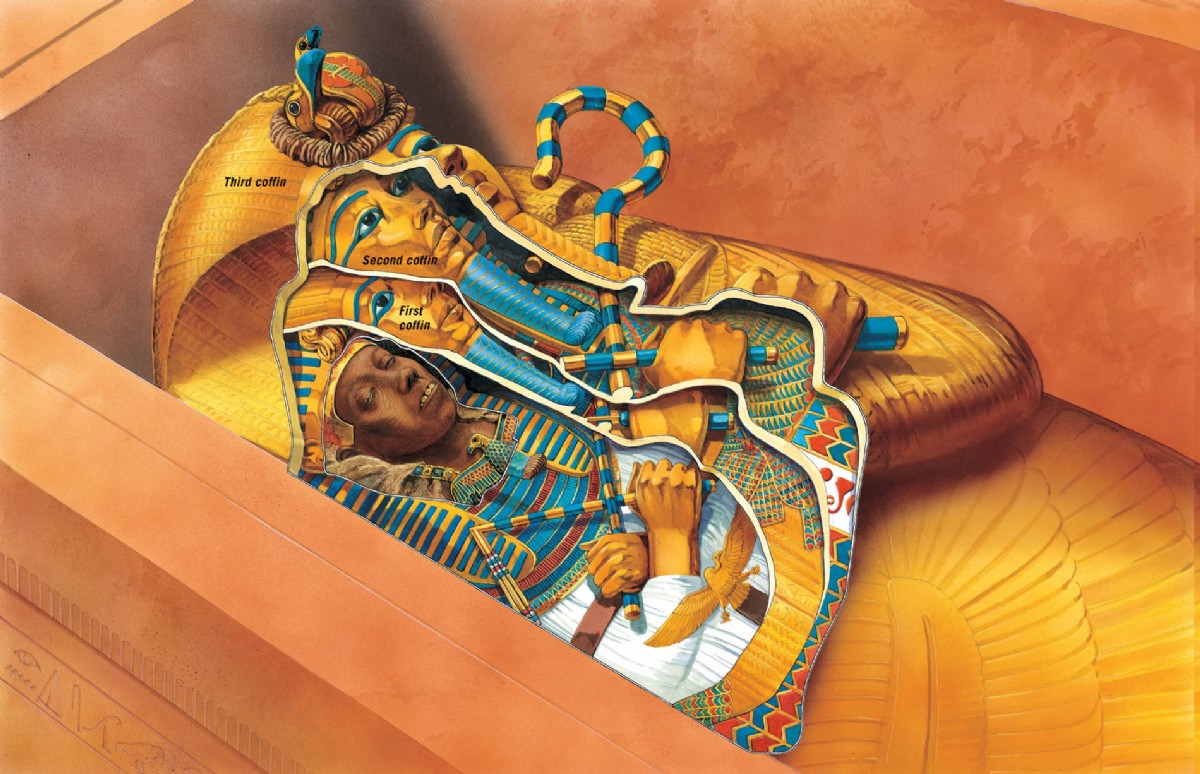
This second coffin was placed inside a third. Also made of wood and plaster, it was covered with gold and moulded in the shape of the dead pharaoh’s body.
Consultant: Philip Parker
pics

Without in any way limiting Q-files Ltd’s exclusive rights under copyright, any use of this publication to “train” generative artificial intelligence (AI) technologies to generate text is expressly prohibited. Q-files Ltd reserves all rights to license use of this work for generative AI training and development of machine learning language models.