
Ancient Egypt

CITE
We have made every effort to follow citation style rules, but there may be some minor differences. If in doubt, please refer to the appropriate citation style manual.
Egyptian gods and goddesses. (2026). In Q-files Encyclopedia, History, Ancient Egypt. Retrieved from
https://www.q-files.com/history/ancient-egypt/egyptian-gods-and-goddesses
"Egyptian gods and goddesses." History, Ancient Egypt, Q-files Encyclopedia, 26 Mar. 2026.
https://www.q-files.com/history/ancient-egypt/egyptian-gods-and-goddesses.
Accessed 30 Oct. 2026.
Egyptian gods and goddesses 2026. History, Ancient Egypt. Retrieved 30 October 2026, from
https://www.q-files.com/history/ancient-egypt/egyptian-gods-and-goddesses
History, Ancient Egypt, s.v. "Egyptian gods and goddesses," accessed October 30, 2026.
https://www.q-files.com/history/ancient-egypt/egyptian-gods-and-goddesses


Egyptian gods and goddesses
The ancient Egyptians worshipped hundreds of gods and goddesses. As religious beliefs changed over the centuries, some old gods became less popular, became merged with others, or disappeared altogether. Over time, some new gods appeared. Many gods and goddesses were associated with different animals, and are shown in paintings or sculptures with animal heads. Most gods were gods of specific things (for example, Nut was goddess of the sky) or an activity (Khnum, god of the Nile, its clay and making pots). Some, however, represented ideas or qualities (Ma’at, the goddess of truth and justice).


Amun
King of the gods and father of the pharaohs
Amun was the chief god of Thebes, whose power grew as the city, once a small village, became large and powerful during the Middle and New Kingdoms. He was eventually merged with Sun god, Re, the dominant god of the Old Kingdom, to become Amun-Re. Karnak was his chief temple.
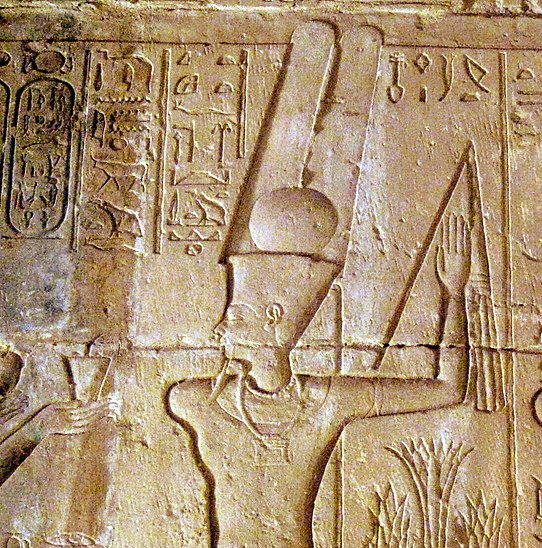
Amun (also known as Amen) is often depicted as a man wearing a plumed double crown.

Anubis
God of mummy embalming
Anubis is usually depicted as a man with the head of a black jackal. His father was Seth and his mother Nephythys. It was Anubis who helped mummify Egyptians when they died and, in the Afterlife, led them to the Hall of the Two Truths. Here he would weigh the hearts of people seeking judgment (see Ma'at, below).
Bastet
Goddess of protection, pleasure and the bringer of good health
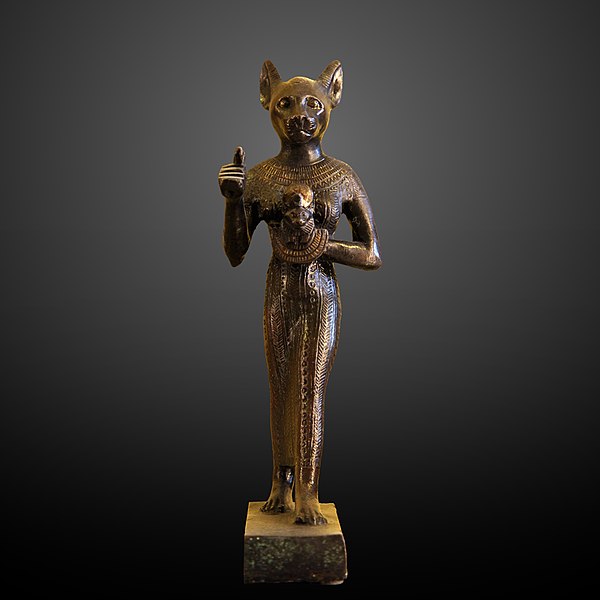
The daughter of Re and the wife of Ptah, Bastet is depicted as a woman with a cat’s head. Cats were important to the ancient Egyptians: by killing rodents they protected their crops and slowed the spread of diseases. Many cats lived at Bastet's temple in the Delta city of Bubastis and were mummified when they died.
It was said that by day Bastet would ride through the sky with her father. At night, she would turn into a cat to protect Re from his greatest enemy, the serpent Apep. For this she became known as the goddess of the Moon and the All Seeing Eye. She was also goddess of protection, pleasure and the bringer of good health.
Geb
God of the Earth
Twin brother to Nut, the goodess of the sky, Geb was the father of Osiris, Isis, Seth and Nephythys. the pharaohs believed themselves to be descendants of Geb—their throne was known as the “Throne of Geb”. As god of the Earth, It was said that earthquakes were his laughter.
Hathor
Goddess of love, music, beauty and joy
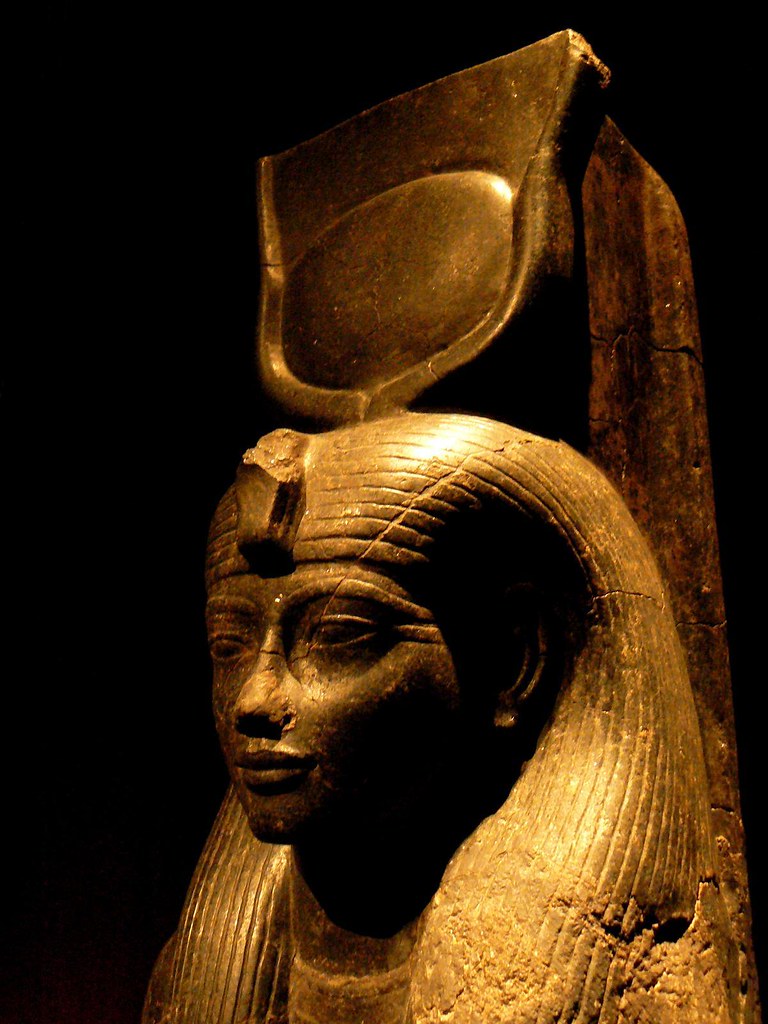
The daughter of Re, Hathor is often depicted as a woman wearing the headdress with a cow’s horns holding the disc of the Sun. As the wife of Horus, Hathor was associated with the mother of the pharaoh. She had many temples, the most famous of which is that of Dendera.

Horus
God of the sky and the living pharaoh
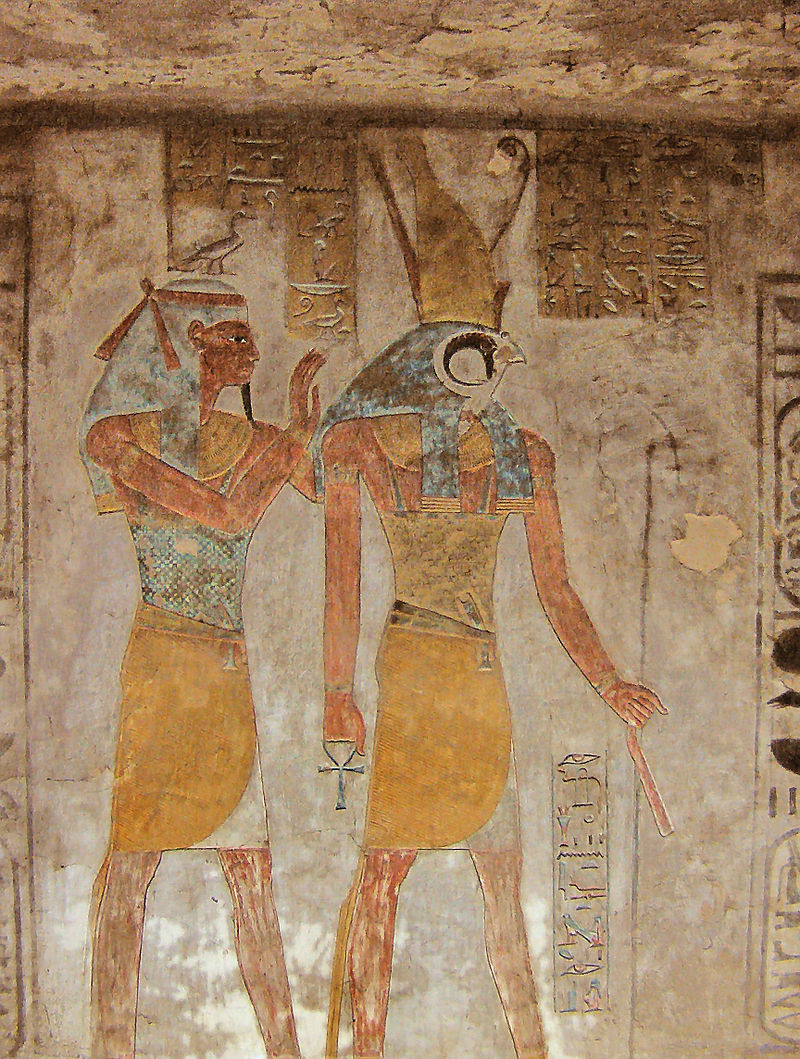
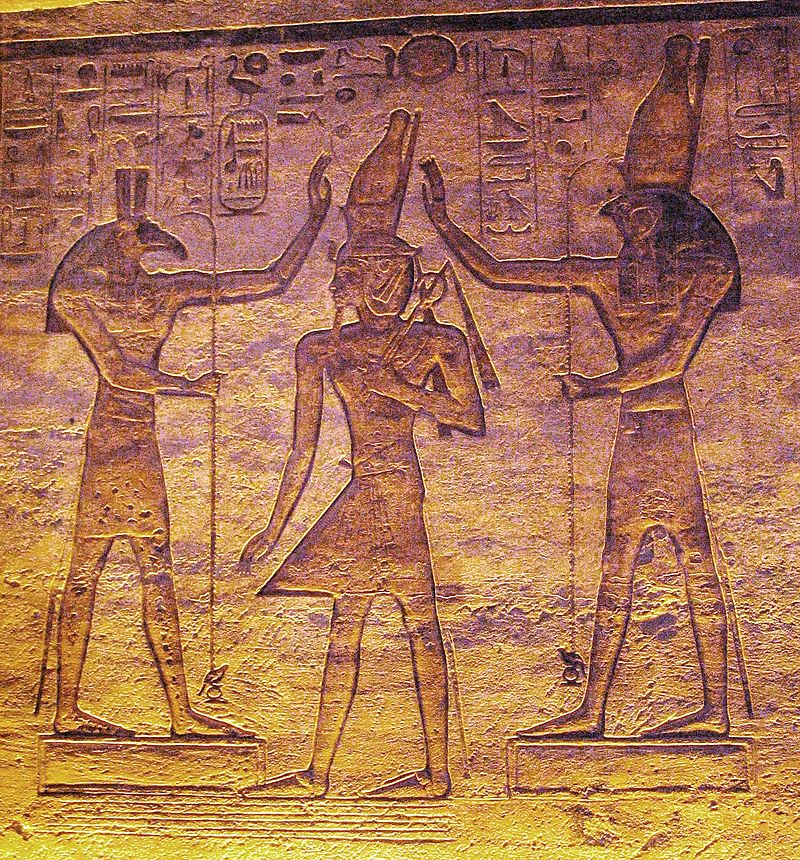
Horus was the son of Osiris and Isis, husband of Hathor—and enemy of the wicked god Seth, whom he defeated in battle. He is usually depicted as a falcon, or as a man with the head of a falcon and wearing the double crown. Pharaohs were considered to be the embodiment (the living form) of Horus on Earth. Worshipped throughout Egypt, Horus is closely associated with Edfu.
Isis

Goddess of women, mothers and children
Isis was the wife (and sister) of Osiris and mother of Horus. Said to have once resurrected Osiris from the dead (following his murder and dismemberment at the hands of Seth), she was worshipped as the giver of life, a healer and protector of kings. Her best-known temple is at Philae. Originally depicted with a throne on her head, during the New Kingdom Isis took on features possessed by Hathor, especially her headdress, the disc of the Sun held between the horns of a cow.
Ma'at
Goddess of truth and justice
The daughter of Re, Ma’at was married to Thoth, god of wisdom. She is often depicted as a seated woman wearing an ostrich feather, or bearing wings. To the ancient Egyptians, Ma’at was more than just a goddess. She represented the idea of order and balance. Ma’at determined the course of the seasons and the movement of the stars.
According to ancient Egyptian mythology, after a person's death, their heart was weighed on a scale against Ma’at’s feather of truth. If it balanced, he or she could continue their journey to the Afterlife. Ammut, the crocodile-headed devourer of the dead, ate those who failed the test.

Nut
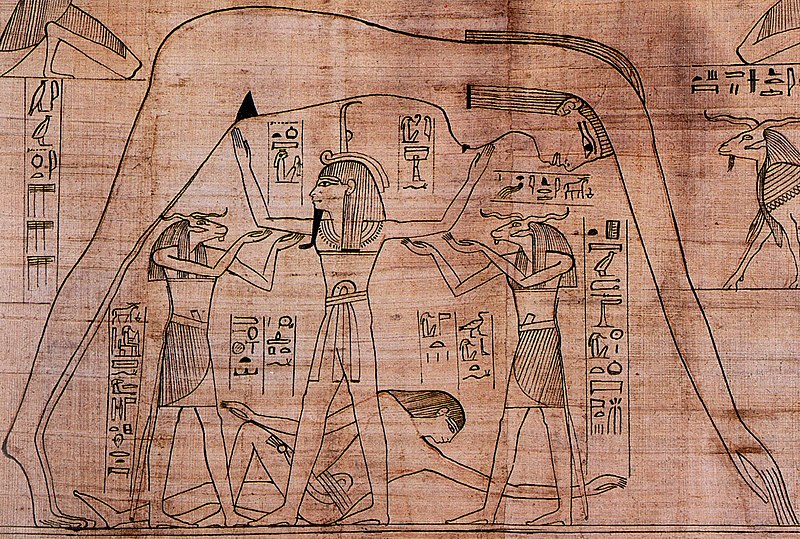
Goddess of the sky
Nut (pronounced "newt") was the mother of Osiris, Isis, Seth and Nephythys. Nut is usually pictured with her elongated body (representing the sky) bent over the Earth, her head in the West and feet in the East. Nut swallowed the setting sun (Re) each evening and gave birth to him each morning. Her image is often found on the ceilings of tombs or temples and on the inside lid of coffins. This is because it was believed she protected the dead until they were reborn in the Afterlife.
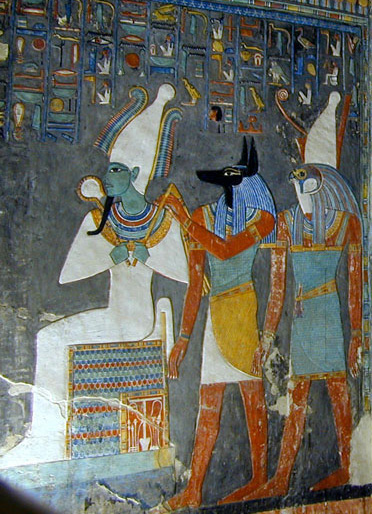
Osiris
God of the dead
The son of Geb and Nut, Osiris was husband—and brother—of Isis. He was originally worshipped as the god who ensured crops would grow. It was said that he brought civilization to mankind.
According to legend, Osiris was the first king of Egypt. He was murdered in a jealous rage by his brother Seth, who cut his body into pieces and spread them around Egypt. Isis gathered up the pieces, reassembled them and brought her husband back to life. After they conceived a child, Horus, Osiris became the ruler of the underworld. He is usually depicted as a mummy holding the crook and flail of kingship. On his head he wears the white crown of Upper Egypt.
Ptah
God of artists, craftsmen and the Creation
Ptah was said to have created the world by giving life to everything with his breath. As the god who created everything, he is worshipped as the patron of craftspeople and architects. Ptah is depicted as a mummy holding a staff. His temple is at Memphis.

Re


God of the Sun
One of the most important gods was Re (also called Ra). He is depicted as a man with a falcon’s head. He is crowned with the Sun’s disc, the wadjet, and the sacred serpent.
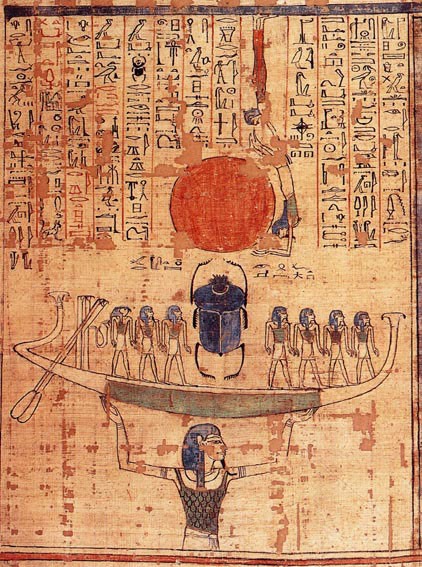
In ancient Egyptian myths, Re is shown making a journey across the sky each day in his boat. At night he journeys through the underworld where he defeats the allies of chaos, before being reborn each morning as the sunrise.
Re's influence on the other gods was so strong that, over time, he became merged with many of them. Thus Amun became Amun-Re and Horus became Re-Horakhty. Akenaten’s Sun god, the Aten, was another form of Re. The pharaohs claimed to be descended from Re, calling themselves “The Son of Re”.
Seth
God of storms, chaos, evil, darkness, war
Seth (also known as Set or Sutekh) was the son of Geb and Nut, and the evil brother of Osiris. He is depicted as a man with the head of an unknown dog-like animal.
Seth murdered his brother Osiris and seized the throne of Egypt, for which act most of the other gods—along with the Egyptian people—despised him. Osiris was miraculously brought back to life by his wife Isis. Horus, the son of Osiris and Isis, eventually defeated Seth in a fight described as the struggle between good and evil. Seth was then adopted by the Sun god Re, sometimes accompanying him across the sky, triggering storms and bad weather.
How the world began
According to ancient Egyptian myths, the world began with dark waters of chaos, called Nun. One day, a mound rose out of these waters. The mound was called ben-ben. On it stood Atum, the first god. Atum coughed and spat out Shu, the god of the air, and Tefnut, the goddess of moisture.
Shu and Tefnut had two children: Geb, the god of the Earth and Nut, the goddess of the sky. Nut stretched from one horizon to the other, touching the ground with only her fingertips and toes. Nut and Geb had four children: Osiris, Isis, Seth and Nephthys. Osiris took his father’s place as king of the earth and Isis was his queen. Osiris ruled fairly and justly over the earth for many years. However, Seth was jealous of Osiris because he wanted to be the ruler of the earth. One day he killed Osiris.
Osiris went down into the underworld and Seth became king of the earth. Osiris and Isis had one son called Horus. Isis protected her son by hiding him in the reeds of the Nile until he grew old enough to avenge his father’s death. Horus battled against Seth and regained the throne to become king of the earth. Every pharaoh, the Egyptians believed, had the spirit of Horus inside him. When he died, he went to the underworld, the Afterlife, where he was joined with the spirit of Osiris.
Consultant: Phillip Parker
pics


Without in any way limiting Q-files Ltd’s exclusive rights under copyright, any use of this publication to “train” generative artificial intelligence (AI) technologies to generate text is expressly prohibited. Q-files Ltd reserves all rights to license use of this work for generative AI training and development of machine learning language models.