
British kings and queens
Scottish kings and queens 11th–14th centuries
Malcolm II (1005–1034)
While the English were struggling to fight off Viking Danish raids, Malcolm took the opportunity to defeat them at the Battle of Carham and regain Lothian in 1018. King Cnut, the Danish king of England invaded Scotland in 1027 and forced Malcolm king to submit to him. But Malcolm held on to Lothian and made alliances with Strathclyde and Orkney.

Duncan I (1034–1040)
Succeeding his grandfather Malcolm II, Duncan I marched south to besiege Durham, but he was beaten off with heavy losses. Married to a relative of the Danish Earl of Northumbria, Siward, Duncan was unpopular with his subjects. He was killed in battle near Elgin in 1040 by one of his own commanders, Macbeth.
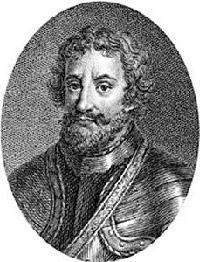
Macbeth (1040–1057)
William Shakespeare's play, Macbeth, is based on the life of this king, but it is not historically accurate. In the play, Macbeth and his wife murder the ageing Duncan I (he was actually only about 39) when he visits them in their castle, not—as actually happened—on the battlefield. Macbeth's marriage to Gruoch, Kenneth III's granddaughter, strengthened his claim to the throne. After killing Duncan I's father, Crinan, at Dunkeld in 1045, Macbeth's rule was peaceful for the rest of his reign. He made a pilgrimage to Rome in 1050, the first Scottish king to do so. Macbeth was killed at the Battle of Lumphanan by Duncan's eldest son, Malcolm Canmore in August 1057.
Lulach (1057–1058)
Following the death of Macbeth, the king's followers placed Lulach on the throne. Nicknamed Tairbith, meaning "the Unfortunate", he a weak king and ruled only for a few months before being assassinated by Malcolm Canmore, who seized the throne.
Malcolm III (1058–1093)
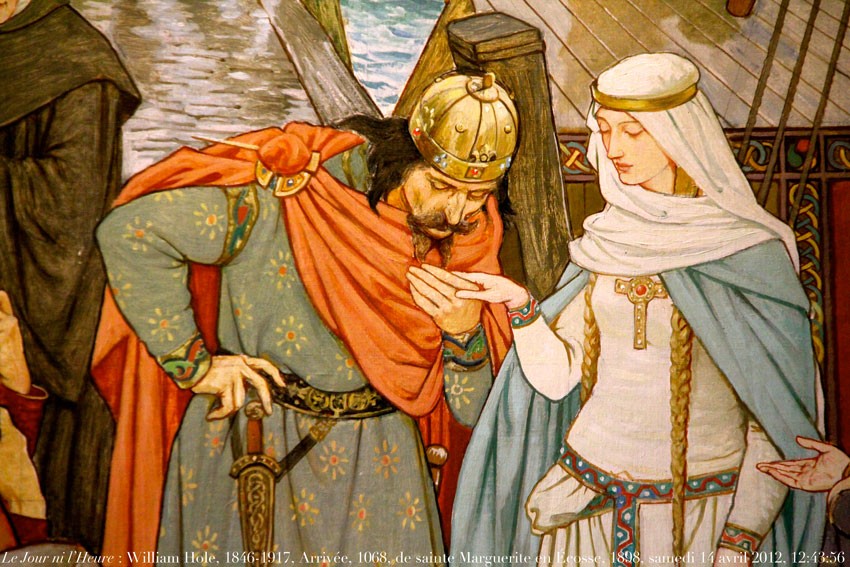
Malcolm Canmore (“great chief”) was the eldest son of Duncan I. His second wife was Margaret, great-niece of King Edward the Confessor of England. She found refuge in Scotland with her brother, Edgar the Atheling, the Anglo-Saxon heir to the English throne, when William the Conqueror became king of England in 1066. Malcolm invaded England several times, but William drove him back, eventually forcing Malcolm to become his vassal under the Treaty of Abernethy of 1072. Malcolm was finally killed in battle at Alnwick, Northumberland. After Malcolm's death, the frontier between the kingdoms of Scotland and England was fixed for the first time.

Donald III (1093–1094 and 1094–1097), Duncan II (1094)
The younger brother of Malcolm III, Donald “Bane” (Fair) seized the throne, but was deposed by his nephew Duncan in 1094, with the help of William Rufus of England. He regained the throne after he had Duncan murdered in November that year, then shared his rule with his nephew Edmund. But in 1097 Donald was captured and blinded by another of his nephews, Edgar. He was the last king of the Scots to be buried in Iona.
Edgar (1097–1107)
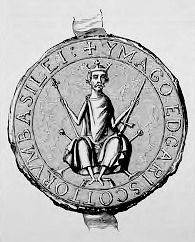
The fourth son of Malcolm III, Edgar had fled to England when his father died in 1093. Following the death of his half-brother, Duncan II, William II of England recognized him as the rightful King of Scots—provided he agreed to become William’s vassal. In 1097 an English army helped Edgar to seize the throne from Donald III. In 1100, his sister Matilda (Maud) married Henry I of England, and so Edgar “the Peaceable”—an insulting nickname, used by those opposed to his alliance with the English—became brother-in-law to the English king. He died unmarried.
Alexander I (1107–1124)
The fifth son of Malcolm III, he was described as a “godly man” but also bore the nickname of “the Fierce” after dealing ruthlessly with an uprising. He married the illegitimate daughter of Henry I, Sybilla, but they died childless.
David I (1124–1153)
The youngest son of Malcolm III, David became, over the course of his reign, almost as rich and powerful as the king of England. He married Matilda, heiress to the earldoms of Northampton and Huntingdon, and welcomed Anglo-Norman immigrants to Scotland, granting them lands and power in return for feudal services. David was the first Scottish king to issue his own coins. He founded the royal burghs of Jedburgh, Perth and Stirling as well as many abbeys, including those of Holyrood, Melrose and Dryburgh. When Henry I of England died in 1135, David I invaded England on behalf of his niece Matilda, taking the opportunity to extend his kingdom southwards. By the Treaty of Durham of 1139, he acquired Northumberland and, 10 years later, Cumberland and Westmorland, too.
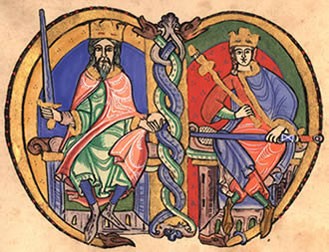
Malcolm IV (1153–1165)
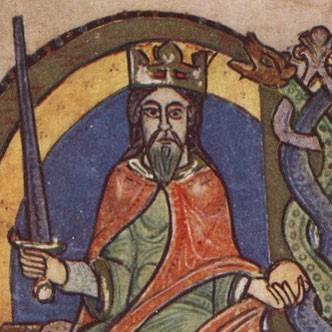
David I persuaded the nobility to recognize his 12-year-old grandson Malcolm as his heir. Malcolm was forced to surrender Cumbria, Westmorland and Northumbria to Henry II. Malcolm's submission to Henry led to rebellions by the earls in 1160 and 1164. He died unmarried and with a reputation for chastity, hence his nickname, “the Maiden”.
William the Lion (1165–1214)
William was the younger brother of Malcolm IV. After a failed attempt to invade Northumbria, he was captured by Henry II. William and other nobles had to swear allegiance to Henry and hand over control of key castles such as Edinburgh and Stirling. William was eventually able to recover Scottish independence in return for a payment of 10,000 marks to Henry’s successor, Richard I, in 1189. William was a great supporter of the Scottish Church and managed to persuade the Pope to recognize its separate identity to the English church in 1192.


Alexander II (1214–1249)
The son of William the Lion, Alexander established a peace with England in 1217 that would last for 80 years. The agreement was sealed by his marriage to Henry III's sister Joan in 1221. After Scotland’s claim to Cumbria, Westmorland and Northumbria was given up, the Anglo-Scottish border was finally established from the Tweed to the Solway Firth by the Treaty of York in 1237.
Alexander III (1249–1286)
The son of Alexander II, Alexander III became king at the age of seven. He married Henry III's daughter Margaret in 1251 when still only 10, but never paid homage to England while he was king. Following the Battle of Largs in 1263, Alexander gained the western Highlands and islands for the Crown from King Haakon of Norway in 1266. After the deaths of his sons, Alexander persuaded the Scottish parliament that his granddaughter Margaret should succeed him. He died after a fall whilst riding along the cliffs of Kinghorn in Fife.


Margaret, Maid of Norway (1286–1290)
The only surviving child of Margaret, daughter of Alexander III, and King Eric of Norway, she became queen while she was a two-year-old infant. It was decided that she should marry Edward, the son of Edward I of England, but she died aged only seven. Her death caused a serious crisis, because there was no obvious heir to the throne.
John Balliol (1292–1296)
Following the death of Margaret in 1290, no single person had an undisputed claim to be king of Scotland. Thirteen “competitors” put their names forward, and they agreed to abide by the decision of Edward I of England. Edward eventually awarded the crown to John Balliol in 1292. But Edward soon made it clear that he regarded Scotland as his vassal state—and Balliol was too weak to resist him. The Scottish nobles resented Edward's demands and agreed to an alliance with King Philip IV of France. Edward marched north, defeating Balliol at the Battle of Dunbar in 1296. Balliol abdicated at Stracathro near Montrose in July 1296. The arms of Scotland were torn from his surcoat, giving him the name of Toom Tabard (empty coat). Balliol was imprisoned in the Tower of London, but eventually released and exiled to France, where he died in 1313. Scotland had no king from 1296 until 1306.


Robert I (Robert the Bruce, 1306–1329)
Robert took up the struggle for Scotland's independence from England after the death of William Wallace, and was crowned King of Scotland in 1306. But he was defeated in battle against the English. Whilst in hiding, he is said to have watched a spider struggling to spin its web. It failed six times, but succeeded at the seventh attempt. Inspired, Bruce resolved to continue the fight. His victory over Edward II's army, which outnumbered his own by three to one, at Bannockburn in June 1314 finally secured Scotland’s freedom from English rule. Edward II refused to give up his claim to the overlordship of Scotland, and so the Declaration of Arbroath was drawn up by the Scottish nobility in 1320, asserting Robert’s right to the throne. In 1324, the Pope recognized Robert as king. By the time Edward III of England agreed to give up England's claim to Scotland, King Robert was seriously ill, probably with leprosy. He died in 1329, aged 54.
David II (1329–1371)
David succeeded his father when only 5 years old. After Edward III defeated the Scots at the Battle of Halidon Hill in 1333, David was sent to the safety of France, where he remained until 1341. Following Edward III's victory at the Battle of Crécy, David II decided to invade England in 1346 in support of his ally, France, but he was captured at the Battle of Neville's Cross later that year. He was held prisoner for 11 years, being freed only on payment of a ransom of 100,000 marks. David's concern over the succession led to an attempted agreement with Edward III, offering Edward's son Lionel the Scottish throne should he, David, die childless. The Scottish Parliament refused to allow this. When David did die without an heir in 1371, his nephew, Robert the Steward succeeded him.


Edward Balliol (1332–1336)
While David II was still a boy, Edward III took the opportunity to regain influence in Scotland. Edward, the eldest son of John Balliol, invaded Scotland with English assistance and defeated a Scottish army at the Battle of Dupplin in 1332. Edward Balliol was then crowned king at Scone in September. He was forced to flee south only three months later. He was restored by the English in 1333, following the Battle of Halidon Hill, but finally deposed in 1336 by those loyal to David II.
Consultant: Philip Parker