
EASY READ Ancient worlds

CITE
We have made every effort to follow citation style rules, but there may be some minor differences. If in doubt, please refer to the appropriate citation style manual.
EASY READ What was it like in the Roman army?. (2025). In Q-files Encyclopedia, History, EASY READ Ancient worlds. Retrieved from
https://www.q-files.com/history/easy-read-ancient-worlds/easy-read-what-was-it-like-in-the-roman-army
"EASY READ What was it like in the Roman army?." History, EASY READ Ancient worlds, Q-files Encyclopedia, 5 Dec. 2025.
https://www.q-files.com/history/easy-read-ancient-worlds/easy-read-what-was-it-like-in-the-roman-army.
Accessed 13 Sep. 2026.
EASY READ What was it like in the Roman army? 2025. History, EASY READ Ancient worlds. Retrieved 13 September 2026, from
https://www.q-files.com/history/easy-read-ancient-worlds/easy-read-what-was-it-like-in-the-roman-army
History, EASY READ Ancient worlds, s.v. "EASY READ What was it like in the Roman army?," accessed September 13, 2026.
https://www.q-files.com/history/easy-read-ancient-worlds/easy-read-what-was-it-like-in-the-roman-army


What was it like in the Roman army?
It was thanks to their well-trained army that the Romans were successful in conquering other lands and building a huge empire. The powerful army crushed any rebellions within the empire. It could even control who became emperor. Ordinary footsoldiers in the army were called legionaries. Their commanding officers were called centurions.
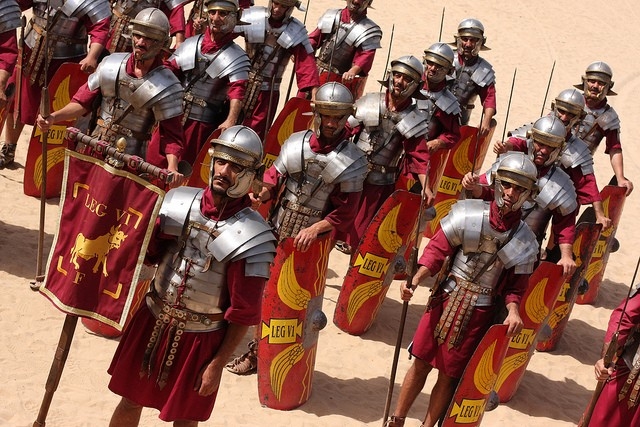

Legions
The Roman army was divided into legions, groups of about 5500 men. A legion was made up of a number of cohorts, each consisting of 10 centuries, or 800 men. Each century (which was made up of 80 men) had its own commander, called a centurion. The century's standard bearer was called a signifer. The bearer of the legion’s standard, a gold or silver eagle, was called the aquilifer. The eagle standard was the most important possession of the legion. Its loss in battle was considered to be a terrible disgrace.
Centurions were responsible for the training and discipline of the men under them. They often led their men into battle, fighting alongside them.
Legionary
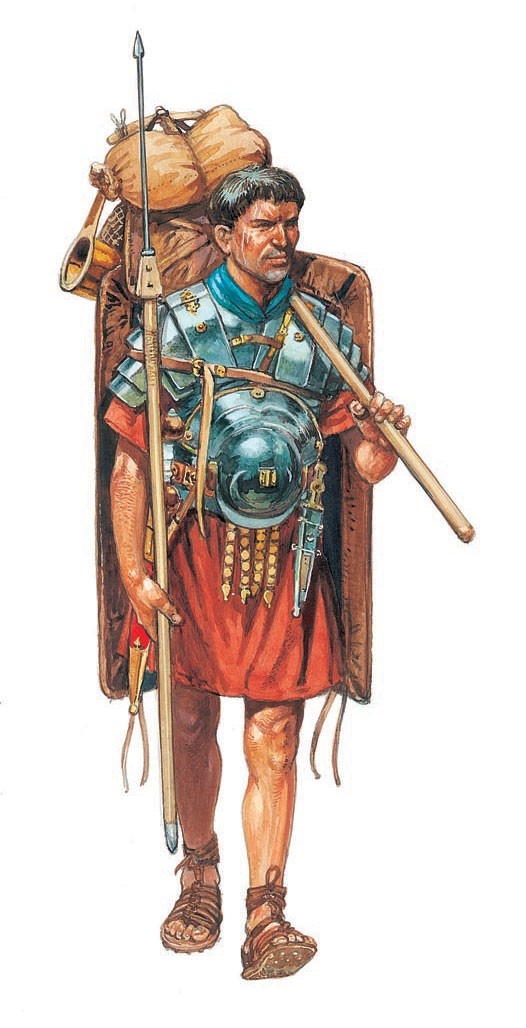
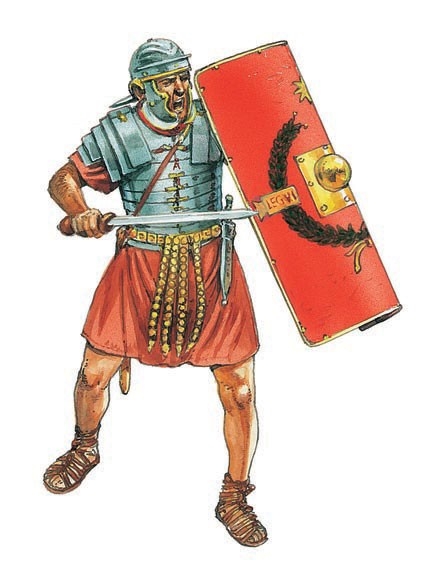
Ordinary Roman footsoldiers were known as legionaries. A legionary wore iron armour over a woollen tunic and a leather kilt. He also had an iron helmet. He carried a gladius (sword), a pugio (dagger), a scutum (shield) and two pila (throwing spears).
The Roman Empire was vast, and much of a legionary’s time was spent marching from place to place. He had to carry with him his weapons, shield, bedroll, cooking pans and food. Legionaries had to be at least 1.73 metres (5 feet 8 inches) tall and have good eyesight.
Weapons
All men fought with their weapons in their right hand and their shield in their left. The rectangular shield curved around the body. This meant that only their fighting arm was unprotected. The shield was made of wood and canvas, reinforced with iron around its edge. It had an iron lump, called a boss, in the centre.
Testudo
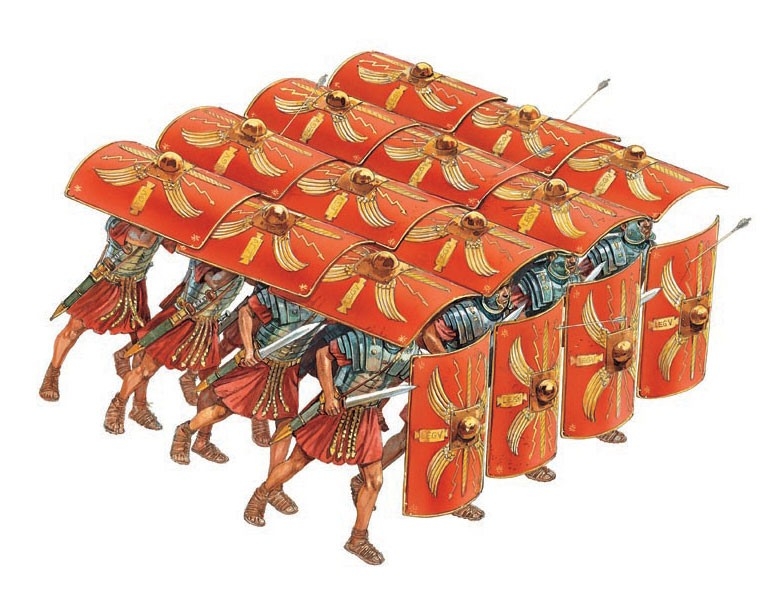
In the testudo ("tortoise") formation, men marched close together, overlapping their shields above their heads and in front of them as they advanced. This formed a barrier. It protected the men from arrows and spears. This allowed the soldiers to get close to the enemy, and was particularly useful during a siege.
Sieges
To capture cities, the Roman army would mount a siege. They surrounded the city walls so that nobody could escape, nor any food be brought in. Soldiers then used catapults to launch an attack.

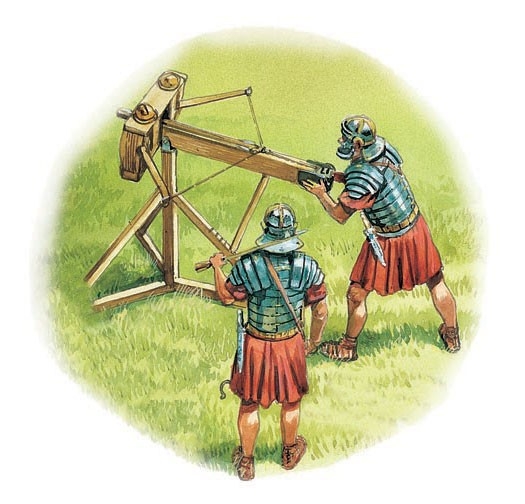
Another weapon used was the ballista, a large and powerful crossbow. It fired bolts tipped with iron that could burst through even the strongest armour. The soldiers also used battering rams to break down the city gates.
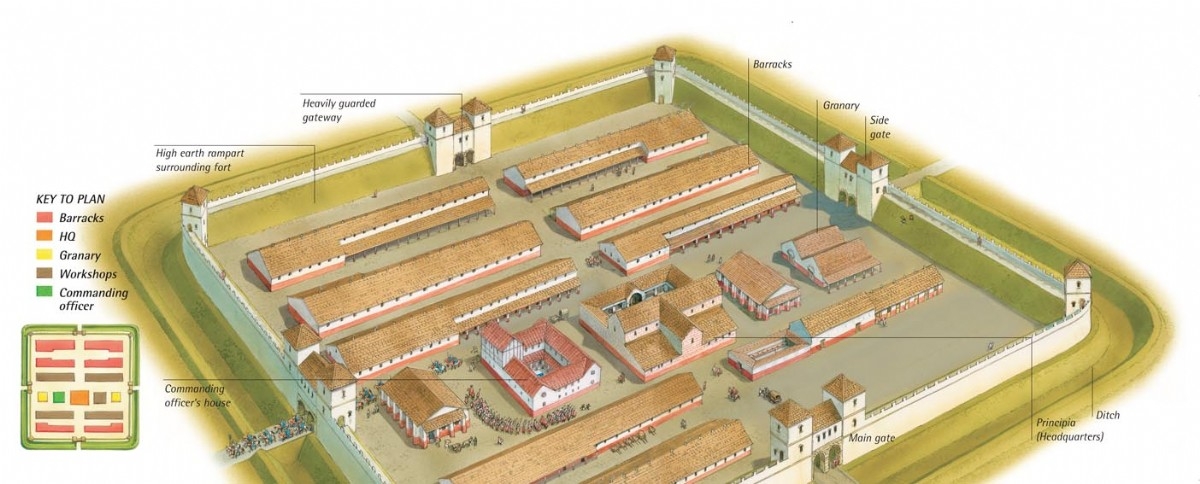
Roman fort
The Romans needed to keep their newly conquered territories under strict control. For this reason the army built forts, each housing up to a whole legion. The fort was protected by a wall and surrounding ditch. Inside were barracks (where the soldiers slept), the commander's house (praetorium), army headquarters (principia), a bathhouse, granary (for storing grain), a hospital and stables.
Legionaries trained every day. New recruits learned how to use their weapons by practising with wooden swords. Soldiers were expected to obey orders instantly. A centurion would beat any soldier who stepped out of line.

Ready to find out more?
Here are some pages in other parts of Q-files you might like to explore:
Roman army
Roman fort
Consultant: Philip Parker
pics
Without in any way limiting Q-files Ltd’s exclusive rights under copyright, any use of this publication to “train” generative artificial intelligence (AI) technologies to generate text is expressly prohibited. Q-files Ltd reserves all rights to license use of this work for generative AI training and development of machine learning language models.