
EASY READ Ancient worlds

CITE
We have made every effort to follow citation style rules, but there may be some minor differences. If in doubt, please refer to the appropriate citation style manual.
EASY READ What do we know about ancient China?. (2025). In Q-files Encyclopedia, History, EASY READ Ancient worlds. Retrieved from
https://www.q-files.com/history/easy-read-ancient-worlds/easy-read-what-do-we-know-about-ancient-china
"EASY READ What do we know about ancient China?." History, EASY READ Ancient worlds, Q-files Encyclopedia, 5 Dec. 2025.
https://www.q-files.com/history/easy-read-ancient-worlds/easy-read-what-do-we-know-about-ancient-china.
Accessed 13 Sep. 2026.
EASY READ What do we know about ancient China? 2025. History, EASY READ Ancient worlds. Retrieved 13 September 2026, from
https://www.q-files.com/history/easy-read-ancient-worlds/easy-read-what-do-we-know-about-ancient-china
History, EASY READ Ancient worlds, s.v. "EASY READ What do we know about ancient China?," accessed September 13, 2026.
https://www.q-files.com/history/easy-read-ancient-worlds/easy-read-what-do-we-know-about-ancient-china


What do we know about ancient China?
The Chinese civilization grew up on the banks of the Yellow River (Huang He) in northern China more than 7000 years ago. It was completely separate from the rest of the world for thousands of years. Eventually, powerful ruling families, called dynasties, began to take power. During the Shang dynasty, which began in about 1600 BC, some large towns grew up, where people carried out different trades and crafts. A form of writing also appeared at this time.


Zhou dynasty
The Shang dynasty was overthrown in about 1100 BC by the Zhou dynasty. The Zhou ruled for about 850 years, longer than any other dynasty in Chinese history. In later centuries of Zhou rule, China descended into chaos, with wars frequently breaking out between rival states.
Confucius
During Zhou times, Chinese scholars began to study philosophy, the meaning of life. Among the most important Chinese philosophers was Confucius. Living during times of war, Confucius’s purpose was to restore peace and order in the land. Confucius believed in strong family loyalty and respect. For him, knowing the difference between right and wrong was very important. His Golden Rule was: "Do not do to others what you would not have done to yourself".

Qin Shi Huangdi
After many years of fighting between states, the Qin (pronounced "chin") dynasty emerged victorious in 221 BC. They were led by Zheng, King of Qin. He was a brilliant military commander. Zheng was the first to rule over a single unified Chinese empire. He took the title of Qin Shi Huangdi, Emperor of China, and ruled from his capital city, Xianyang (near the present-day city of Xi'an).
Shi Huangdi was a powerful man. Under his command were a million armoured soldiers, a thousand chariots and 10,000 horses. He was also a strict ruler. He kept order in China by having anyone who opposed him executed. He made everyone pay tax and use the same sort of money, weights and way of writing. He also built new roads across the country.


Terracotta Army
Despite his great power, there was one thing Shi Huangdi was afraid of: death. He made elaborate plans for his burial. When he died in 210 BC, more than 8000 life-size soldiers, and dozens of horses and chariots—all made of a baked clay called terracotta—were buried alongside him in his tomb. They were there to protect the emperor’s spirit. Every statue, based on a real person, was different. They were originally painted in bright colours and carried real weapons.
They can be seen today, giving us a clear picture of what Qin warriors really looked like.

Great Wall of China
In 214 BC Shi Huangdi ordered the building of a great wall to protect the north of China from attack by enemy tribes. More than 300,000 soldiers, peasants and prisoners worked to build what is today called the Great Wall of China. They used stone from nearby quarries, wood and earth. Many died in the process and their bodies were buried inside the wall. By the time it was finished, the first Great Wall of China stretched for about 2400 kilometres (1500 miles).


Soldiers were stationed in watchtowers positioned along the length of the wall. They sent messages to one another by smoke signals. Messages could travel from one end of the wall to the other in less than a day.

Silk Road
The Han dynasty ruled China after the Qin dynasty fell. Under Emperor Wu (ruled 141–87 BC) Han rule expanded into Central Asia. Soon, Chinese merchants started to travel west to take silks and spices to sell to traders from the Middle East. In return, they received gold, silver, cotton and other goods. The merchants used what is now called the Silk Road. This route skirted around the deserts and mountains of Central Asia.
Inventions
The Han period was a time of great advances in technology. The Chinese invented many things that we take for granted today. One of the most important inventions was paper, which was first manufactured in AD 105. The earliest paper was made from tree bark and old rags pulped together with water, then flattened and dried in thin sheets.

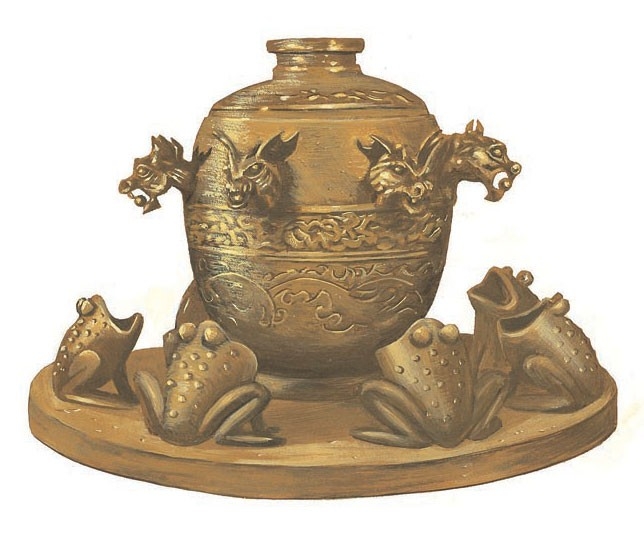
Chinese scientists were the first to understand magnetism. They invented the magnetic compass. The stirrup was another early invention. Stirrups gave mounted soldiers more control over their horses and so helped them in battle. They also invented gunpowder and an earthquake detector. These and other inventions did not reach the West until hundreds of years later.
Ready to find out more?
Here are some pages in other parts of Q-files you might like to explore:
Ancient China
Shang dynasty
Zhou dynasty
Qin dynasty
Great Wall of China
Terracotta Army
Han dynasty
Chinese inventions
Silk Road
Consultant: Philip Parker
pics


Without in any way limiting Q-files Ltd’s exclusive rights under copyright, any use of this publication to “train” generative artificial intelligence (AI) technologies to generate text is expressly prohibited. Q-files Ltd reserves all rights to license use of this work for generative AI training and development of machine learning language models.