
EASY READ Ancient worlds

CITE
We have made every effort to follow citation style rules, but there may be some minor differences. If in doubt, please refer to the appropriate citation style manual.
EASY READ Why were ancient Egyptian mummies made?. (2025). In Q-files Encyclopedia, History, EASY READ Ancient worlds. Retrieved from
https://www.q-files.com/history/easy-read-ancient-worlds/easy-read-why-were-ancient-egyptian-mummies-made
"EASY READ Why were ancient Egyptian mummies made?." History, EASY READ Ancient worlds, Q-files Encyclopedia, 5 Dec. 2025.
https://www.q-files.com/history/easy-read-ancient-worlds/easy-read-why-were-ancient-egyptian-mummies-made.
Accessed 30 Oct. 2026.
EASY READ Why were ancient Egyptian mummies made? 2025. History, EASY READ Ancient worlds. Retrieved 30 October 2026, from
https://www.q-files.com/history/easy-read-ancient-worlds/easy-read-why-were-ancient-egyptian-mummies-made
History, EASY READ Ancient worlds, s.v. "EASY READ Why were ancient Egyptian mummies made?," accessed October 30, 2026.
https://www.q-files.com/history/easy-read-ancient-worlds/easy-read-why-were-ancient-egyptian-mummies-made


Why were ancient Egyptian mummies made?
The Egyptians believed that their pharaoh was a god. He would come to life again after he died (the Afterlife). But this would only happen if his body had not decayed. Turning the body into a mummy would stop it decaying. So, whenever a pharaoh died, his body was always mummified. Then, after a ceremony, priests carried his coffin to the tomb.


Making a mummy
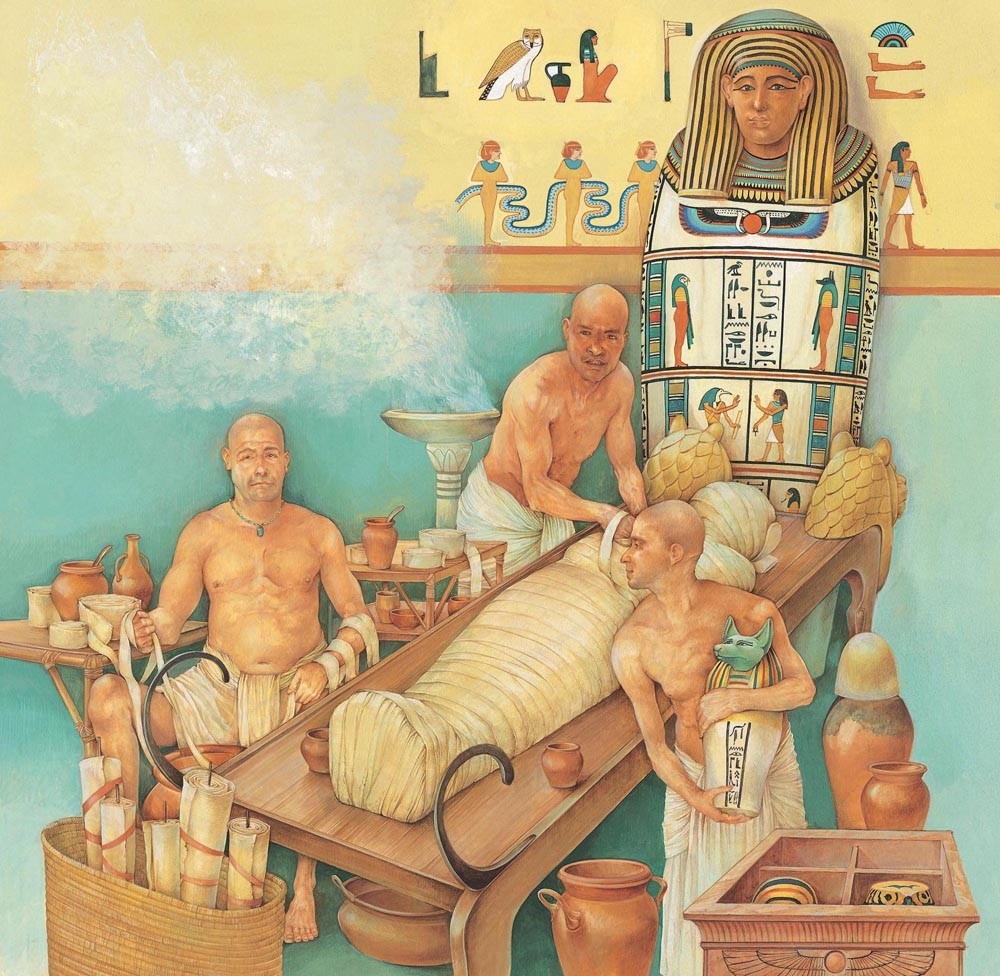
Firstly, the team of embalmers removed the brain. Using an iron hook, they pulled it carefully out through the nostrils. Then they made a cut in the side of the body and took out the liver, lungs, stomach and intestines. The organs were put into special jars called canopic jars.
The heart was left inside the body. The Egyptians believed the heart was used for thinking and so would be needed in the afterlife.
The body was dried out using a salt called natron. It was then covered with spices and resin (sticky tree-sap). Sand and fragrant spices were packed inside the body.
Finally, the body was carefully wrapped in linen bandages and a mask placed over the head. The whole process took 70 days to complete.

Amulets
Amulets were charms that Egyptians thought would protect them against evil spirits and illness. They were placed between the layers of bandages wrapped round the mummy. Popular amulets included the winged scarab, the wedjat eye—both symbols of rebirth—and the ankh. The ankh, the “key of eternal life”, was a kind of cross.

Opening of the Mouth
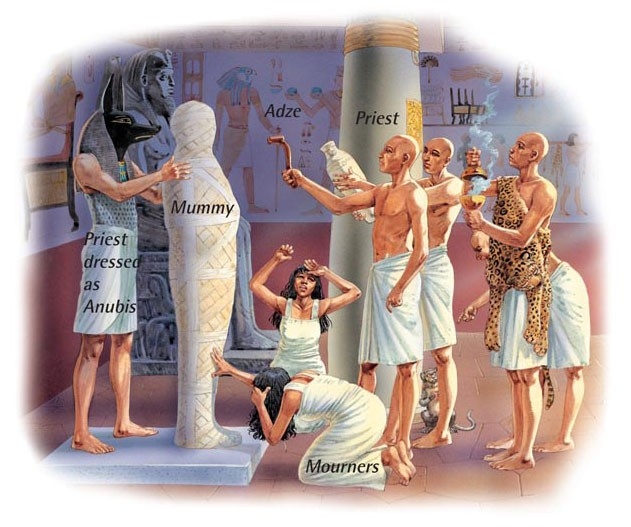
The Opening of the Mouth ceremony took place after the mummy-making process was completed. While one priest, dressed as the jackal-headed god Anubis, held the pharaoh's mummy upright, another held out an adze, a kind of hand tool. He touched the hands, feet, eyes, ears, nose and mouth with it. By so doing, the priest had now enabled the dead pharaoh to breathe, eat and speak in the Afterlife.

Burial
Following a final ceremony, the coffin was lowered carefully into a stone coffin called a sarcophagus. Priests said prayers for the pharaoh’s spirit, or ka. They then left the tomb. Treasures and things the pharaoh might need in the Afterlife, such as food, wine, furniture and fine jewellery, were piled up inside the tomb.
Valley of the Kings

In Old Kingdom times, pharaohs built pyramids to house their tombs. But these were often robbed of their treasures. So, during the New Kingdom, pharaohs were buried in tombs carved out of the rock in the Valley of the Kings. They hoped these tombs would be more secure. Some had a well shaft to drain away water if the tomb ever flooded. The burial chamber was at the end of a passageway, sealed with blocks of stone.

Ready to find out more?
Here are some pages in other parts of Q-files you might like to explore:
Afterlife
Mummies
Funeral of a pharoah
Valley of the Kings
Tutankhamun's tomb
Ancient Egyptian temples
Consultant: Philip Parker
pics
Without in any way limiting Q-files Ltd’s exclusive rights under copyright, any use of this publication to “train” generative artificial intelligence (AI) technologies to generate text is expressly prohibited. Q-files Ltd reserves all rights to license use of this work for generative AI training and development of machine learning language models.