
EASY READ Ancient worlds

CITE
We have made every effort to follow citation style rules, but there may be some minor differences. If in doubt, please refer to the appropriate citation style manual.
EASY READ Who were the pharaohs?. (2025). In Q-files Encyclopedia, History, EASY READ Ancient worlds. Retrieved from
https://www.q-files.com/history/easy-read-ancient-worlds/easy-read-who-were-the-pharaohs
"EASY READ Who were the pharaohs?." History, EASY READ Ancient worlds, Q-files Encyclopedia, 5 Dec. 2025.
https://www.q-files.com/history/easy-read-ancient-worlds/easy-read-who-were-the-pharaohs.
Accessed 13 Sep. 2026.
EASY READ Who were the pharaohs? 2025. History, EASY READ Ancient worlds. Retrieved 13 September 2026, from
https://www.q-files.com/history/easy-read-ancient-worlds/easy-read-who-were-the-pharaohs
History, EASY READ Ancient worlds, s.v. "EASY READ Who were the pharaohs?," accessed September 13, 2026.
https://www.q-files.com/history/easy-read-ancient-worlds/easy-read-who-were-the-pharaohs


Who were the pharaohs?
Pharaoh was the title for the man (and, in some cases, woman) who was high priest and ruler of ancient Egypt. The Egyptians believed that the pharaoh was more than just a ruler. He or she was almost a god, descended from Re, the sun god.

Pharaoh

The pharaoh was entrusted by the gods with keeping order in the land of Egypt. He was responsible for ensuring that offerings were made to the gods. The gods would then continue to bless Egypt with the annual Nile floods. These watered the crops on which all the Egyptian people depended.

The pharaoh wore the Double Crown. It combined the White Crown of Upper Egypt with the Red Crown of Lower Egypt. This showed he was ruler of both Upper and Lower Egypt. The cobra on the rim of the crown represented the eye of Re. This protected him against his enemies.
The pharaoh also carried a crook, a symbol of his duty to protect his people, and a flail or whip, a symbol of his power to punish his enemies.
History
By about 3400 BC Egypt consisted of two kingdoms, Upper and Lower Egypt. In about 3100 BC, Egypt was united, probably under the rule of Menes (also called Narmer), the first pharaoh. From then on, the history of Egypt was divided into three main periods: the Old Kingdom, the Middle Kingdom and the New Kingdom. The Old Kingdom was the age of pyramid-building. In the Middle Kingdom, Egypt traded with other lands and conquered Nubia to the south.
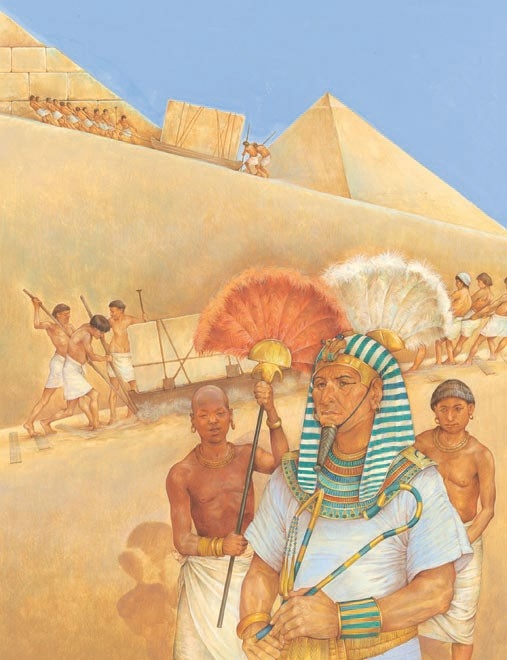

The New Kingdom (1550–1070 BC) was Egypt’s Golden Age. The capital was at Thebes in the south.The pharaohs conquered lands in the Middle East and made Egypt rich. They built great temples. But the wealth of ancient Egypt attracted other rulers. Egypt was invaded by the armies of Assyria, Greece, Persia and finally fell to the Romans in 30 BC.
Akhenaten
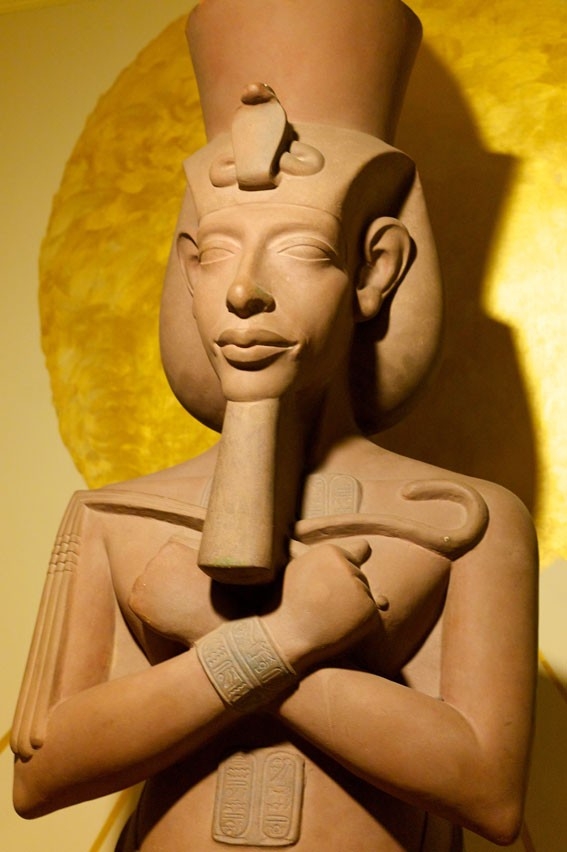
In 1352 BC Amenhotep IV succeeded to the throne of Egypt. Shortly afterwards, he changed his name to Akhenaten. This was because he believed in a single god, the sun-god Aten. The ancient Egyptians traditionally believed in many gods. The priests had become almost as powerful as the pharaoh himself. Akhenaten and his queen, Nefertiti, banned these beliefs and began a new religion based upon worship of Aten alone. This turned out to be unpopular.
The boy king
Akhenaten’s son, Tutankhamun, came to the throne in about 1336 BC. He was just nine years old, and so has become known as the "boy king". King Tut, as he is also sometimes called, is one of the most famous of all the pharaohs. This is because it was his tomb that was discovered, still with nearly all its treasures, in 1922.
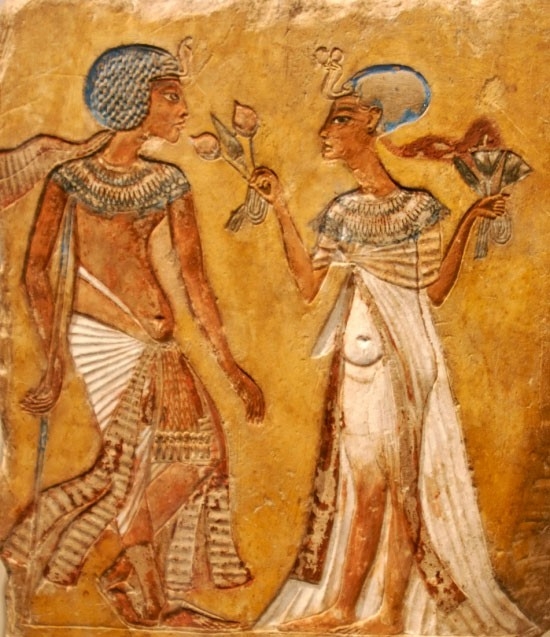
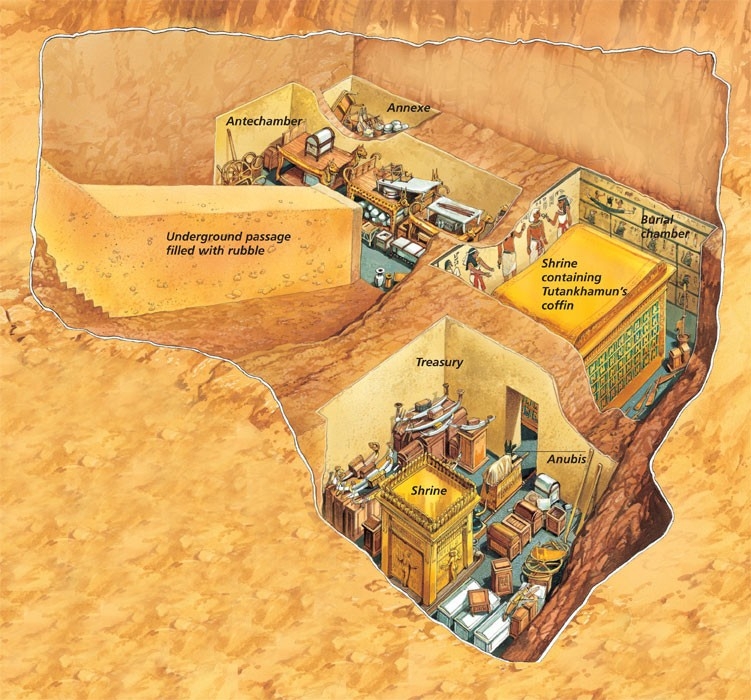
When he became king, Tutankhamun married his half-sister Ankhesenamun. He was always in poor health and needed to walk with the aid of a cane. A leg infection may have been enough to cause his sudden death at the age of only 19. Preparations for his burial had not yet been made, which is probably why his tomb is smaller than most other pharaohs’ tombs. It had originally been made for someone else, a lesser figure than a pharaoh.
Ramesses II
Ramesses II (1279–1213 BC) was probably the most powerful pharaoh in ancient Egyptian history. His reign was extremely long, 67 years, and he lived to around the age of 90. Although he had many wives and children in the course of his long life, his Great Royal Wife, Queen Nefertari, was a well-loved and much respected figure. Ramesses had many magnificent monuments, including temples and statues, built to commemorate his rule.


Ramesses vowed to recapture the territories of Palestine and Syria, then ruled by a people called the Hittites, for the Egyptian Empire. His armies fought the Hittites at a place called Kadesh. Ramesses narrowly avoided a heavy defeat but afterwards claimed it as an Egyptian victory. Later, he made peace with the Hittites and married a Hittite princess.

Cleopatra
The last ruling pharaoh of Egypt was Cleopatra VII (69–30 BC). She was descended from a Greek king, Alexander the Great. The Roman general Julius Caesar helped her to become sole ruler of Egypt instead of her brother, Ptolemy XIII. After Caesar's assassination in 44 BC, she and her lover Mark Antony made an alliance against Octavian (later Augustus). Their forces were defeated at the Battle of Actium.
Cleopatra killed herself by allowing herself to be bitten by an asp, a venomous snake. Egypt then became a province of the Roman Empire.
Ready to find out more?
Here are some pages in other parts of Q-files you might like to explore:
Ancient Egypt
History of ancient Egypt
Pharaoh
Famous pharaohs
Hatshepsut
Akhenaten
Queen Nefertiti
Tutankhamun
Tutankhamun's tomb
Ramesses II
Consultant: Philip Parker
pics

Without in any way limiting Q-files Ltd’s exclusive rights under copyright, any use of this publication to “train” generative artificial intelligence (AI) technologies to generate text is expressly prohibited. Q-files Ltd reserves all rights to license use of this work for generative AI training and development of machine learning language models.