
EASY READ Ancient worlds

CITE
We have made every effort to follow citation style rules, but there may be some minor differences. If in doubt, please refer to the appropriate citation style manual.
EASY READ When was the Golden Age of Greece?. (2025). In Q-files Encyclopedia, History, EASY READ Ancient worlds. Retrieved from
https://www.q-files.com/history/easy-read-ancient-worlds/easy-read-when-was-the-golden-age-of-greece
"EASY READ When was the Golden Age of Greece?." History, EASY READ Ancient worlds, Q-files Encyclopedia, 5 Dec. 2025.
https://www.q-files.com/history/easy-read-ancient-worlds/easy-read-when-was-the-golden-age-of-greece.
Accessed 13 Sep. 2026.
EASY READ When was the Golden Age of Greece? 2025. History, EASY READ Ancient worlds. Retrieved 13 September 2026, from
https://www.q-files.com/history/easy-read-ancient-worlds/easy-read-when-was-the-golden-age-of-greece
History, EASY READ Ancient worlds, s.v. "EASY READ When was the Golden Age of Greece?," accessed September 13, 2026.
https://www.q-files.com/history/easy-read-ancient-worlds/easy-read-when-was-the-golden-age-of-greece


When was the Golden Age of Greece?
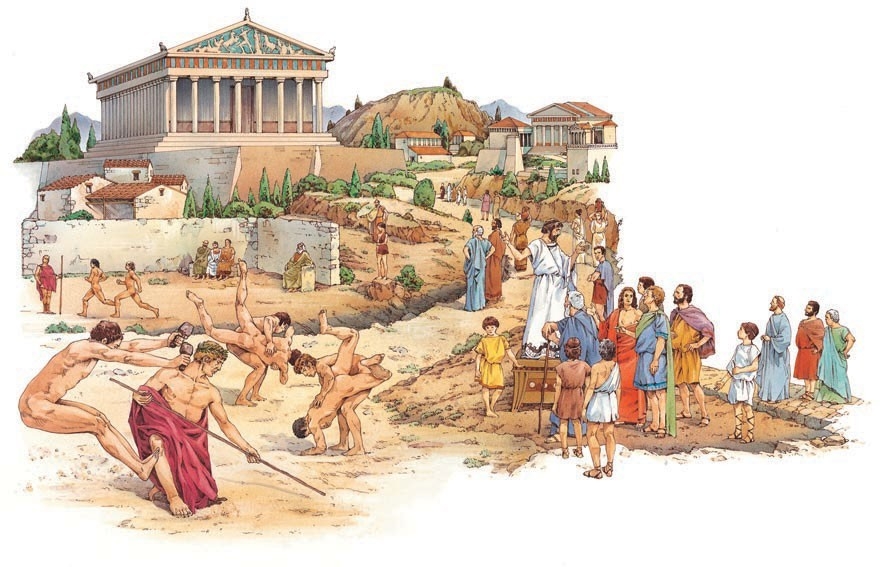
The “Golden Age” of Greece began around 2500 years ago. The country was divided into small states, each consisting of a city or town and surrounding villages. The city-state of Athens was the most powerful of all. It was full of beautiful temples and theatres, and the Athenian people lived well. The Greeks prized freedom of speech. Political speeches were often made in the city marketplace.


Gods and goddesses
The ancient Greeks worshipped dozens of gods and goddesses. The twelve most important were said to live on Mount Olympus, the highest mountain in Greece. Zeus was king of the Olympian gods, and also god of the sky, thunder and lightning. Hera, queen of the gods, was goddess of women and childbirth. The most important gods and goddesses had temples built in their honour.
The Parthenon
A group of buildings were built on the Acropolis, a rocky outcrop that still dominates Athens today. At the heart of the Acropolis was the Parthenon, a temple dedicated to the city’s goddess, Athena. The Greeks used columns for many of their temples and public buildings. They were made by standing one block of stone on top of another.

Drama

Plays were popular in ancient Greece. The audience sat on stone seats in an open-air theatre. Semicircular in shape, the theatre was cut into a hillside so that as many people as possible could see the play.
There were two main types of play: comedies and tragedies. Playwrights such as Sophocles and Aristophanes wrote plays for actors to perform. All the actors were men. They wore large masks so that even people sitting right at the back could tell who was who.

Art
Vases were often decorated with tales of gods, goddesses and heroes. Many also had scenes of everyday life, showing musicians, sportsmen and warriors painted on them. Sculptors created beautiful, life-like statues of both gods and real people.
Olympic Games
The original Olympic Games were held near Olympia, in southern Greece, every four years from 776 BC. At this time, Greece was made up of several city-states who were at war with one another. They declared a truce (ceasefire) for the Games, and sent their best athletes to compete. There were running races, throwing and jumping events, fight contests and chariot-racing. Only men were allowed to compete.


Science and ideas
The ancient Greeks had many ideas that have passed down to us today. They were the first to use a system of government called democracy, in which ordinary people choose their leaders by voting for them. Greek doctors understood that some illnesses could be cured by medicines made from herbs and plants.
The Greek alphabet spread from Greece to become the basis of the one we use today. Brilliant writers, mathematicians and scientists lived in ancient Greece. Clever thinkers, called philosophers, including Socrates, Plato and Aristotle, asked questions about the world that still puzzle us today.

At home

A typical home of a wealthy Greek family was built round an open courtyard which probably had a well for fresh water. The building was usually two storeys high with bedrooms and a room for women, called the gynaeceum, upstairs. The kitchens, a bathroom and the men’s dining area, or andron, were downstairs. Slaves would prepare the food, and do all the domestic work around the house.
Ready to find out more?
Here are some pages in other parts of Q-files you might like to explore:
Ancient Greece
Life in ancient Greece
History of ancient Greece
Consultant: Philip Parker
pics

Without in any way limiting Q-files Ltd’s exclusive rights under copyright, any use of this publication to “train” generative artificial intelligence (AI) technologies to generate text is expressly prohibited. Q-files Ltd reserves all rights to license use of this work for generative AI training and development of machine learning language models.