
EASY READ Ancient worlds

CITE
We have made every effort to follow citation style rules, but there may be some minor differences. If in doubt, please refer to the appropriate citation style manual.
EASY READ Who were the Aztecs?. (2025). In Q-files Encyclopedia, History, EASY READ Ancient worlds. Retrieved from
https://www.q-files.com/history/easy-read-ancient-worlds/easy-read-who-were-the-aztecs
"EASY READ Who were the Aztecs?." History, EASY READ Ancient worlds, Q-files Encyclopedia, 5 Dec. 2025.
https://www.q-files.com/history/easy-read-ancient-worlds/easy-read-who-were-the-aztecs.
Accessed 30 Oct. 2026.
EASY READ Who were the Aztecs? 2025. History, EASY READ Ancient worlds. Retrieved 30 October 2026, from
https://www.q-files.com/history/easy-read-ancient-worlds/easy-read-who-were-the-aztecs
History, EASY READ Ancient worlds, s.v. "EASY READ Who were the Aztecs?," accessed October 30, 2026.
https://www.q-files.com/history/easy-read-ancient-worlds/easy-read-who-were-the-aztecs


Who were the Aztecs?
Centuries ago, the Aztecs ruled a huge area of what is now Mexico. They conquered many neighbouring tribes. They had a huge army of trained soldiers, including the fearsome Jaguar warriors. The Aztec capital, Tenochtitlán, was a magnificent city built in the middle of a lake. It had many temples, each built in the shape of a stepped pyramid.


The eagle and the cactus
According to legend, the gods told the Mexica people (later known as the Aztecs) where to build their new home. It was to be the place where they saw an eagle resting on a prickly pear cactus. This came to pass on a swampy island in the middle of Lake Texcoco, high in the mountains. So it was on this spot that the Aztecs founded the city of Tenochtitlán in 1325. It would later be the capital of the Aztec Empire. (Today, what little remains of Tenochtitlán lies under the streets of modern Mexico City.)
Under their ruler Moctezuma I (ruled 1440–1468), the Aztecs extended their empire across central Mexico, from coast to coast. At its height, the Aztec Empire had a population of around 4 million people.
Tenochtitlán
The island city of Tenochtitlán had a population of about 200,000 people. The city was connected to the mainland by causeways (long, thin embankments rising above the water) reaching to the north, south and west. A network of canals criss-crossed the city.

Surrounding the city were chinampas, manmade islands. They were built from earth piled up on the shallow lake bottom. These so-called “floating gardens” were used for growing crops.
Gods
The Aztecs worshipped many gods. They believed that they owed a debt to the gods for keeping them safe from disaster. To keep their side of the bargain, sacrifices of humans and animals had to be made once a month. This would persuade the gods to ensure plentiful harvests and good fortune.
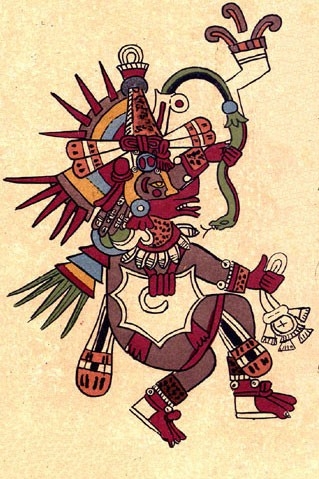
Quetzalcoatl was the chief Aztec god. He was also the god of order and civilization. The name Quetzalcoatl means “feathered serpent” in Nahuatl, the Aztec language.
Temples
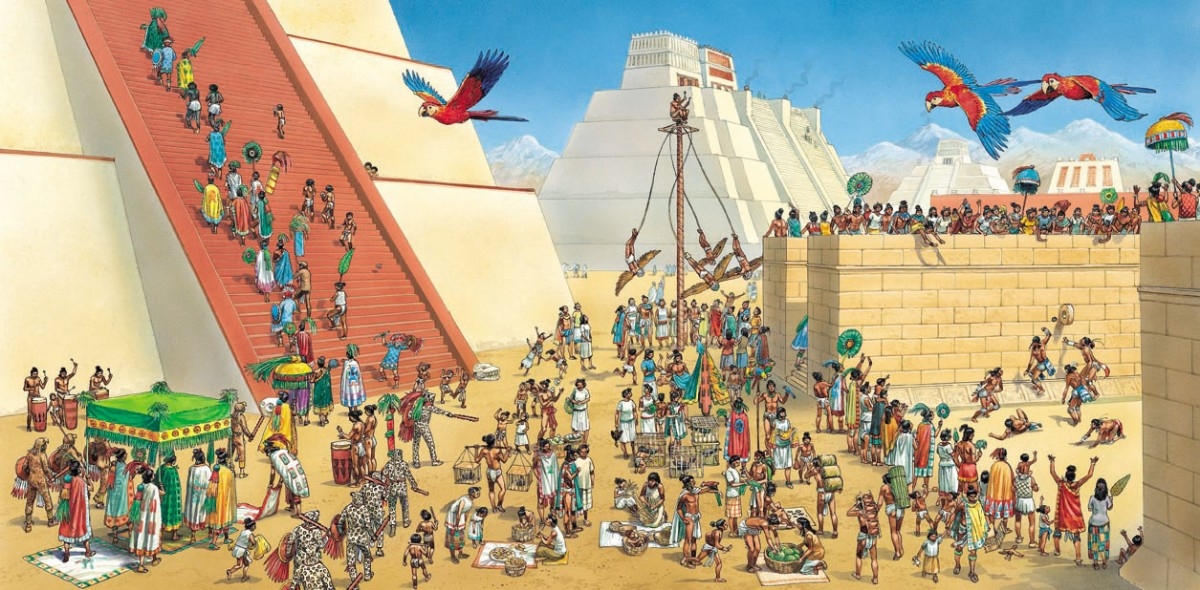
The Aztecs built temples to their gods in the shape of stepped pyramids. Some were 45 metres (150 feet) high. Many of these temples were used to sacrifice human victims. In front of each temple was a plaza, or square. Here people gathered to watch the sacrifices and festivals.


Life in Tenochtitlán
All children, whether they were boys or girls, rich or poor, went to school. Every house had a toilet and boats went up and down the city's canals collecting rubbish and waste. About 1000 men were employed to clean the city’s streets. At the same time, however, laws were harsh: many crimes were punishable by death.
Warfare
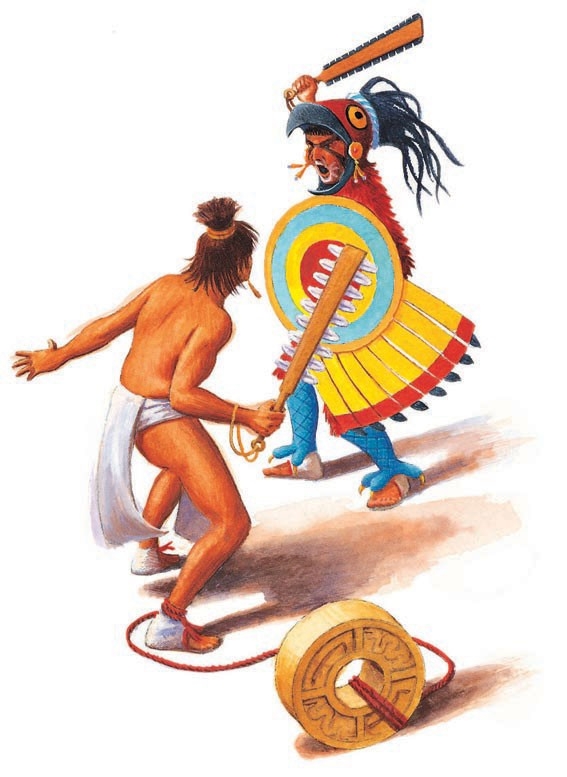
The Aztecs often went to war. They wanted extra food and treasures from new lands and cities. More importantly, they needed to gather captives to sacrifice to their gods. Aztec warriors attacked on foot, shouting, banging drums and blowing whistles. Some warriors carried a net for capturing their victims alive, while others were armed with clubs, spears and bows and arrows.
Warriors
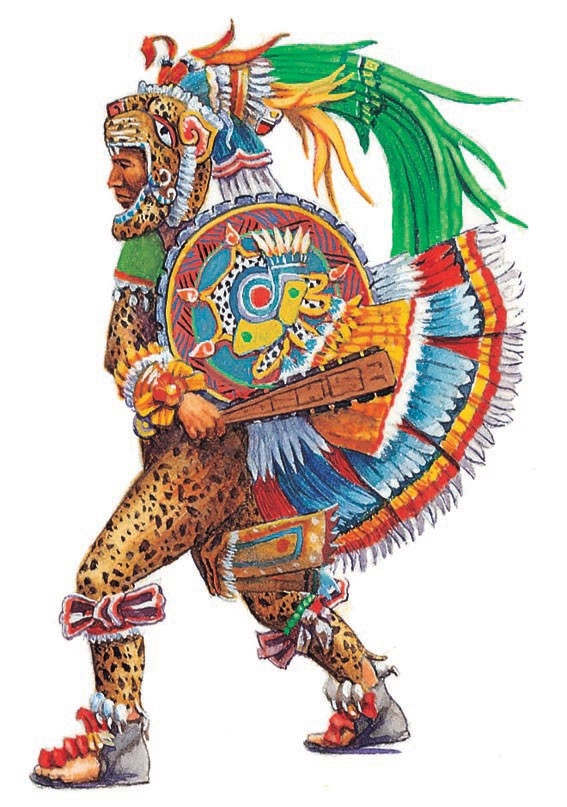
Brave, skilled warriors received rewards, such as elaborate headdresses, feathered clothing, animal skins and jewellery. The best warriors became jaguar or eagle knights.
Jaguar knights were the finest Aztec warriors. They believed the strength of a jaguar, a leopard-like cat, would come to them during battle. Jaguar knights carried out night-time attacks. They fought with a spear and a wooden club called a macahuitl. This was studded with glass blades. Their feathered shield was believed to hold magic powers.
End of the empire
In 1519, the Aztecs were attacked by Spanish invaders led by Hernán Cortés. The spears and clubs of the fierce Aztec warriors were no match for Spanish guns. By 1521, the empire, at that time ruled by Moctezuma ll, was defeated.

Ready to find out more?
Here are some pages in other parts of Q-files you might like to explore:
Aztecs
Conquest of the Aztecs
Quetzalcoatl
Consultant: Philip Parker
pics


Without in any way limiting Q-files Ltd’s exclusive rights under copyright, any use of this publication to “train” generative artificial intelligence (AI) technologies to generate text is expressly prohibited. Q-files Ltd reserves all rights to license use of this work for generative AI training and development of machine learning language models.