
EASY READ Ancient worlds

CITE
We have made every effort to follow citation style rules, but there may be some minor differences. If in doubt, please refer to the appropriate citation style manual.
EASY READ What was it like to live in Roman times?. (2025). In Q-files Encyclopedia, History, EASY READ Ancient worlds. Retrieved from
https://www.q-files.com/history/easy-read-ancient-worlds/easy-read-what-was-it-like-to-live-in-roman-times
"EASY READ What was it like to live in Roman times?." History, EASY READ Ancient worlds, Q-files Encyclopedia, 5 Dec. 2025.
https://www.q-files.com/history/easy-read-ancient-worlds/easy-read-what-was-it-like-to-live-in-roman-times.
Accessed 13 Sep. 2026.
EASY READ What was it like to live in Roman times? 2025. History, EASY READ Ancient worlds. Retrieved 13 September 2026, from
https://www.q-files.com/history/easy-read-ancient-worlds/easy-read-what-was-it-like-to-live-in-roman-times
History, EASY READ Ancient worlds, s.v. "EASY READ What was it like to live in Roman times?," accessed September 13, 2026.
https://www.q-files.com/history/easy-read-ancient-worlds/easy-read-what-was-it-like-to-live-in-roman-times


What was it like to live in Roman times?
Every Roman town had its own bathhouse, theatre, amphitheatre and circus (chariot racing circuit). There were also shops, bars, restaurants and workshops. Farmers from the countryside brought their produce into town to sell at the market. Wealthy Romans lived in luxurious townhouses or countryside villas. Poor people lived in small and cramped apartments, called insulae.

Citizens
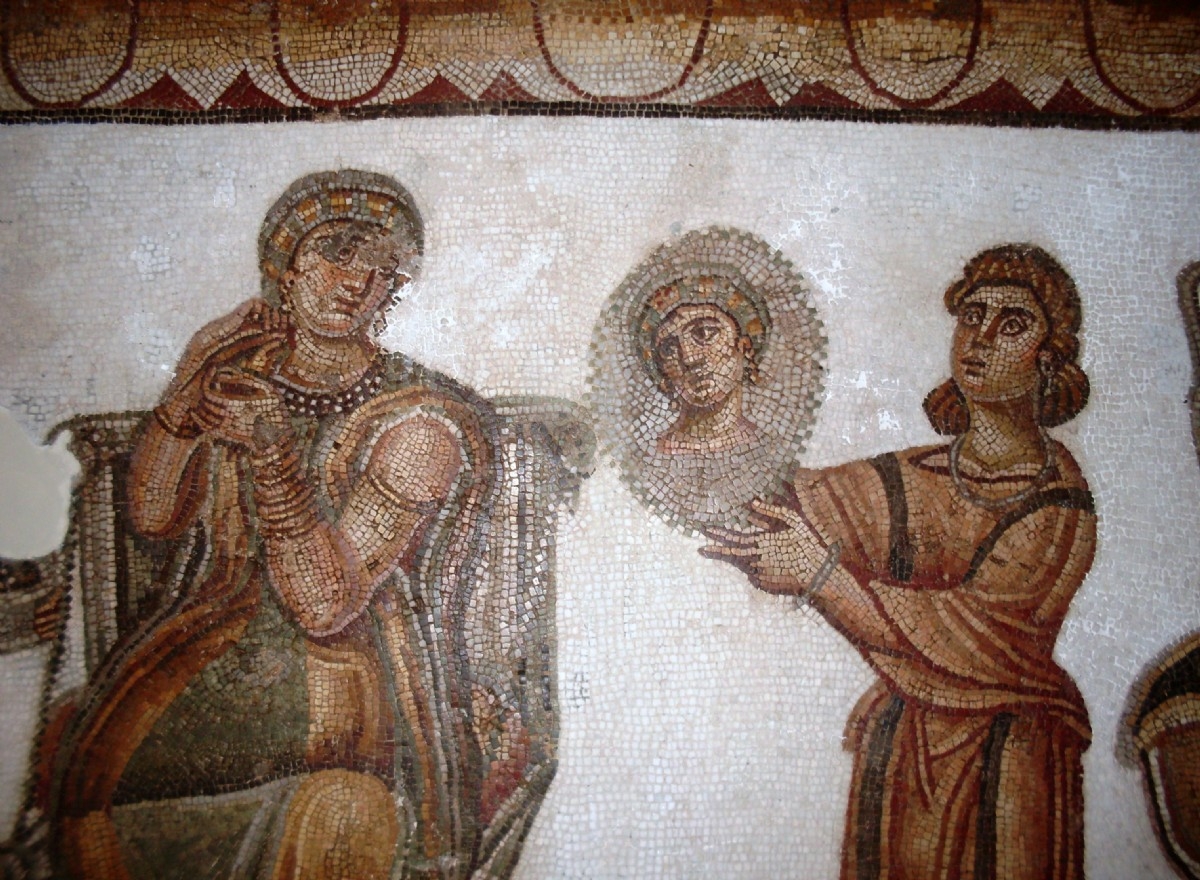
Roman citizens were divided into two groups. Patricians came from noble families. All other citizens were plebeians. Slaves could not be citizens. Patricians travelled around by carriage or in litters (portable chairs) carried by slaves.

Domus
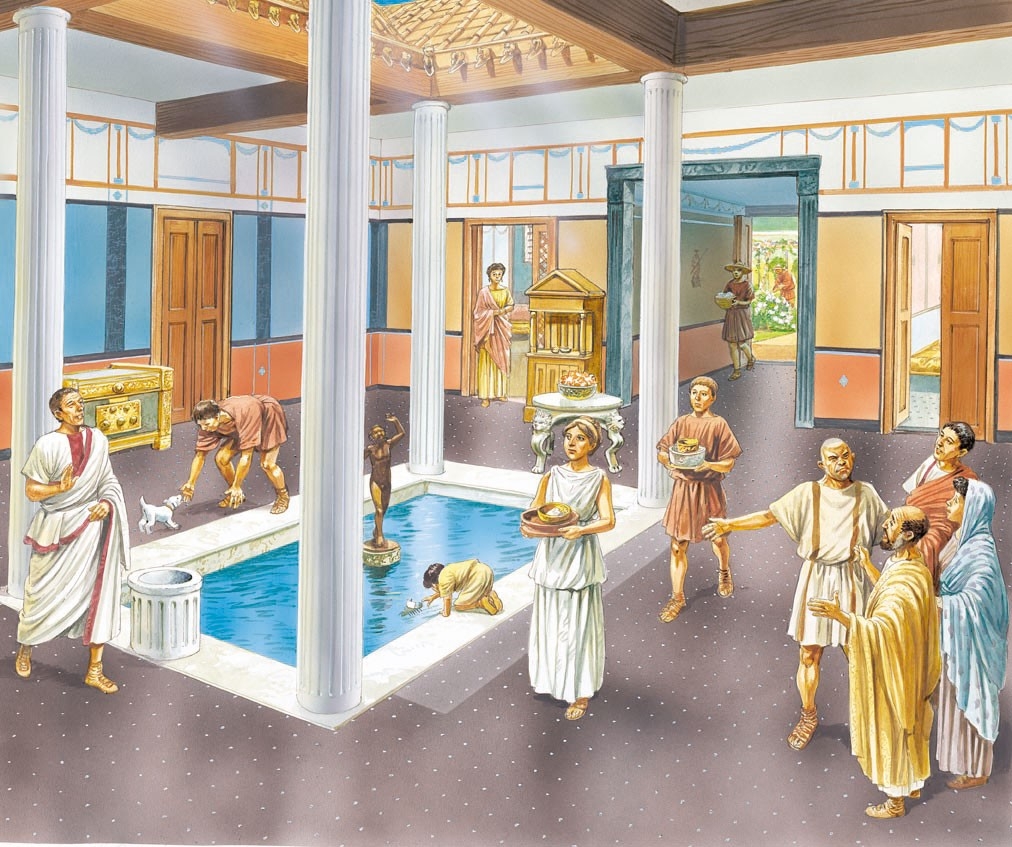
Wealthy Romans lived in a large town house called a domus. It was plain on the outside, but luxurious on the inside. The house was decorated with paintings on the walls and mosaics on the floors. The bedrooms were on the upper floor. Here they overlooked a tranquil garden, called a peristyle. The lower rooms at the front were often rented out to shops and traders.
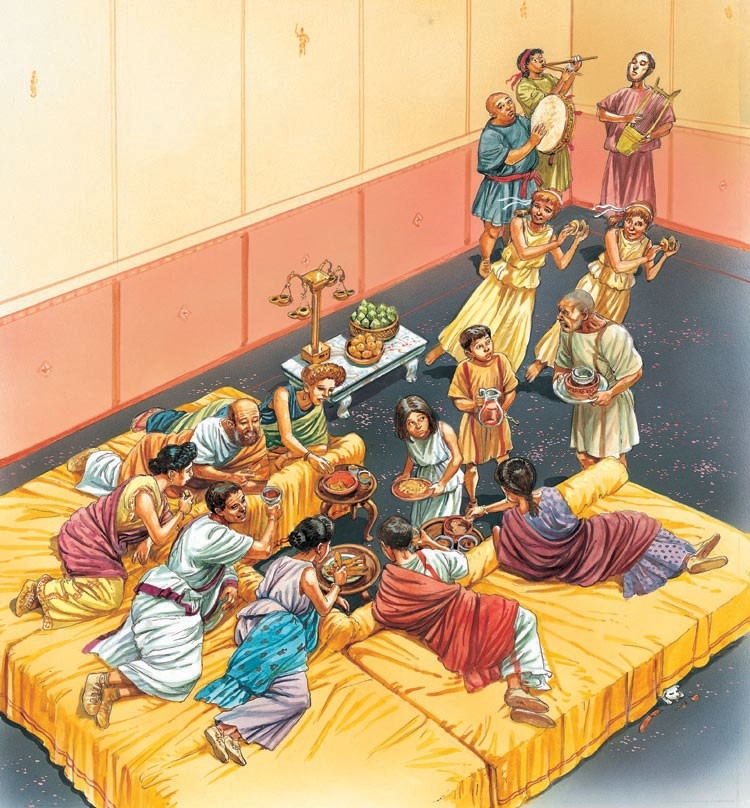
The domus had a grand space in the centre called the atrium. Guests were welcomed there. At the centre of the atrium, beneath an open skylight, was a rainwater pool called an impluvium. In the dining room, guests lay on cushioned couches to eat their meals. These were laid out on low tables by slaves.
Insulae
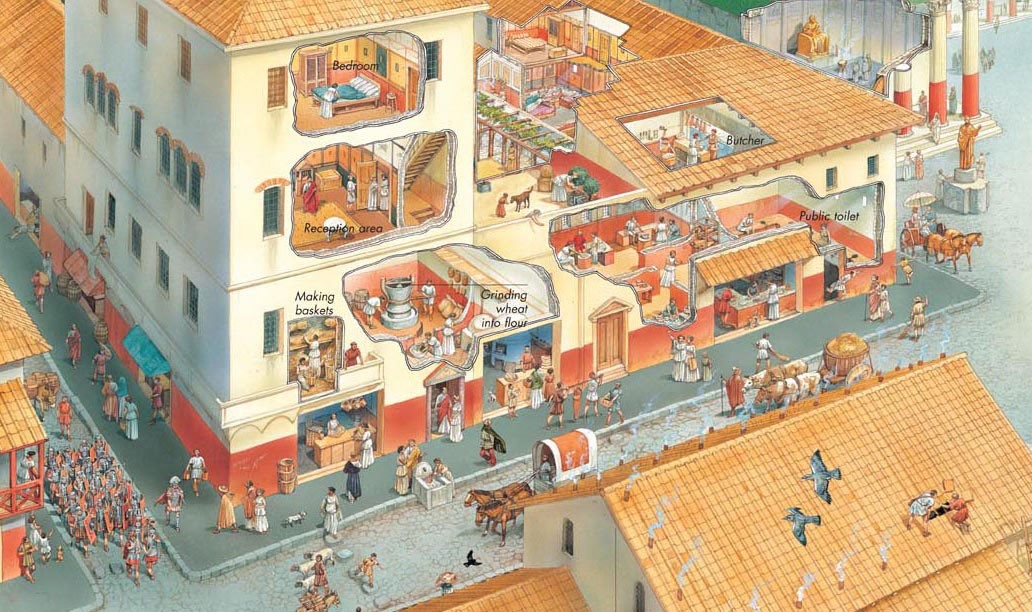
Apartment buildings, containing insulae, were several storeys high. Poorer families lived in small rooms at the top, while the better-off had large, comfortable rooms on the lower floors. Shops and bars occupied the ground floors of buildings.
Most apartments had no running water or toilets, so people used public baths and lavatories. They fetched fresh water from public fountains on street corners. Waste was dumped straight into the street. Apartments had no stoves for cooking either, because of the risk of fire. For a hot dinner, Romans bought takeaways from a thermopolium (snack bar).
Meals
The Romans took three meals a day. Poorer families might have a breakfast of bread or biscuits. Better-off Romans enjoyed fresh meat, fish, fruits and vegetables. They used honey to sweeten their food. Lunch was often a cold meal, eaten in the late morning. It usually consisted of bread, fruit, nuts, cheese, olives and salad. After lunch, the Romans enjoyed a midday rest, or siesta.
Dinner was eaten at sunset. For the poor, this meal might be a hot wheat porridge, vegetables and fruit. They rarely ate meat. For the rich, dinner was a lavish three-course meal with a variety of meats and fish, accompanied by fine wine.
Baths

All Roman towns had at least one bathhouse and many had several. They were not only places to wash. Baths were also places to exercise, play games, meet people or discuss business. Most Romans, rich and poor, went every day, women in the morning, men in the afternoon. Wealthy Romans took slaves with them to help wash them and bring them refreshments.
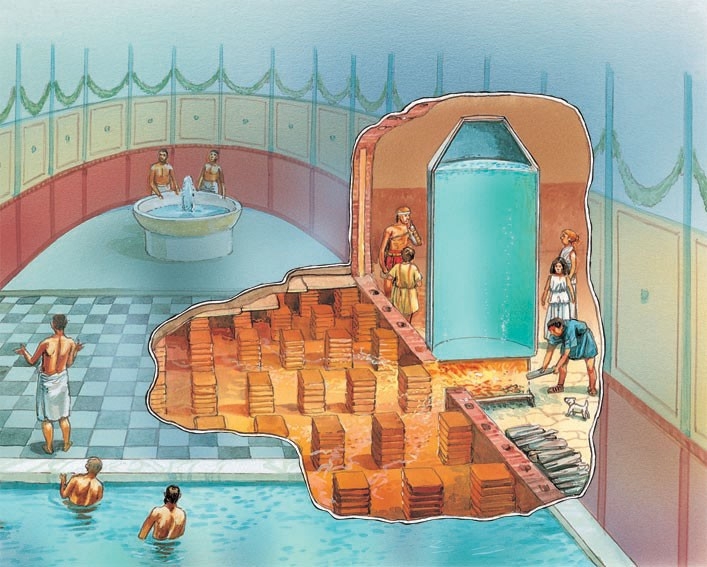
The baths had several rooms and the bathers passed through each one. The tepidarium was a warm room where the bathers could relax and get used to the heat. The caldarium had a hot pool. This was the place where people cleaned themselves. Finally, the bathers entered the frigidarium, where there was a cold bath. In between visiting these rooms, people sat and chatted.
Hypocaust
The Romans invented an underfloor heating system, called a hypocaust, for heating their baths. The floor was raised on pillars of tiles. Hot air, heated by a furnace in the basement, flowed around the empty spaces between the pillars. The furnace also heated the water for the baths.
Religion

The Romans worshipped many different gods and goddesses. People believed that each one ruled a different aspect of their lives. For example, Neptune was the god of the sea and Vesta was the goddess of the home. The king of the gods was Jupiter. This form of worship remained popular even after Emperor Constantine converted to Christianity and ended persecution of Christians across the empire in AD 313.
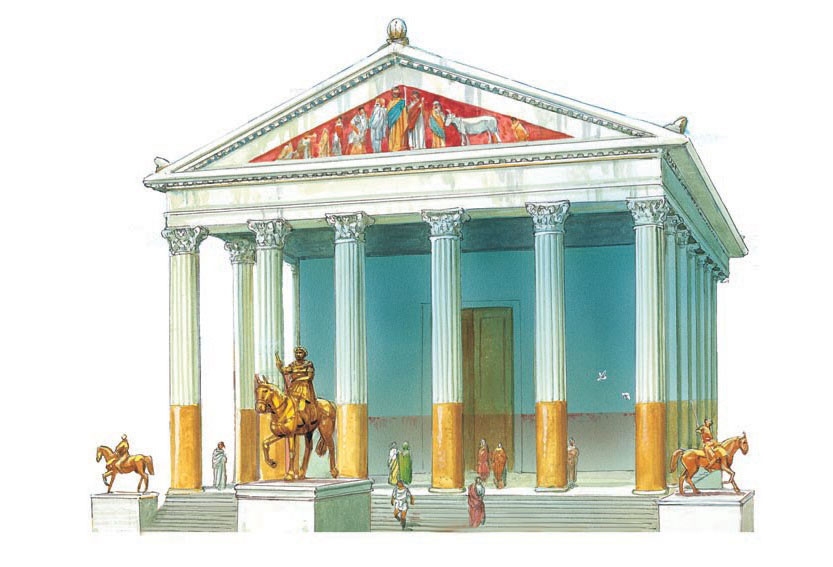
All Roman towns and cities had temples for worship. Every day, Romans took offerings of food, flowers or money, which was kept by priests.
Slaves
Slaves were men and women with no rights. They were mostly prisoners captured in battle. They could be bought or sold at a slave market. Slaves did all the labouring work in a Roman town. In the homes of wealthy Romans, they cooked, cleaned and looked after the children. A rich man might have as many as 400 slaves working for him.

Ready to find out more?
Here are some pages in other parts of Q-files you might like to explore:
Life in the Roman Empire
Roman baths
Roman townhouse
Consultant: Philip Parker
pics


Without in any way limiting Q-files Ltd’s exclusive rights under copyright, any use of this publication to “train” generative artificial intelligence (AI) technologies to generate text is expressly prohibited. Q-files Ltd reserves all rights to license use of this work for generative AI training and development of machine learning language models.