
EASY READ Ancient worlds

CITE
We have made every effort to follow citation style rules, but there may be some minor differences. If in doubt, please refer to the appropriate citation style manual.
EASY READ Who were the gladiators?. (2025). In Q-files Encyclopedia, History, EASY READ Ancient worlds. Retrieved from
https://www.q-files.com/history/easy-read-ancient-worlds/easy-read-who-were-the-gladiators
"EASY READ Who were the gladiators?." History, EASY READ Ancient worlds, Q-files Encyclopedia, 5 Dec. 2025.
https://www.q-files.com/history/easy-read-ancient-worlds/easy-read-who-were-the-gladiators.
Accessed 30 Oct. 2026.
EASY READ Who were the gladiators? 2025. History, EASY READ Ancient worlds. Retrieved 30 October 2026, from
https://www.q-files.com/history/easy-read-ancient-worlds/easy-read-who-were-the-gladiators
History, EASY READ Ancient worlds, s.v. "EASY READ Who were the gladiators?," accessed October 30, 2026.
https://www.q-files.com/history/easy-read-ancient-worlds/easy-read-who-were-the-gladiators


Who were the gladiators?
Gladiators were slaves or criminals who were trained to fight one another in Roman times. Gladiatorial contests were held in stadiums called amphitheatres attended by large crowds. Some gladiators fought with swords and shields, others with tridents and nets. Many contests were fought to the death. However, if the gladiators fought well enough they might be given their freedom.


The amphitheatre
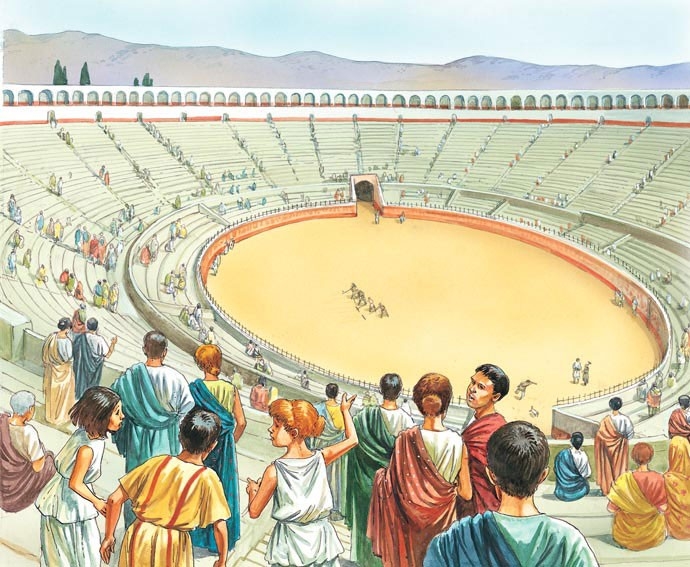
Most large Roman towns had an amphitheatre. It was a large, stone-built stadium with an oval arena in the middle. The largest was the Colosseum in Rome itself. It could hold up to 50,000 people. Built in AD 70–80, much of the original building still stands today.

Audience
The games were popular and entry to the amphitheatre was free. The best seats were reserved for the most important citizens, all men. Rich Roman men sat in the middle tiers, while above them sat poorer citizens, slaves, foreigners and women. At the very top sat the wives of the important citizens. Here they were protected from sun and rain by a canopy.

Types of gladiator
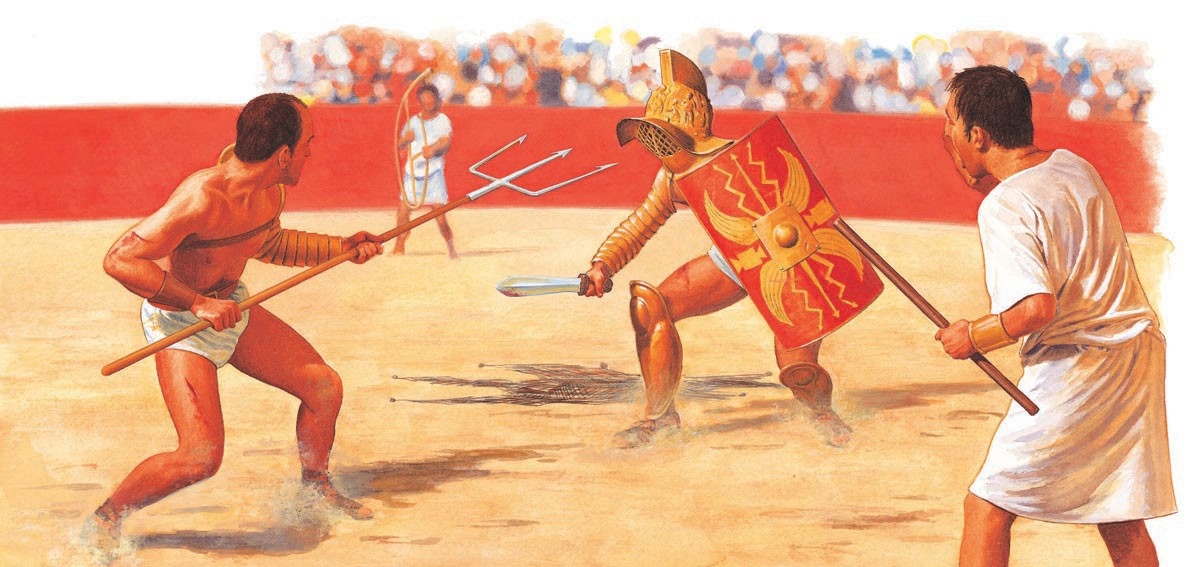
The Thracian had a curved dagger and a small shield. A Samnite carried a sword and a large shield, and wore a helmet with a visor. The Hoplomachus wore the uniform of a Greek soldier.

A gladiator who fought animals was a Bestiarius. A lightly armed fighter who chased his opponent was called a Secutor. He wore a smooth, rounded helmet that protected him from the blow of the trident (three-pronged spear).
The Myrmillo (or Murmillo), with his crested helmet and heavy armour, was a mythical “fish-man”. The Dimaecherus fought with two swords, but no shield. The Retiarius had no defensive armour but had a trident as a weapon and a net which he used to trap his opponent. The Essedarius went into battle on a chariot.


Fighting animals
Gladiators were treated harshly. Like the animals they sometimes fought, they were kept in cages before their contests began. Sometimes criminals were dragged into the arena to face hungry lions or bears unarmed.
Judgment
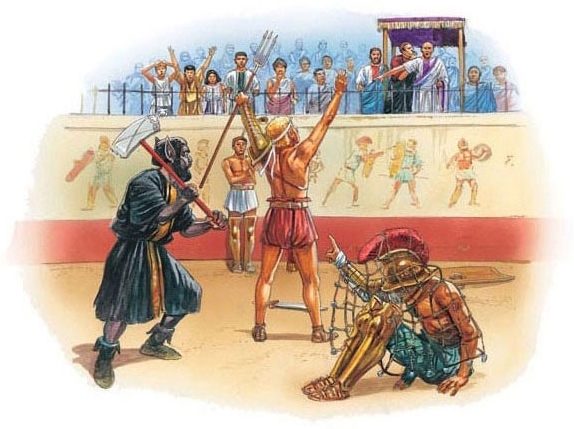
When a gladiator was wounded and conceded defeat, he would hold up his left index finger. The crowd would show their preference by gesturing with closed fists if they wished him to live, or with a “thumbs up" if they wanted him to be killed. It was the decision of the sponsor of the games sponsor—the emperor himself, or the governor, a senator or other important person—whether the defeated gladiator was to be spared or not.
Ready to find out more?
Here is a page in another part of Q-files you might like to explore:
Gladiators
Consultant: Philip Parker
pics

Without in any way limiting Q-files Ltd’s exclusive rights under copyright, any use of this publication to “train” generative artificial intelligence (AI) technologies to generate text is expressly prohibited. Q-files Ltd reserves all rights to license use of this work for generative AI training and development of machine learning language models.