
Pirates & galleons

CITE
We have made every effort to follow citation style rules, but there may be some minor differences. If in doubt, please refer to the appropriate citation style manual.
Golden Age of Piracy. (2025). In Q-files Encyclopedia, History, Pirates & galleons. Retrieved from
https://www.q-files.com/history/pirates-galleons/golden-age-of-piracy
"Golden Age of Piracy." History, Pirates & galleons, Q-files Encyclopedia, 29 Jul. 2025.
https://www.q-files.com/history/pirates-galleons/golden-age-of-piracy.
Accessed 26 Jul. 2026.
Golden Age of Piracy 2025. History, Pirates & galleons. Retrieved 26 July 2026, from
https://www.q-files.com/history/pirates-galleons/golden-age-of-piracy
History, Pirates & galleons, s.v. "Golden Age of Piracy," accessed July 26, 2026.
https://www.q-files.com/history/pirates-galleons/golden-age-of-piracy


Golden Age of Piracy
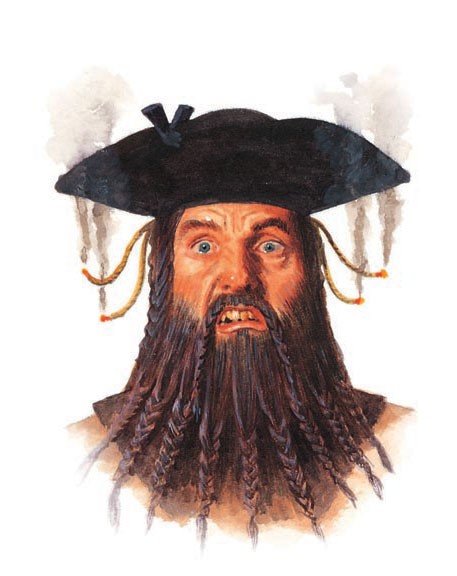
The Golden Age of Piracy, which lasted from the 1680s to the 1720s, was a time when thousands of ocean-going ships, especially in the Caribbean Sea or off the Atlantic coast of North America, fell prey to bands of sea robbers. Vessels travelling between European nations and their overseas colonies carrying valuable cargo were frequently captured. The pirates sold the goods they looted on to traders—often in pirate hideouts such as Port Royal in Jamaica or Nassau in the Bahamas—in exchange for cash and alcohol. Many of the most notorious pirate captains in history, including Blackbeard, William Kidd, Calico Jack, Black Bart and Henry Morgan, lived during this era. Some pirates operated further afield, off the West African coast or in the Indian Ocean, where Madagascar became an important pirate base.

To be a pirate
Most pirates in the Golden Age were English, Welsh, Dutch, Irish or French in origin, and came from poor backgrounds. London in the 17th and 18th centuries in particular was known for widespread poverty and high unemployment. Most pirates started out as lowly seamen, forced to endure the harsh discipline of the Royal Navy or the poor pay of merchant shipping. For anyone with so little to lose, a life of piracy and the chance of riches seemed a far better bet—despite the risks of getting caught for a crime punishable by death. Stealing luxury goods such as silks and spices that could easily be sold for ready cash and alcohol, especially rum, offered the way to a good life.
When was the Golden Age?

The Golden Age of Piracy dawned as English colonies became established in the Caribbean—especially with the capture of Jamaica from Spain in 1655. A period of fierce conflict between England and Spain followed in which fortune-hunters known as buccaneers (see below) were actively encouraged by the English to raid their enemy's ports and treasure ships. They and the ships they used were known as privateers: authorized by government for the capture of enemy merchant ships. When they turned to looting ships for their own gain, without permission, they acted as pirates.

In the 1690s, pirates began to look beyond the Caribbean for booty and saw opportunities in the Indian Ocean, where the cargo ships of the East India Company and the Mughal Empire were vulnerable to attack. But the period most closely associated with piracy’s Golden Age began in around 1713. The end of British participation in the War of the Spanish Succession that year led to an explosive increase in piracy—especially in the Caribbean—which lasted until the 1720s.
Buccaneers
French hunters, known as buccaneers (their name came from the French word boucan, the barbecue on which they smoked their meat), established themselves in the northern part of Hispaniola in around 1625. Efforts by the Spanish, who claimed the entire Caribbean island, to wipe them out, forced the buccaneers to migrate to the offshore island of Tortuga in around 1630. From their island stronghold they mounted raids on passing Spanish ships. The Spanish tried to drive them out of Tortuga, but the buccaneers were joined by many more French, Dutch and British adventurers, who took part in their piratical exploits.

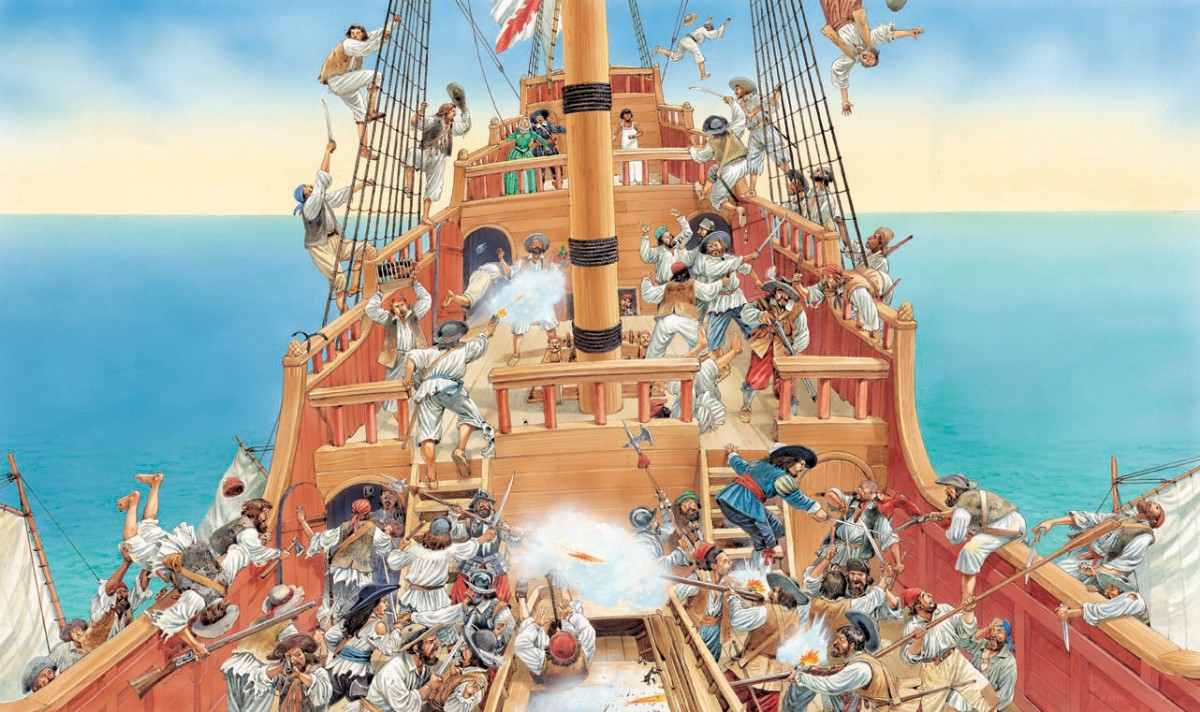
After Jamaica had been captured from the Spanish in 1655, the island's English governors willingly granted letters of marque (official permission to attack and seize enemy ships) to the Tortuga buccaneers—and to the English and Welsh men who had joined them, known as the Brethren of the Coast. Port Royal (see below) became the home port of English and Dutch privateers who were encouraged to attack Spanish vessels.
Henry Morgan
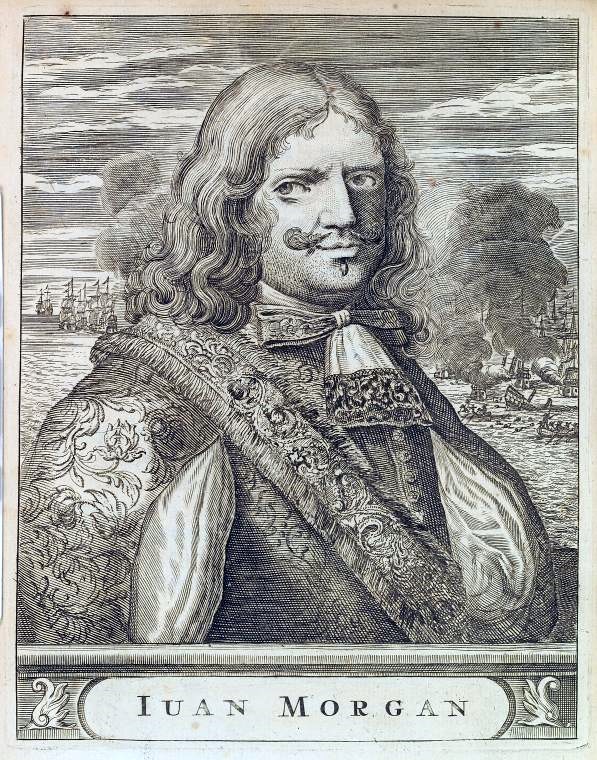
in 1667 Sir Thomas Modyford, the Governor of Jamaica, gave Welsh buccaneer Henry Morgan a letter of marque to attack the Spanish. Morgan proceeded to carry out successful raids on several ports on the Spanish Main, including Porto Bello (present-day Portobelo in Panama) in 1668 and Panama City, which he plundered and burned in 1671. The Porto Bello raid alone delivered a bounty worth £75,000, more than seven times the annual value of Jamaica’s sugar exports. The 300 men who accompanied Morgan returned to Port Royal with a prize of at least £60 each (two or three times the usual annual plantation wage).
With the loot from the raids, Morgan himself purchased three large sugar plantations on Jamaica. Summoned to London in 1672 to face charges of piracy, the Welshman was instead celebrated as a hero and knighted by King Charles II. In 1674 he returned to the Jamaica shortly afterwards to serve as the colony's lieutenant governor.
Port Royal
Situated on Jamaica's southeastern coast, Port Royal was close to the shipping lanes that ran between the Spanish Main (the Caribbean coast of South and Central America) and the Atlantic Ocean. Its location was also good for launching raids on Spanish settlements and ports in the region. With a harbour large enough to accommodate their ships and its shallow waters providing a convenient place to repair their vessels, privateers were soon drawn to Port Royal.


From the late 1650s onwards, the town became notorious for lawlessness as crews spent their earnings in the many taverns and gambling houses that catered for them. The practice of issuing letters of marque to privateers against the Spanish treasure fleets was later abandoned, but many of them became pirates and carried on plundering illegally. Port Royal became known as "the wickedest city on Earth".

Port Royal began to change after Henry Morgan's appointment as lieutenant governor in 1674. The selling of enslaved people shipped from Africa took on greater importance to the local economy. In 1687, Jamaica passed anti-piracy laws. Then, on 7th June 1692, Port Royal was destroyed by an earthquake. After that, it never recovered its previous status as a busy trading port and pirate haven. In fact, in the first years of the 18th century, Port Royal became the place where captured pirates were brought to be executed by hanging.
Pirate Round

In the 1690s, some Englishmen who had become pirates during the buccaneering period began to look beyond the Caribbean for treasure. Many of the Spanish Main ports, already looted many times, were now exhausted of plunder. The Indian Ocean, by contrast, offered greater riches. Ships of the Mughal Empire, then the wealthiest empire in the world, carried luxury goods such as silk and calico (cotton cloth)—ideal pirate booty. They and the vessels of the European companies trading with India and the East Indies had no powerful navies to defend them and so were vulnerable to attack.
The long-distance voyages from the Americas to rob targets in the Indian Ocean and Red Sea followed a route across the Atlantic Ocean, then around the Cape of Good Hope at the southern tip of Africa to the newly established pirate haven of Île Sainte-Marie (or St Mary's, present-day Nosy Boraha) off the eastern coast of Madagascar. It was called the Pirate Round and pirates who followed it were known as Roundsmen.
Founded by English pirate Adam Baldridge, Sainte-Marie provided bays for protection from storms, abundant food and calm waters. Pirates captains such as William Kidd, Robert Culliford, Henry Every, Abraham Samuel and Thomas Tew, used Sainte-Marie as their base for attacks on ships off the coast of Yemen and India.

By the early 1700s, cargo ships plying the Indian Ocean were being protected by heavily armed British East Indiamen warships. At the same time, the War of the Spanish Succession, fought between 1701 and 1713, provided English seamen with employment and opportunities for plunder as privateers with the backing of the British government. As a result, the Pirate Round and other acts of piracy went into decline, for the time being.

Henry Every
In September 1695, English pirate and Roundsman Henry Every (or Avery) captured the Ganj-i-Sawai, a ship belonging to the Mughal emperor Aurangzeb and laden with treasure worth roughly £600,000 (around £127 million today). The share for each crew member was more than they could expect to earn in a lifetime. Every became the target of the first worldwide manhunt in history, but he was never found, nor was his treasure recovered.

There is some evidence that, the following year, 1696, Every brought his ship, the Fancy, loaded with loot, to Nassau, on New Providence Island in the Bahamas. There, under the name of Henry Bridgeman, he is said to have bribed the governor Nicholas Trott both with gold and silver, and with the Fancy itself (including its cargo of ivory tusks and gunpowder), in return for granting him and his men safe refuge. Thanks to Every, Nassau then became established as a base from which pirates could operate safely. Although the Nassau governors were still in charge, it was the pirates who held the power.

After the War of the Spanish Succession


In 1713 and 1714, a series of peace treaties ended the War of the Spanish Succession. Thousands of seamen, whether they were sailors for the British Royal Navy or privateersmen operating in the West Indies, found themselves out of work. For many, accustomed to attacking and plundering enemy ships—but embittered by the harsh conditions they had been forced to endure—the obvious choice was to become a pirate. Seamen serving as crew to the merchantmen, including slave ships, and forced to accept poor working conditions (death rates among them were as high, if not higher, than the slaves they transported), were also keen to take up the freer existence as pirates.
Pirate captains now had a large and willing pool of recruits for their crews.
Transatlantic shipping traffic between Africa, the Caribbean and Europe—known as the triangular trade—began to soar at this time, providing plentiful targets for the rapidly growing number of pirate bands. As part of the settlement of the War of the Spanish Succession, the British South Sea Company had obtained the asiento, a Spanish government contract to supply slaves to Spain's New World colonies. This gave British traders access to Spanish ports, providing even more opportunities for pirate raids.
All these factors came together to produce a massive increase in piracy, especially in the Caribbean, where Spanish treasure ships still sailed in great numbers.


Pirate republic
Nassau, on the island of New Providence in the Bahamas, an English colony, had been established as a pirate haven in the 1690s. Following attacks on the port by the combined French–Spanish fleet during the War of the Spanish Succession in 1703 and 1706, it had been largely abandoned by the English government. Privateers, who became pirates at the end of the war, took over and in around 1713 established their own republic. Pirate Thomas Barrow even declared himself "Governor of New Providence".
The republic was dominated by two bitter rivals: Benjamin Hornigold and Henry Jennings. Together they had founded the "Flying Gang", members of which included Edward Teach, known as "Blackbeard", Samuel Bellamy, Stede Bonnet, Charles Vane, Edward England, John Rackham ("Calico Jack") and two female pirates, Mary Read and Anne Bonny.
The activities of the pirates caused havoc with shipping in the Caribbean until the newly-appointed Royal Governor of the Bahamas, Woodes Rogers, reached Nassau in 1718 and restored British control. Taking advantage of the Act of Grace, a royal proclamation issued by King George I in 1717 promising a pardon for acts of piracy to those pirates who surrendered themselves, Hornigold returned to being a privateer. Under Rogers, he proceeded to hunt down his former comrades. Although Vane and Blackbeard evaded capture, nine others were not so lucky: they were captured and executed on 12th December 1718.


End of the
Golden Age
With anti-pirate campaigns, such as that of Rogers in Nassau in 1718, becoming more effective, some Caribbean pirates began to look elsewhere for safer hunting grounds. This led to a brief revival of the Pirate Round. Two pirates, John Taylor and Olivier "La Buse" Levasseur, actually succeeded in carrying off the greatest prize of all in the Golden Age of Piracy with the plunder of the Portuguese East Indiaman Nossa Senhora Do Cabo off Réunion Island in the Indian Ocean in 1721, stealing treasure worth around £800,000 (a total of over £200 million today). The booty consisted of bars of gold and silver, dozens of boxes full of diamonds, golden guineas, pearls, silk, art and the Fiery Cross of Goa, made of gold and inlaid with rubies, emeralds and diamonds. When the loot was divided, each crew member received 42 diamonds and at least $50,000-worth of golden guineas
Attacks by pirates off the coasts of North America and West Africa as well as the Indian Ocean and the Caribbean Sea caused major problems for trading nations. Governments began to take action to deal with the menace. The Piracy Act, passed in Britain in 1721, gave the Royal Navy more powers to hunt down pirates, while the courts could impose harsher penalties for illegal trading. Cash rewards for those who informed on pirates (often former pirates) were also offered. At the same time, pardons were granted, allowing pirates to give up their criminal past in return for freedom from prosecution.


Black Bart
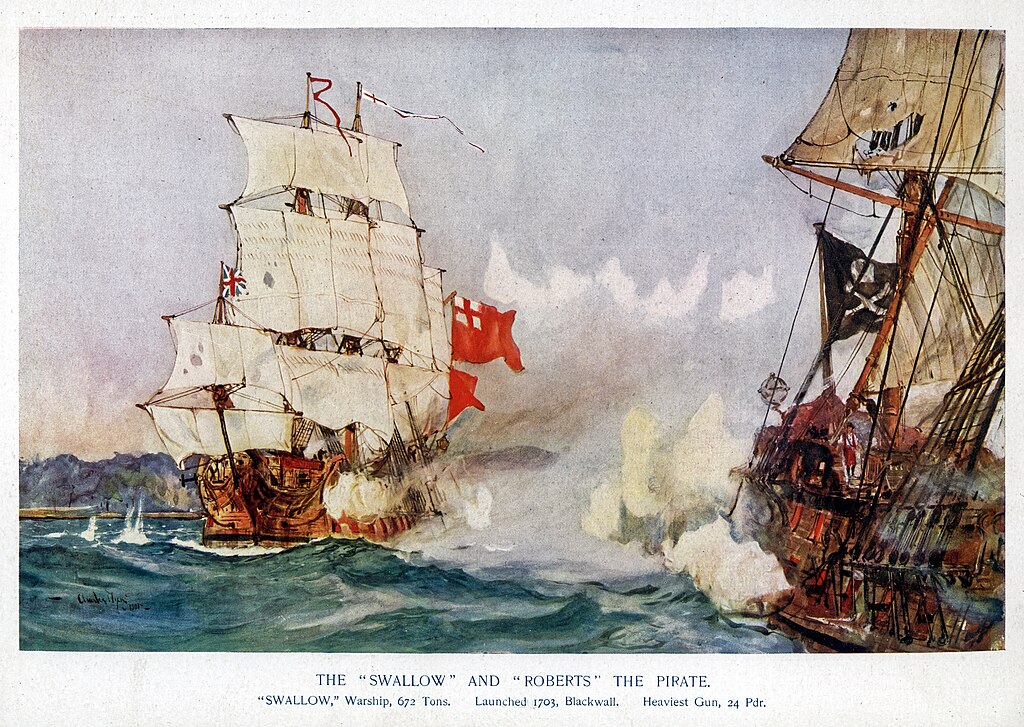
One of the most successful pirates of the Golden Age, Bartholemew "Black Bart" Roberts captured more than 400 vessels during his career. He was famous for wearing a scarlet silk coat, a matching damask waistcoat and a diamond necklace. On 10th February 1722, however, his luck ran out. His ship, the Royal Fortune, was intercepted by the Royal Navy off the coast of West Africa and Black Bart was killed during the battle. Many of his crew were put on trial in a Court of Admiralty at Cape Coast Castle in present-day Ghana and 52 men were sentenced to death by hanging.
The incident proved to be a turning point in the war against piracy. The fate that befell Roberts and many of his crew marked the beginning of the end of the Golden Age of Piracy.
pics
Without in any way limiting Q-files Ltd’s exclusive rights under copyright, any use of this publication to “train” generative artificial intelligence (AI) technologies to generate text is expressly prohibited. Q-files Ltd reserves all rights to license use of this work for generative AI training and development of machine learning language models.