
North America

CITE
We have made every effort to follow citation style rules, but there may be some minor differences. If in doubt, please refer to the appropriate citation style manual.
Bahamas. (2026). In Q-files Encyclopedia, Geography, North America. Retrieved from
https://www.q-files.com/geography/north-america/bahamas
"Bahamas." Geography, North America, Q-files Encyclopedia, 1 Apr. 2026.
https://www.q-files.com/geography/north-america/bahamas.
Accessed 30 Oct. 2026.
Bahamas 2026. Geography, North America. Retrieved 30 October 2026, from
https://www.q-files.com/geography/north-america/bahamas
Geography, North America, s.v. "Bahamas," accessed October 30, 2026.
https://www.q-files.com/geography/north-america/bahamas


Bahamas
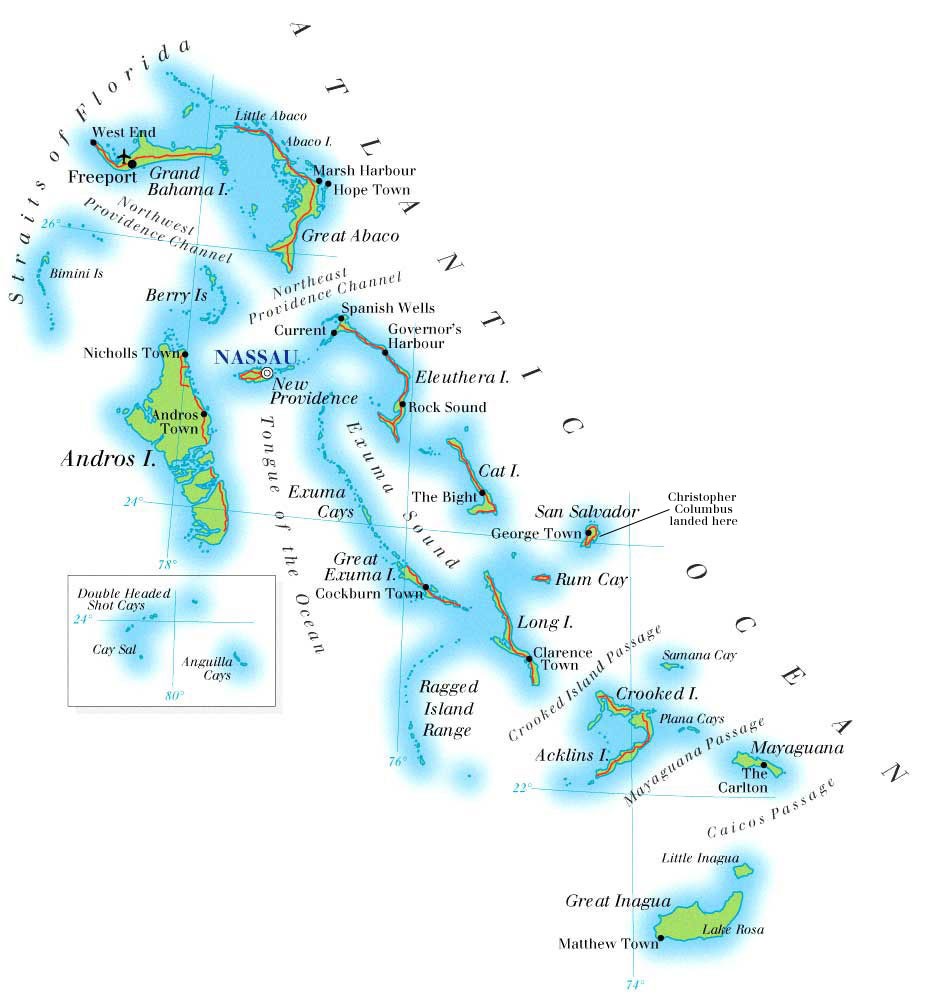
The Bahamas are made up of about 700 islands, along with more than 2000 rocks and small, low-lying islands called cays. They form a chain stretching for nearly 970 kilometres (600 miles). The largest islands are Grand Bahama, Andros and Abaco; the most populated is New Providence, home to the nation’s capital, Nassau along with around two-thirds of its people. The islands of the Bahamas are made of coral. In some places, there are low rounded hills. Most of the islands are fringed by white, sandy beaches, while inland are tropical shrubs and trees. The Bahamas have a warm, sunny climate all year round. They are occasionally at risk from hurricanes sweeping in from the Atlantic Ocean.

People
Only about 30 of the islands are inhabited. Most people live on New Providence, in and around the capital Nassau. Nearly all Bahamians are descended from Africans who settled in the country after escaping slavery in the 19th century. The rest have ancestors from Europe and the USA, or have migrated to the country from Haiti. English is the main language.
Tourism and banking
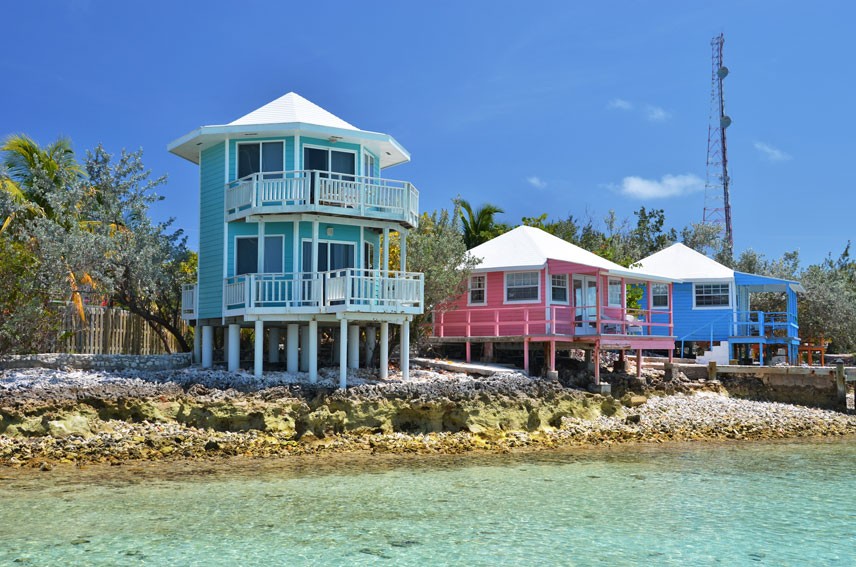
More than half of all Bahamians work in the tourist industry, many in hotels, restaurants or as guides. Every year, nearly 6 million tourists visit the Bahamas, attracted by its warm climate and beaches. Most arrive on cruise ships. Another major industry is international banking: liberal tax laws have encouraged many global companies and banks to set up offices in the Bahamas.


Pirate republic
The town that would be called Nassau was founded as Charles Town in 1670 by English colonists. It was used as a base for privateering against the Spanish. After being burned to the ground, the town was rebuilt in 1695 and renamed Nassau in honour of the English king William III, who belonged to the Dutch House of Nassau. Following attacks on the port by the combined French–Spanish fleet during the War of the Spanish Succession in 1703 and 1706, it was largely abandoned by the English. Pirates took it over at the end of the war in 1713 and established their own republic there, known as New Providence, "governed" by pirates.
The pirate republic was dominated by two bitter rivals: Benjamin Hornigold and Henry Jennings. Together they had founded the "Flying Gang", members of which included Edward Teach, known as "Blackbeard", Samuel Bellamy, Stede Bonnet, Charles Vane, Edward England, John Rackham ("Calico Jack") and two female pirates, Mary Read and Anne Bonny. The activities of the pirates caused havoc with shipping in the Caribbean until the newly-appointed Royal Governor of the Bahamas, Woodes Rogers, reached Nassau in 1718 and restored British control.

Consultant: Nicholas Harris
Facts about the Bahamas
Population 412,628 (2023 census)
Area 10,010 sq km
Highest Point Mount Alvernia, Cat Island 63 m (207 ft)
Capital Nassau, population 296,522
Other major cities Freeport, Grand Bahama (pop. 26,910)
Language English
Religion Christian (Protestant) 70%, Christian (Roman Catholic) 12%, others 18%
Ethnicity black / African 91%, white European 5%, mixed black / European 2%, others 2%
Currency Bahamian dollar (BSD)
Chief exports crayfish, salt, polystyrene, aragonite (a mineral formed from coral sands)
History of the Bahamas
11th century
Taino people arrive from Hispaniola, settling in the southern Bahamas. They are known as the Lucayans
1492
Christopher Columbus lands on the Bahamian island of island of Guanahani, which he names San Salvador
Early 1500s
The Spanish transport the entire native Lucayan population to work on other islands as slaves
1647
A group of English religious refugees and slaves, called the Eleutherian Adventurers, build a settlement in the Bahamas
1666
English build settlements on New Providence Island
1670
Charles Town is founded by English noblemen on New Providence. It is rebuilt after a fire and renamed Nassau in 1695.
1713–18
Nassau becomes a pirate republic, known as New Providence
1718
Britain makes the Bahamas a crown colony of the British Empire under the governorship of Woodes Rogers
1782–83
Spain occupies the Bahamas, but agrees to return them to Britain at the Treaty of Paris in exchange for East Florida
1784
Bahamas becomes a British colony once more. After US independence, the British resettle thousands of Loyalists with their African slaves in the Bahamas, where they are granted land to establish plantations.
1820s
Hundreds of escaped slaves flee from Florida, USA, to settle in the northern Bahamas
1834
Slavery officially abolished in the British Empire
1940–45
The Duke of Windsor (formerly King Edward VIII) serves as governor of the Bahamas
1964
Britain gives the Bahamas more control over its internal affairs; campaigns for independence continue
1973
Bahamas become independent; it remains part of the Commonwealth of Nations
2004
Hurricanes Frances and Jeanne sweep through the Bahamas, causing widespread damage
2019 (September)
Hurricane Dorian devastates Abaco Islands and Grand Bahama, destroying buildings, overturning cars, shipping containers and boats and causing widespread flooding. Scores of people are believed to have been killed.
pics

Without in any way limiting Q-files Ltd’s exclusive rights under copyright, any use of this publication to “train” generative artificial intelligence (AI) technologies to generate text is expressly prohibited. Q-files Ltd reserves all rights to license use of this work for generative AI training and development of machine learning language models.